
ESL Lesson Plans: A Ready-to-Use Structure (Plus a Full Example)
Plan a lesson in minutes
Planning is the invisible half of teaching. Nobody pays you for the hour you spend the night before working out how to get a shy A2 student talking about their weekend — but that hour decides how the lesson goes.
This guide gives you a lesson structure that works at any level, a complete worked example you could teach tomorrow, and a way to cut the planning time down to a few minutes.
The example further down was generated by the AI Lesson Planner in the Parlora Library and lightly tidied — so you can judge for yourself what a two-minute plan looks like.
The structure: five stages, 50 minutes
Most effective ESL lessons follow the same arc, whatever the level or topic. Warm the student up, introduce something new, practise it with support, then let them use it freely.
| Stage | Time | Purpose |
|---|---|---|
| Warm-up | 5 min | Get them speaking immediately, in low-stakes language |
| Introduction | 10 min | Present the target language clearly |
| Practice | 20 min | Controlled practice with support and materials |
| Production | 10 min | Free use — role-play, discussion, task |
| Wrap-up | 5 min | Review, correct, set homework |
Two principles make this structure work rather than just fill time.
The student should be speaking more than you are. A rough target is 70% student talking time. If you're explaining for ten minutes straight, the plan has gone wrong somewhere.
Controlled practice comes before free production. Don't ask a beginner to improvise a conversation about their family before they've drilled the vocabulary. Support first, freedom second.
This arc is also what any decent planning tool should give you by default. The Parlora planner builds to this shape every time, with the timings already apportioned — so what you're adjusting is the content, not the skeleton.
A complete worked example
Here's the structure filled in for a real beginner lesson. This is a full plan — you could open it and teach it.
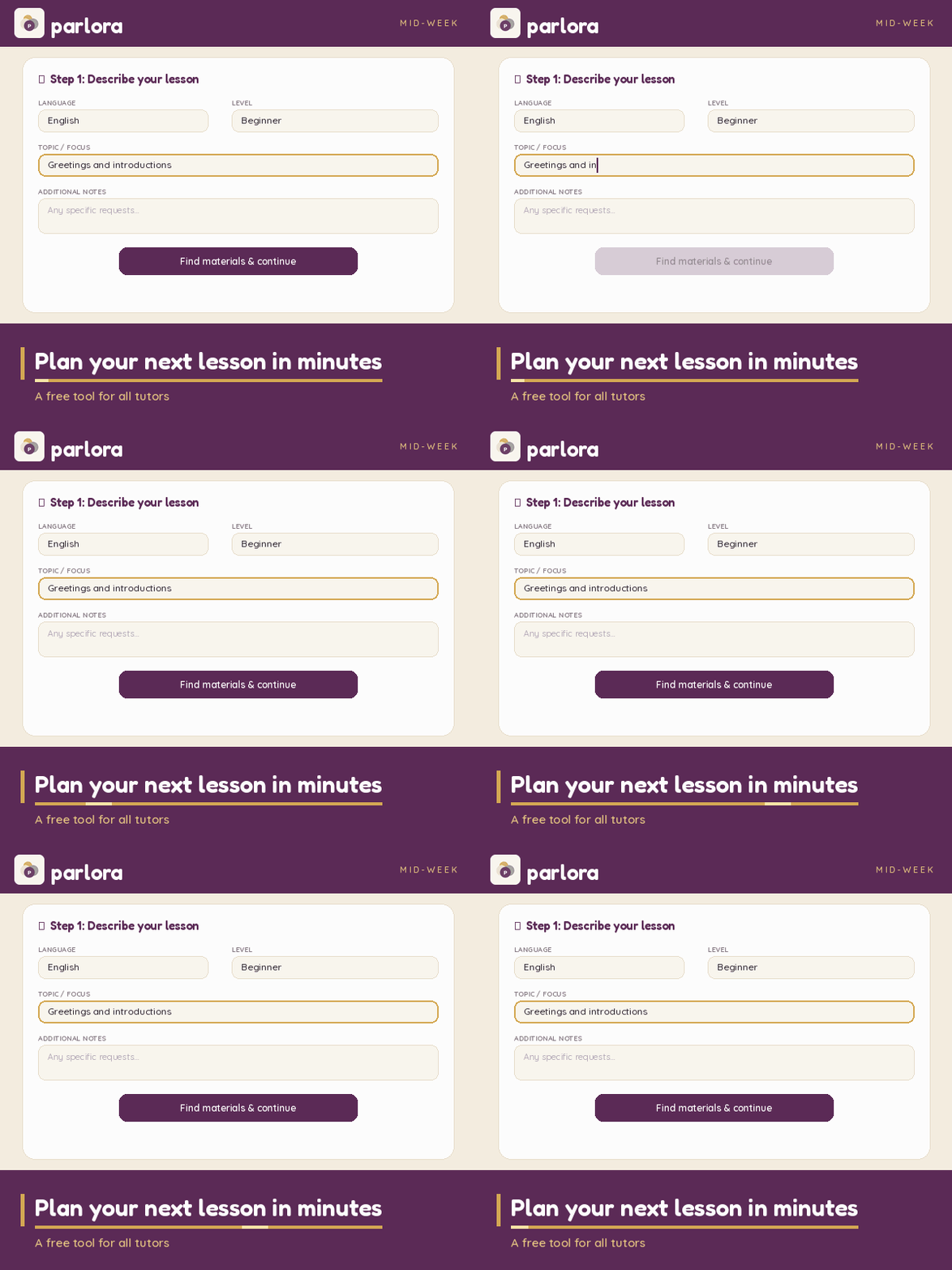
It came from three inputs: language (English), level (Beginner), and topic ("greetings and introductions"). Everything below — the objectives, the timings, the activities, the homework, the notes at the end — was generated from those three fields, with the vocabulary worksheets pulled in automatically.
Module 1: Greetings and Introductions
English · Beginner (A1) · 50–55 minutes
Learning objectives
By the end of the lesson, students will be able to:
- Use basic greetings and farewells
- Introduce themselves and ask others' names
- Talk briefly about their family
- Describe simple weather conditions
Warm-up (5 min)
Start with common greetings and a quick check-in.
- Greet the student: "Hello! How are you today?"
- Encourage a simple response: "I'm fine, thank you."
- Review common greetings: "Good morning / afternoon / evening", "Hi", "Hello"
Introduction to greetings and introductions (10 min)
Present key phrases for self-introduction, and how to ask about someone's well-being.
- Write on screen: "Hello, my name is ___. What's your name?"
- Student practises introducing themselves
- Introduce: "Nice to meet you", "How are you?", "I'm good / well / fine, thanks"
- Discuss ways to say goodbye: "Goodbye", "See you later", "Have a good day"
Practice: family and weather (20 min)
Practise new vocabulary in the context of introductions.
- Open a family vocabulary worksheet. Point to each relative — "Who is this?"
- Student repeats. Then ask: "Do you have a brother or sister?"
- Student describes their own family: "I have one sister."
- Move to weather vocabulary: "What's the weather like today?"
- Point to conditions (sunny, cloudy, rainy, snowy): "Is it sunny today?" — student answers "Yes, it is" / "No, it isn't"
- Discuss seasonal activities: "What do people do when it's snowy?"
Production: mini-introductions (10 min)
A short role-play so the student uses the language without prompts.
- "Imagine we've just met. You start — how would you greet me?"
- Student greets you and introduces themselves
- Follow up: "How are you today?" / "Do you have a big family?"
- Ask about the weather in their city using the new vocabulary
Wrap-up (5 min)
- Review all greetings and introduction phrases
- Review the family and weather vocabulary
- Close with a farewell: "It was great meeting you today!"
Homework
- Practise introducing yourself to a mirror or a family member
- Draw your family and label each person in English
- Write down the weather for three days: "Today is sunny and warm"
Tutor notes
Encourage the student to speak freely even when they make mistakes. Focus on clear pronunciation for greetings and key vocabulary. If the student is shy, extend the controlled practice before moving to free production. Use the document visuals heavily — beginners anchor language to images far faster than to translations.
Adapting the same plan for other levels
The structure doesn't change. What changes is how much support you give and how far you push the production stage.
- A1–A2 (beginner) — Heavier controlled practice, more visuals, shorter production. Accept single-word and short-phrase answers. Model everything before asking for it.
- B1–B2 (intermediate) — Shorten the introduction, lengthen production. This is where discussion questions earn their place: give an opinion prompt and let them run with it, stepping in only to correct patterns rather than individual slips.
- C1–C2 (advanced) — Almost all production. Debate, abstract topics, nuance and register. Your job shifts from teaching language to stretching it — pushing for precision, idiom and tone rather than accuracy.
- Group lessons — Use pair work inside the production stage so everyone speaks at once rather than waiting their turn. In a group of six, a round-robin role-play means each student speaks for two minutes; pairs mean each speaks for ten.
If you're generating plans rather than writing them, the level field does most of this work for you — the same topic at A2 and at C1 comes back as two quite different lessons. The notes field is where you add the specifics a tool can't know: that this student freezes in role-plays, or that they're preparing for a job interview next month.
Where to find materials that fit
The plan above needs a family vocabulary sheet and a weather sheet. Sourcing those is often the slowest part of planning.
A few options that don't cost anything:
- Creative Commons materials. Plenty of university and teacher-created ESL resources are openly licensed. Check the licence terms and credit the author.
- The Parlora Library. Worksheets, dialogues, conversation cards and exam prep, searchable by level and language. Some are free to everyone, and every tutor with an active profile gets an Access tier upgrade at no cost — unlimited downloads, including the paid documents.
- Your own back catalogue. If you've made materials over the years, they're worth organising in one searchable place rather than scattered across folders and drives. If you upload yours to the Library, you also earn from them — $2 for every 200 views.
For speaking-focused lessons specifically, a few that work straight out of the box: conversation cards for B2 discussion, a Part 3 framework if you're prepping IELTS candidates, and situational dialogues for role-play at beginner level.
Worth knowing: if you plan inside the Library, this step happens on its own. Describe the lesson and the planner searches the collection for you, returning the closest matches with the rest ranked underneath — you tick the ones you want, add anything from your own library, or upload something new. The plan then references those documents by name in the relevant activities, so you're not hunting for the right worksheet halfway through the lesson.
Cutting the planning time
Even with a structure and a materials source, building a plan from scratch takes 30 to 60 minutes. Doing that for every lesson, for every student, is the reason so many tutors burn out on prep.
The AI Lesson Planner in the Parlora Library exists for this. You describe the lesson — language, level, topic, any specific requests — and it produces a full timed plan like the one above, pulling relevant materials from the Library as it goes. You choose which documents to include, add your own, and remove anything that doesn't fit.
Then you either download it as a PDF to teach from, or save it to your library and reopen it whenever you like. Saved plans sit alongside your materials in My Library, with their own search — so last term's B1 job-interview lesson is findable when a similar student turns up, rather than lost in a folder somewhere.
That reuse is where the real saving comes from. The first plan for a topic takes a few minutes; the fourth takes seconds, because you're adapting something you've already taught and refined.
It's free for every tutor on Parlora. The point isn't to replace your planning judgement — you'll still adapt the plan for the student in front of you, and you should. It's to get you from a blank page to a working draft in a couple of minutes instead of an hour.
The short version
- Use the five-stage arc: warm-up, introduction, practice, production, wrap-up
- Aim for the student speaking around 70% of the time
- Controlled practice before free production, always
- Keep the structure constant across levels; change the support and the stretch
- Don't build every plan from scratch — generate or reuse a draft, then adapt it for the student in front of you
Planning well is what separates a lesson that fills an hour from one a student books again. It shouldn't cost you your evening.
Keep going with Parlora