Why group conversation classes might be the smartest way to learn a language
If you've ever sat through a 1-on-1 language lesson and found your mind wandering, or felt the quiet pressure of being the only person your tutor is paying attention to for a full hour — you're not alone. One-on-one tutoring is brilliant for some things, but it's not the only way to learn a language, and for a lot of people it's not even the best way.
Group conversation classes are quietly becoming one of the most effective formats for actually getting fluent. Not "I can ask for directions" fluent — can hold a real conversation with another human being without panicking fluent. Here's why they work, and why they might be worth trying if you've been grinding through apps and private lessons without quite getting there.
You learn a language by speaking it. Groups force you to speak more, not less.
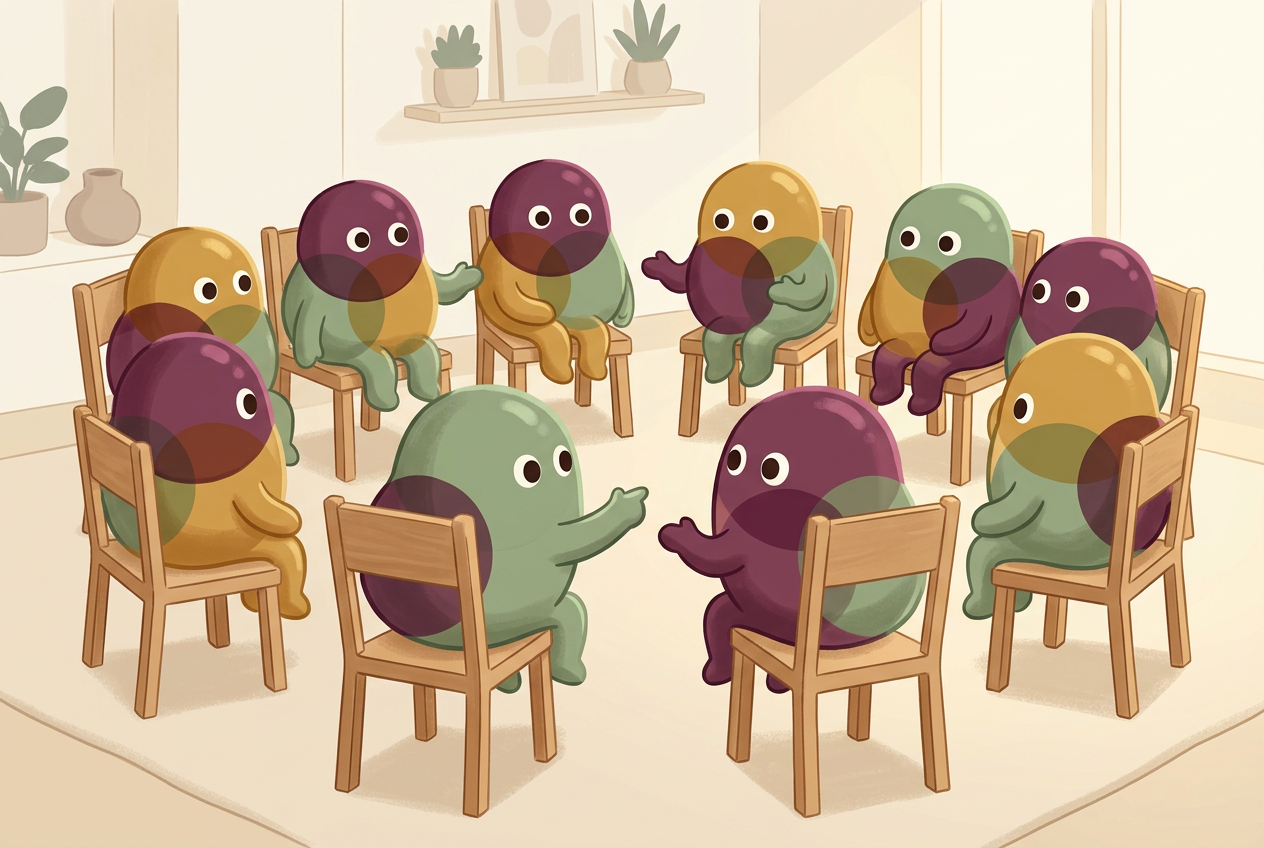
This is the bit people get backwards. The instinct is: "1-on-1 means more speaking time, so it must be better." But sit in a well-run group of four or five learners and count. You're not speaking less — you're speaking differently. You're responding to people who don't sound exactly like your tutor. You're hearing the same grammar point used three different ways by three different people. You're picking up on which mistakes are common ones and which are just yours.
And critically, you're speaking when you don't have to. When it's your turn 1-on-1, all the pressure is on you. In a group, you can choose to jump in — which means when you do speak, you're speaking because you have something to say, not because there's an awkward silence to fill. That's much closer to how real conversation works in the wild.
Listening to other learners is underrated
Here's something tutors don't always say out loud: a lot of language learning happens in the listening. Hearing another learner stumble through a sentence, correct themselves, and arrive at the right word — that's a free demonstration of the kind of cognitive work you're going to have to do yourself five minutes later. It's also strangely comforting. You realise everyone else is also forgetting verb endings. You're not uniquely terrible.
In a 1-on-1, you almost never hear another learner. You only hear your tutor, who already speaks the language perfectly. That's useful for picking up the right model — but it's not useful for understanding what your own learning curve looks like, or for normalising the messiness of getting there.
It's a lot cheaper
Let's be honest about this one. Quality 1-on-1 language tutoring isn't cheap — and rightly so, your tutor is giving you their full attention. But that means you're often choosing between one expensive lesson a week and the kind of consistency that actually builds a language skill.
Group classes change that calculation. The cost per learner is lower because it's shared, but the tutor is still right there guiding the session. For most people, that means you can afford to show up two or three times a week instead of once — and turning up consistently is the single biggest predictor of whether you'll actually get conversational, more than your tutor, your textbook, or your app of choice.
Speaking in front of strangers is the skill you actually need
If your goal is to use the language in real life — travel, work, family, anything — you don't just need to know the words. You need to be able to produce them in front of someone you don't know, while a small voice in your head is going "what if I sound stupid?"
Group classes are practice for that exact moment. You're speaking in front of people. They're not your tutor. You don't know them perfectly. You might say something wrong. You do it anyway. That muscle — speaking-while-uncertain — is the muscle that lets you actually use the language outside the classroom. And it's almost impossible to build in a 1-on-1, where the safety net is so good you barely register it.
You make friends with people learning the same thing
This one matters more than it sounds. Learning a language is a long project. It takes months. Some weeks you'll be motivated, some weeks you'll want to quit. Having a few other people on the same journey — who you actually like, who notice when you miss a class, who you can swap voice notes with — turns the project from a solo grind into a small community.
A lot of learners describe the friendships they make in conversation groups as the thing that kept them going long enough to actually become conversational. The grammar was the same in any format. The community is what made them stick around for it.
Where conversation groups beat self-study
Apps are wonderful for vocabulary, drills, and consistency. They're terrible for teaching you what to do when someone responds to you and you didn't catch a word. They can't replicate the slightly nervous, slightly exciting feeling of trying to say something real and watching another person work out what you meant.
That feeling — I almost got there, and the other person met me halfway — is the actual experience of learning a language. Apps will never give it to you. Conversation groups give it to you every session.
A few honest caveats
Groups aren't for every situation. If you're preparing for a specific exam and need targeted help on a specific weakness, 1-on-1 will move you faster. If you have very particular goals (a job interview next month, a wedding speech in a partner's language) you probably want focused private lessons. And if you're a total beginner, some learners find a few weeks of 1-on-1 helps before jumping into a group.
But for the vast middle of language learning — the long stretch between "I know some words" and "I can actually talk to people" — groups are often the more effective, more enjoyable, and more affordable choice. And they're the format most likely to get you to the only outcome that really matters: being able to have a real conversation, in a real language, with a real human being.
That's what we built Parlora around. Small, friendly conversation groups led by real tutors, at prices designed for showing up regularly rather than splurging once a month. Browse upcoming groups — drop into one and see how it feels.