English Learning Resources
Everything in the Parlora Library tagged English as a Second Language (ESL). Browse by category or format, or open the full library to filter further.
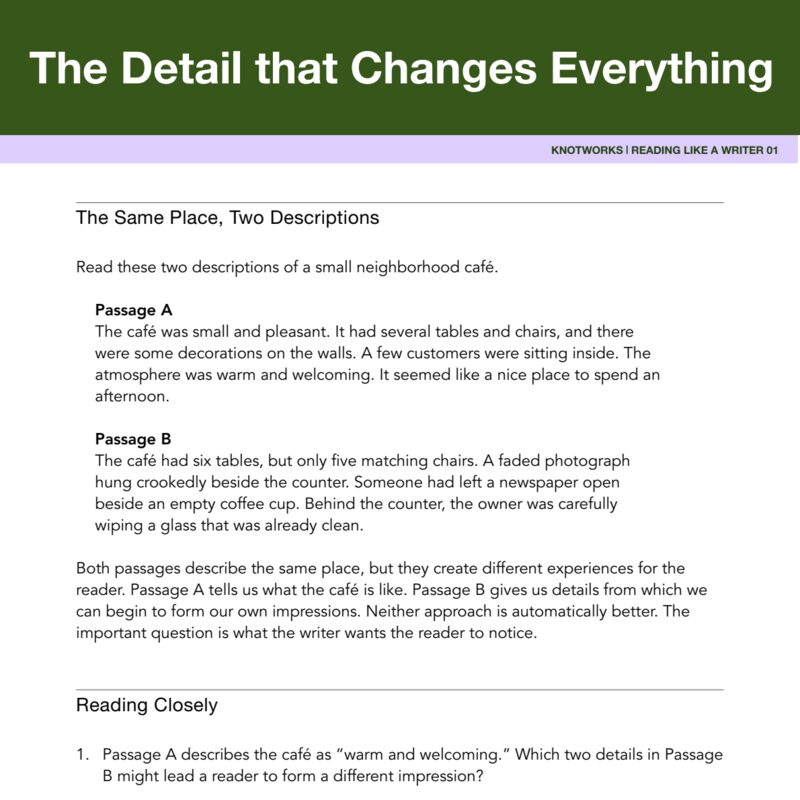
Reading Like a Writer: The Detail that Changes Everything
An analytical reading and creative writing worksheet that teaches how selecting specific, observable details shapes atmosphere and reader perception. Includes comparative passage analysis, writing exercises, and an answer key with writer insights.
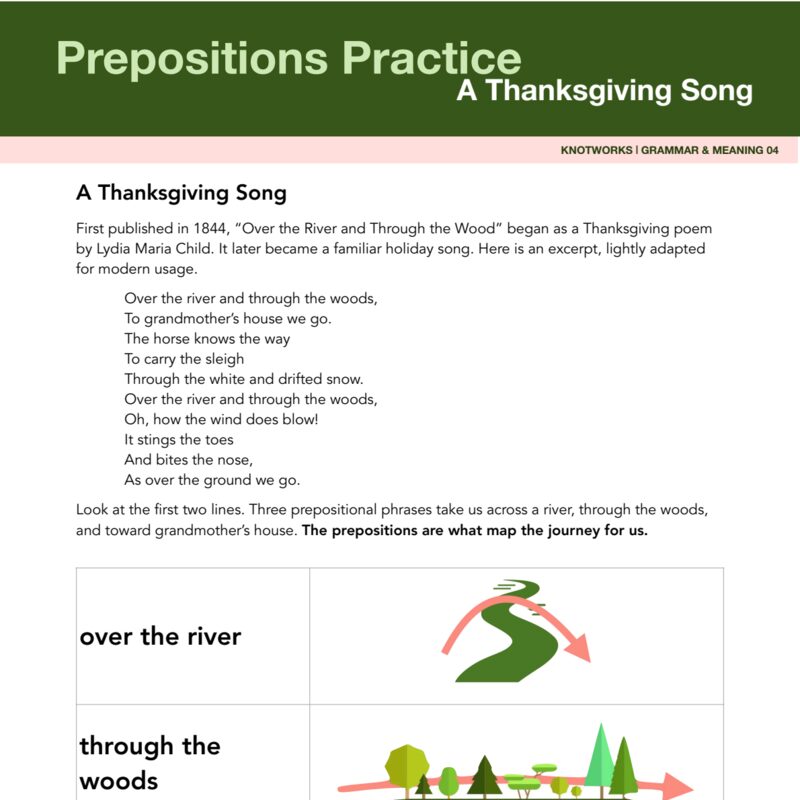
Prepositions Practice: A Thanksgiving Song
An illustrated grammar worksheet that explores directional prepositions (over, through, to) using Lydia Maria Child's classic Thanksgiving poem 'Over the River and Through the Wood'.
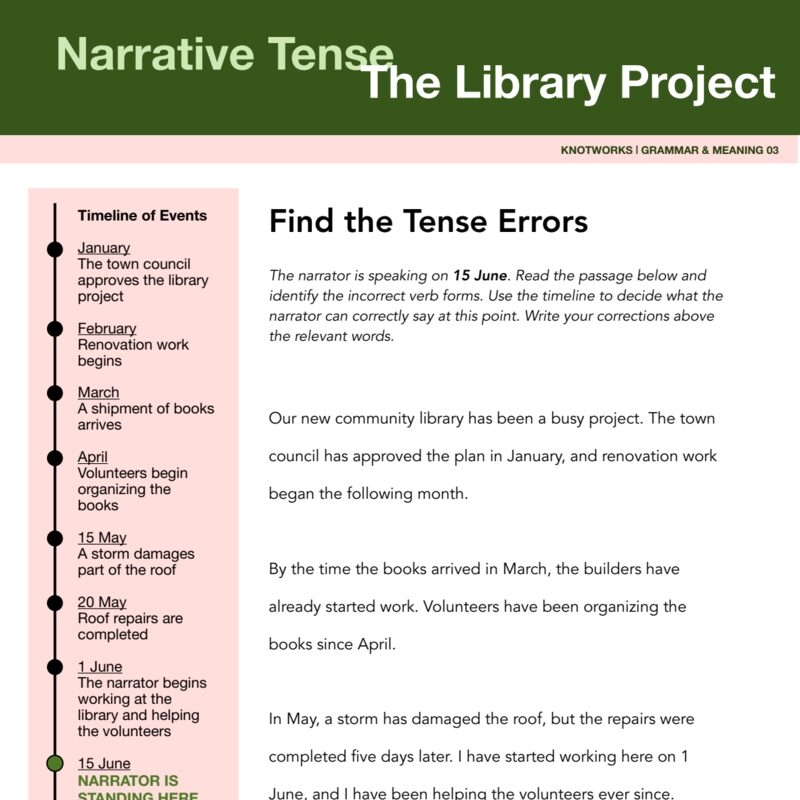
Narrative Tense: The Library Project
An English grammar exercise examining how a narrator's chronological position on a timeline determines verb tenses, featuring an error-correction task, answer key explanations, and perspective-shift analysis.
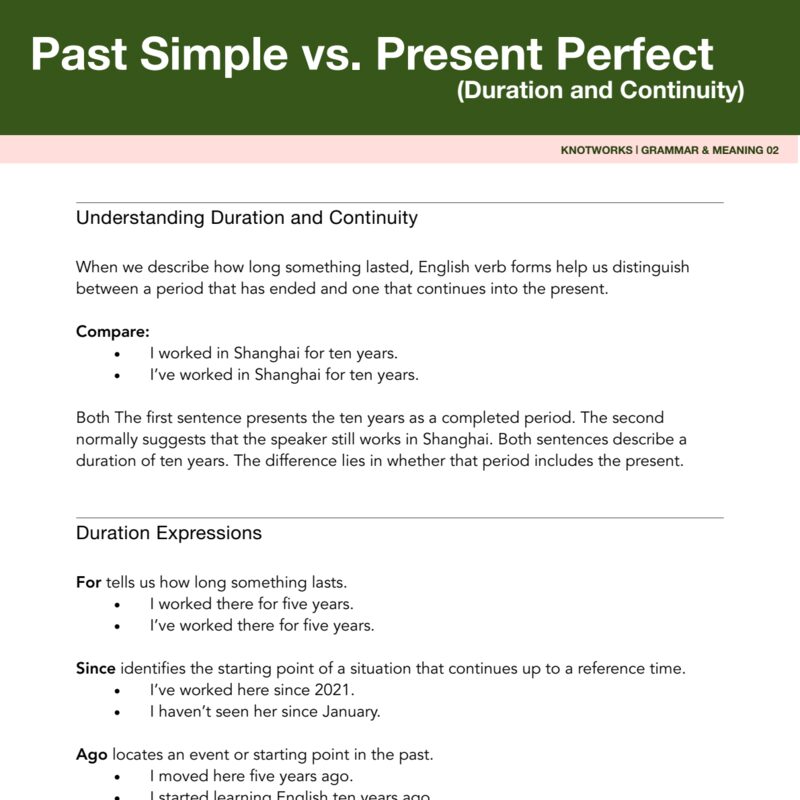
Past Simple vs. Present Perfect: Duration and Continuity
A comprehensive grammar worksheet and guide examining the distinction between past simple and present perfect tenses through duration expressions such as for, since, ago, until, and still, complete with exercises and an answer key.
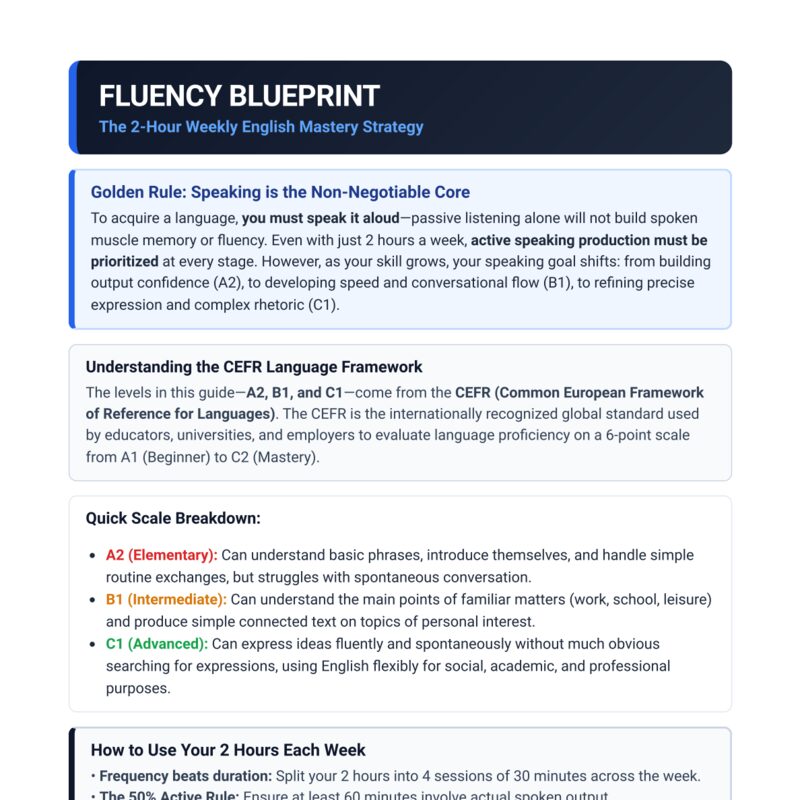
Fluency Blueprint: 2-Hour Weekly English Mastery Strategy
A comprehensive study guide designed to maximize English fluency in two hours per week across CEFR levels A2, B1, and C1, with an emphasis on active spoken output.
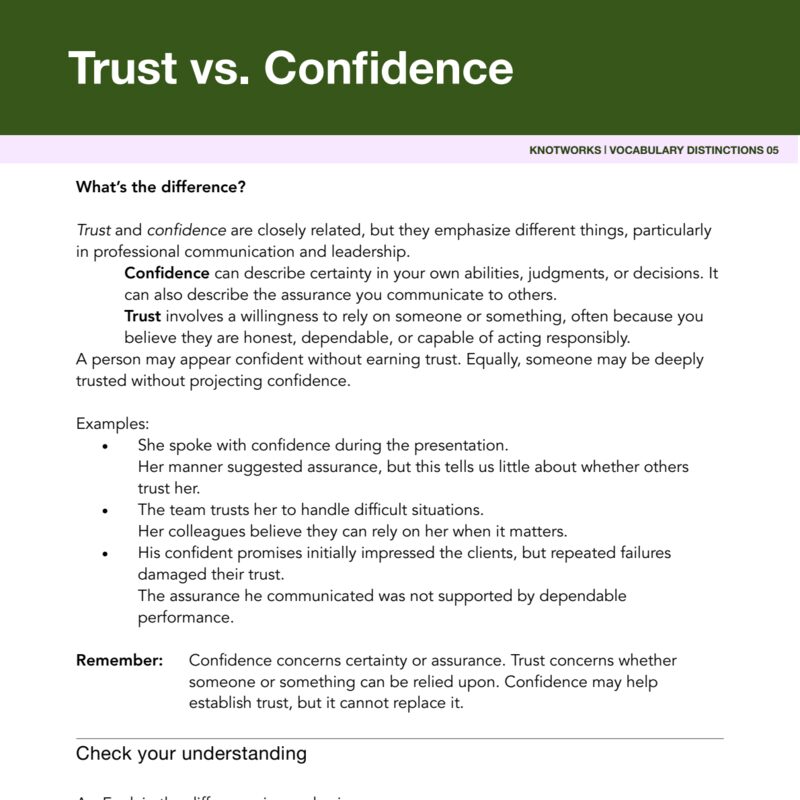
Vocabulary Distinctions: Trust vs. Confidence
An advanced vocabulary guide analyzing the nuanced differences between 'trust' and 'confidence' in professional communication, featuring examples, practice exercises, and real-world explanations.
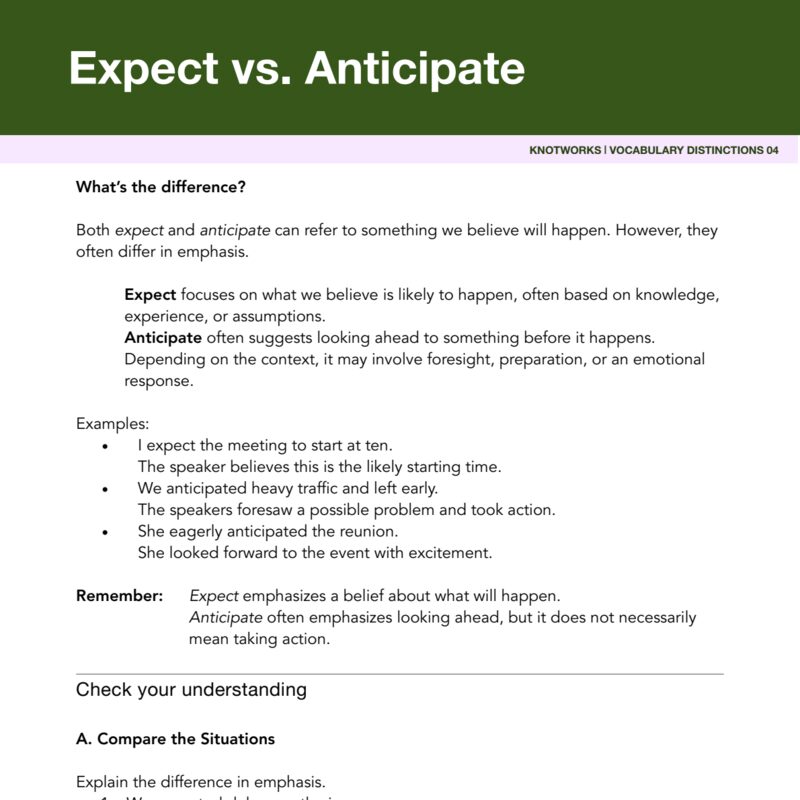
Expect vs. Anticipate: Vocabulary Distinctions
A guide clarifying the nuanced differences in meaning and usage between 'expect' and 'anticipate', complete with contextual examples, practice exercises, and an answer key.
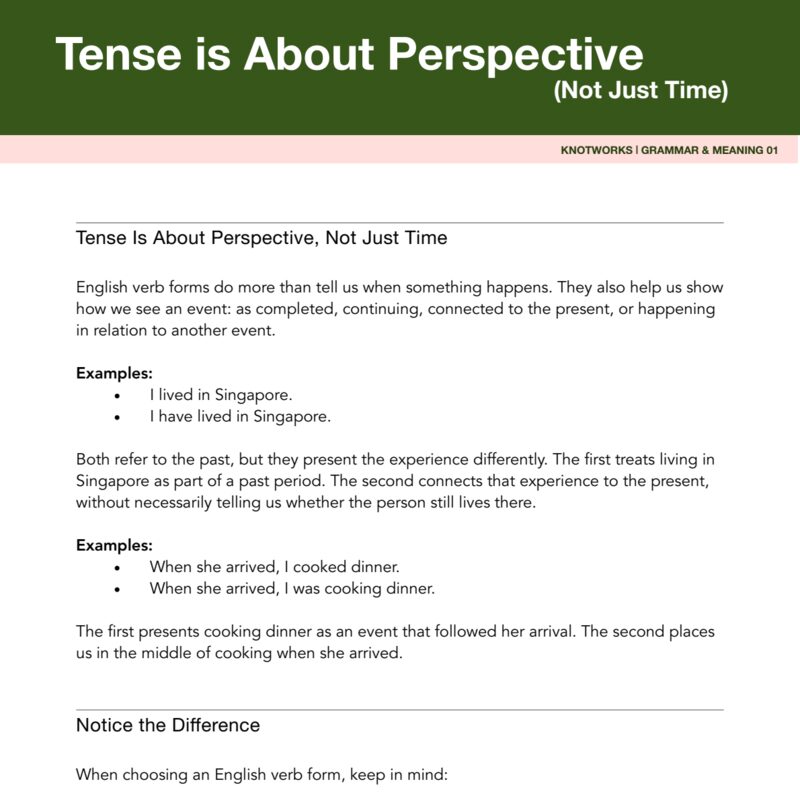
Tense is About Perspective (Not Just Time)
An intermediate English grammar lesson exploring how verb tenses and aspects convey perspective, completion, and connection to the present rather than merely indicating time.
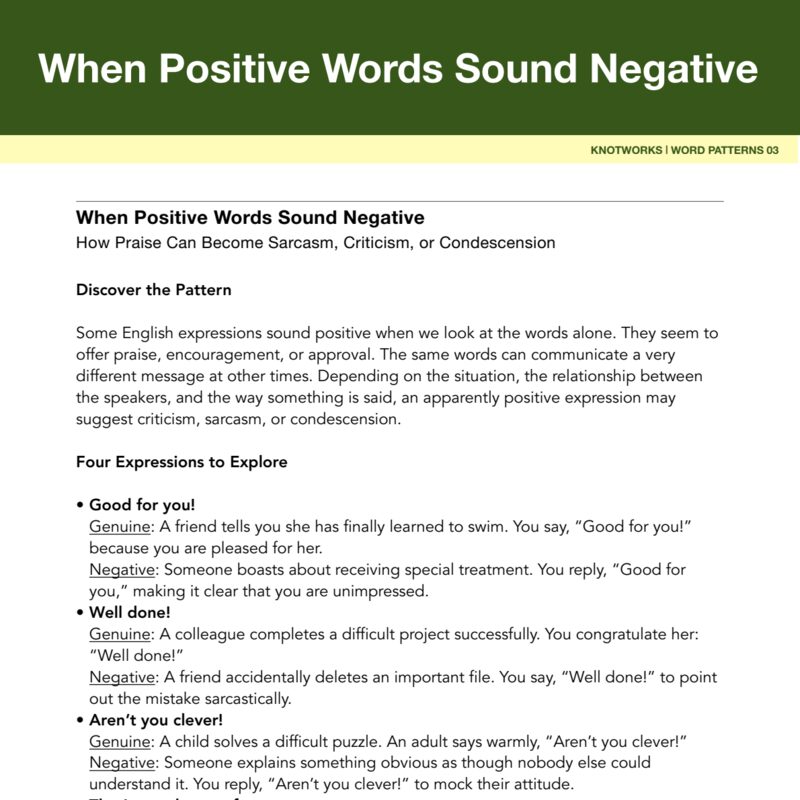
When Positive Words Sound Negative: Pragmatics and Sarcasm in English Praise
An English pragmatics worksheet exploring how common expressions of praise and approval can communicate sarcasm, criticism, or condescension depending on context and tone. Includes pattern recognition exercises, contextual analysis, and an answer key.
The Other Player: a sci-fi reader for language learners
The Other Player is designed to make language learning engaging while encouraging closer attention to the way English actually works. What’s Included An original science fiction mystery featuring Daniel and his online gaming companion 24 pages of story Seven questions and one broader reflection prompt in the “Did You Spot It?” section A substantial “Beyond the Story” section exploring idioms, conversational tone, metaphor, and language judgment Discussion of how AI can produce fluent English while sometimes misjudging context
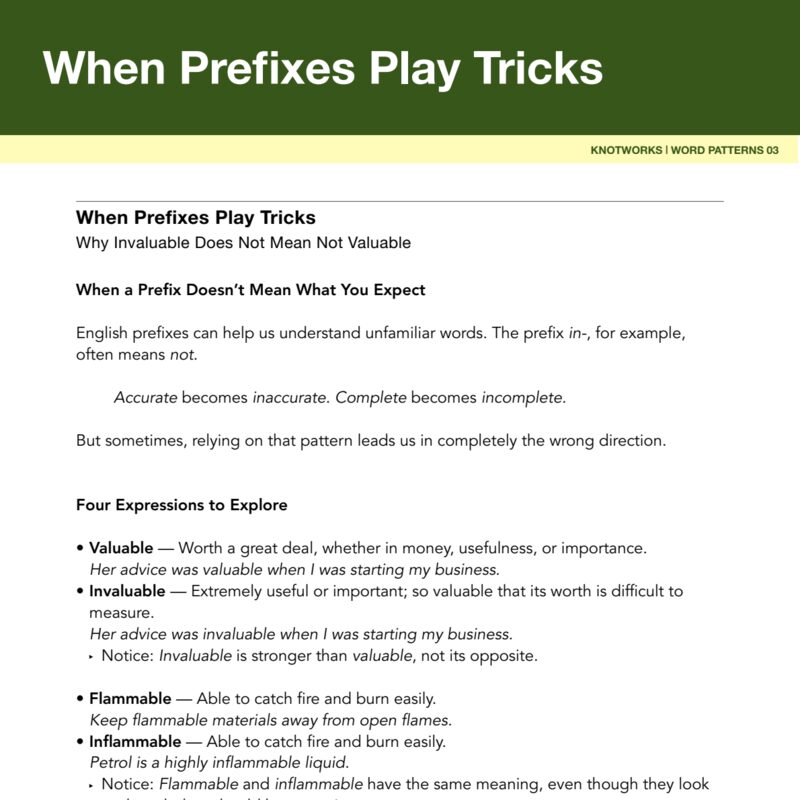
When Prefixes Play Tricks: Understanding 'Invaluable' and 'Inflammable'
An English vocabulary study guide examining misleading prefixes, highlighting how 'invaluable' and 'inflammable' differ from standard negative prefix patterns, complete with practice exercises and explanations.

Punctuation as Personality
Punctuation as Personality explores how tiny marks on a screen have become some of the most powerful emotional signals in modern communication. In a world where our voices, facial expressions, and body language are often missing, punctuation has stepped in to do the work of tone, warmth, hesitation, and intention. This video looks at how the same word can feel completely different depending on how it’s punctuated: “Sure.” “Sure!” “sure” “Sure…” Each version carries a different emotional message, even though the word itself never changes. These meanings aren’t taught in textbooks. We learn them through lived experience—through texting, chat apps, emails, and group conversations. Punctuation has become a form of emotional coding. We also explore how these codes shift across cultures and generations. A period might feel cold in English texting, but neutral in French or German. In Chinese, emotional tone often comes from rhythm, repetition, or particles like 啊, 呀, and 哦 rather than punctuation. Gen Z, millennials, and older generations all read the same message differently, based on the emotional grammar they’ve grown up with. This isn’t just about writing style. It’s about how we interpret one another’s intentions, kindness, distance, or care in a digital world. Today, we aren’t only translating language—we’re translating emotion. Punctuation as Personality invites you to notice the invisible system you already use every day. It offers insight into how tone is negotiated without sound, how misunderstanding is created without malice, and how generosity and awareness can make digital communication more humane. Because words carry meaning. But punctuation carries mood.
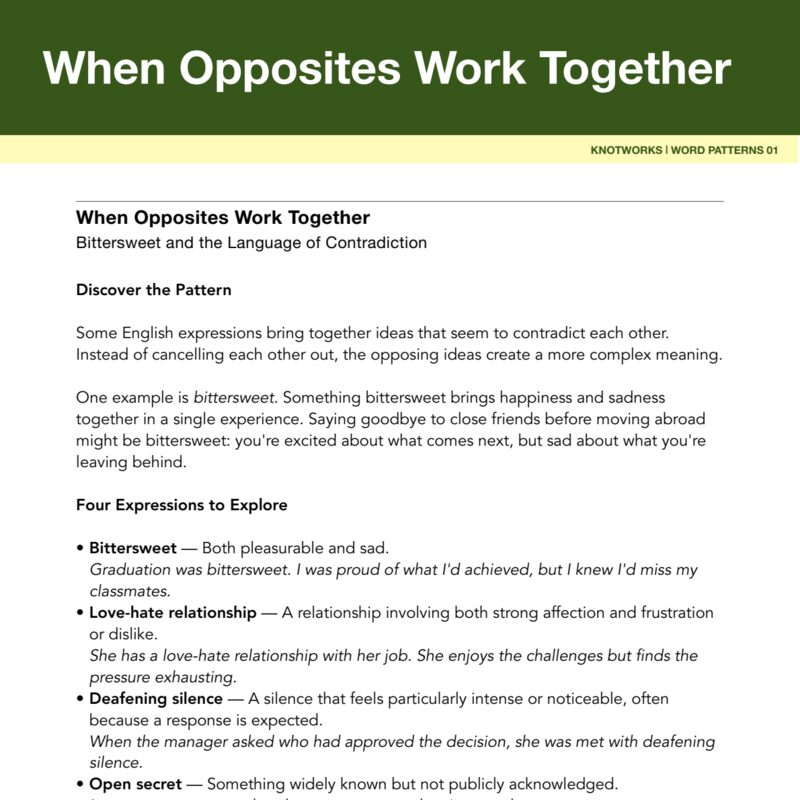
When Opposites Work Together: The Language of Contradiction
An exploration of English expressions that combine contradictory ideas—such as bittersweet, love-hate relationship, deafening silence, and open secret—with matching exercises and context practice.
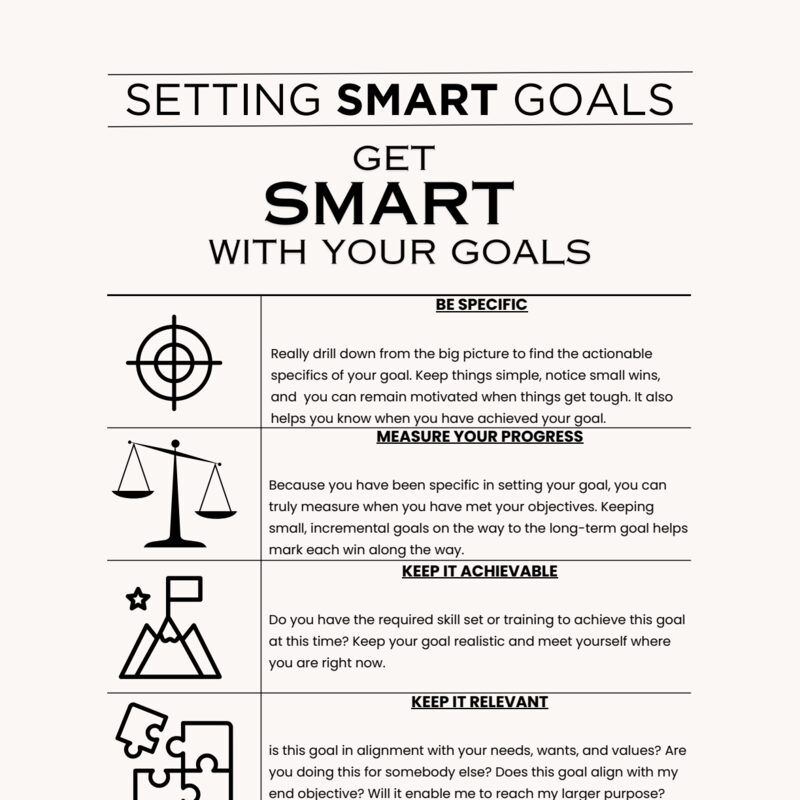
Goal Setting Frameworks: SMART, GROW, and SWOT
An introductory guide and worksheet exploring popular goal-setting and self-reflection frameworks including SMART goals, the GROW coaching model, and SWOT analysis.
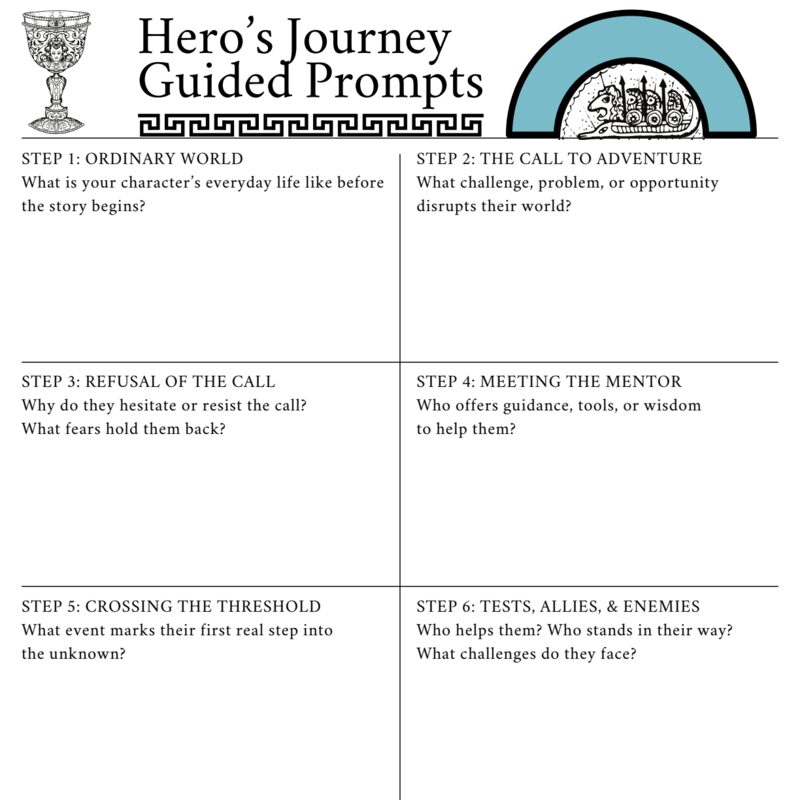
Hero's Journey Guided Prompts Worksheet
A two-page creative writing graphic organizer providing step-by-step guided prompts based on the 12 stages of the classic Hero's Journey story structure.
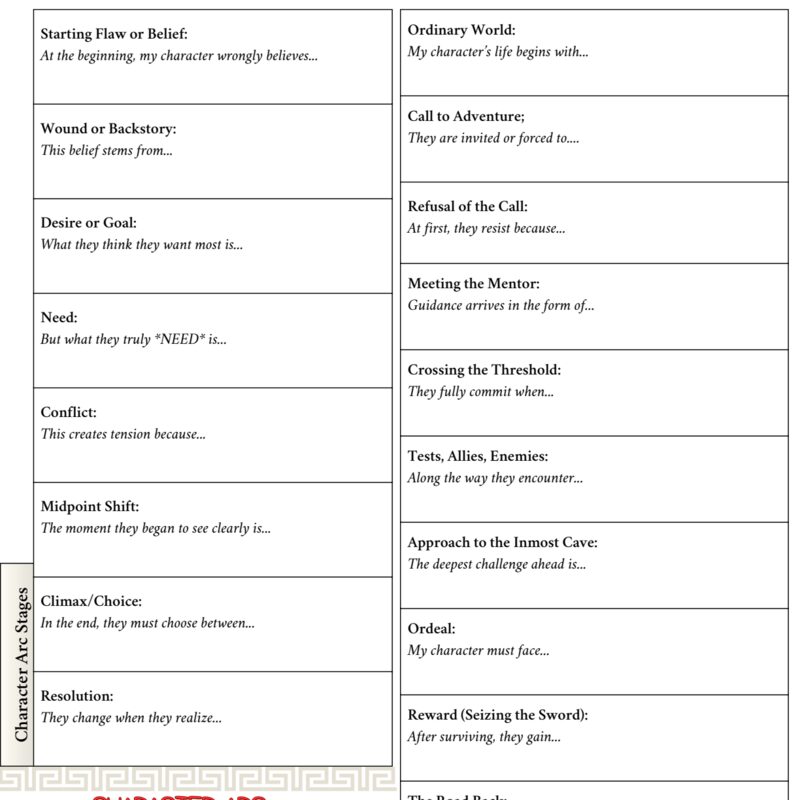
Character Arc & Hero's Journey Storyteller's Reference Guide
A side-by-side creative writing worksheet mapping character arc stages against the classic Hero's Journey story structure with prompt sentence starters.
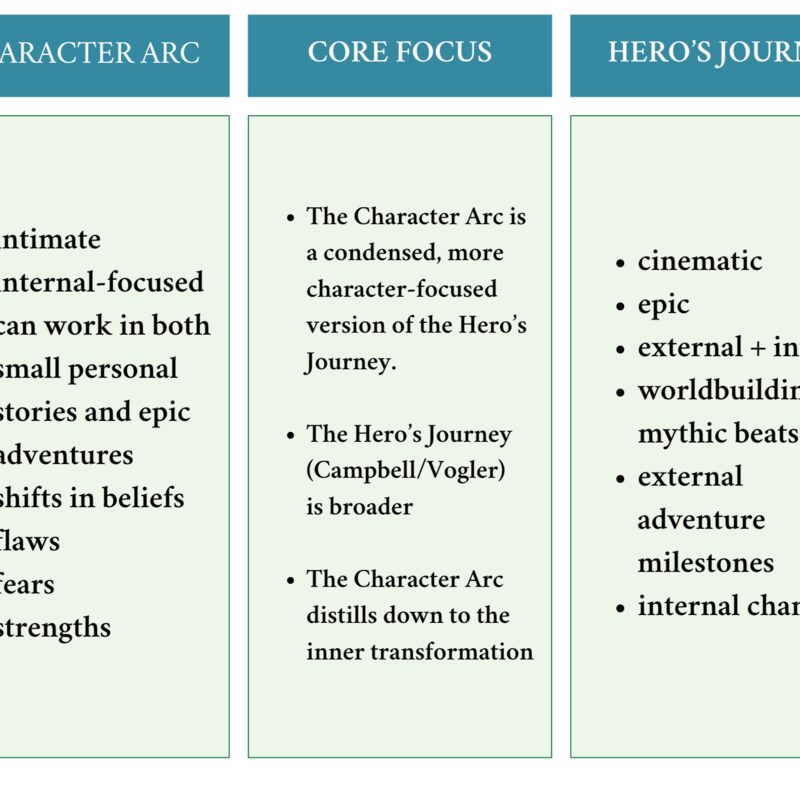
Contrasting Character Arc and the Hero's Journey
A comparative breakdown illustrating the differences in focus, scope, and elements between an internal character arc and the mythic structure of the Hero's Journey.
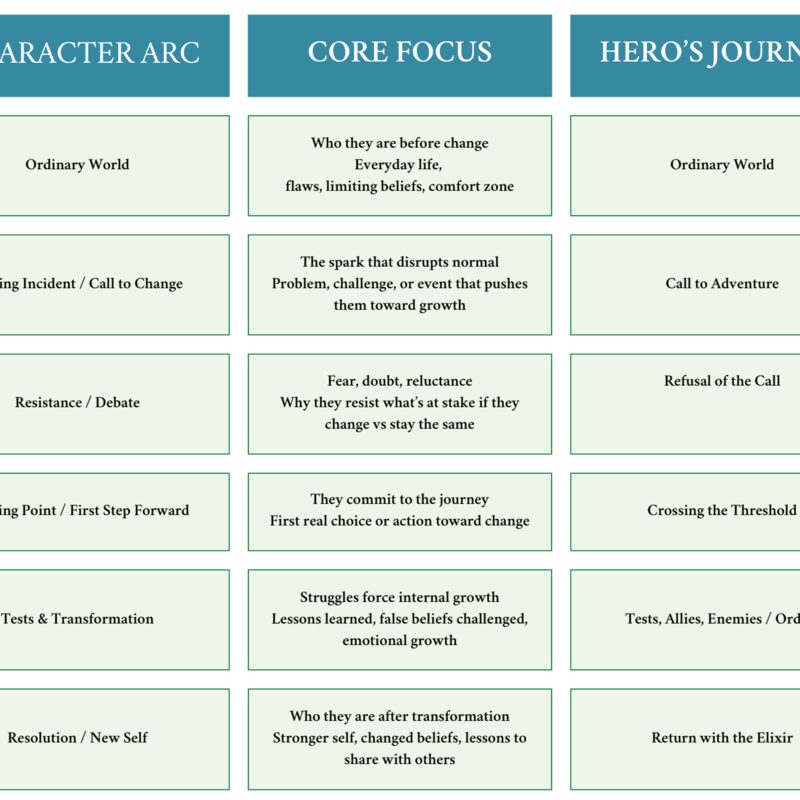
Character Arc vs. Hero's Journey Comparison Chart
A comparative guide mapping the stages of internal character development alongside the classic Hero's Journey narrative framework, highlighting the core focus of each phase.
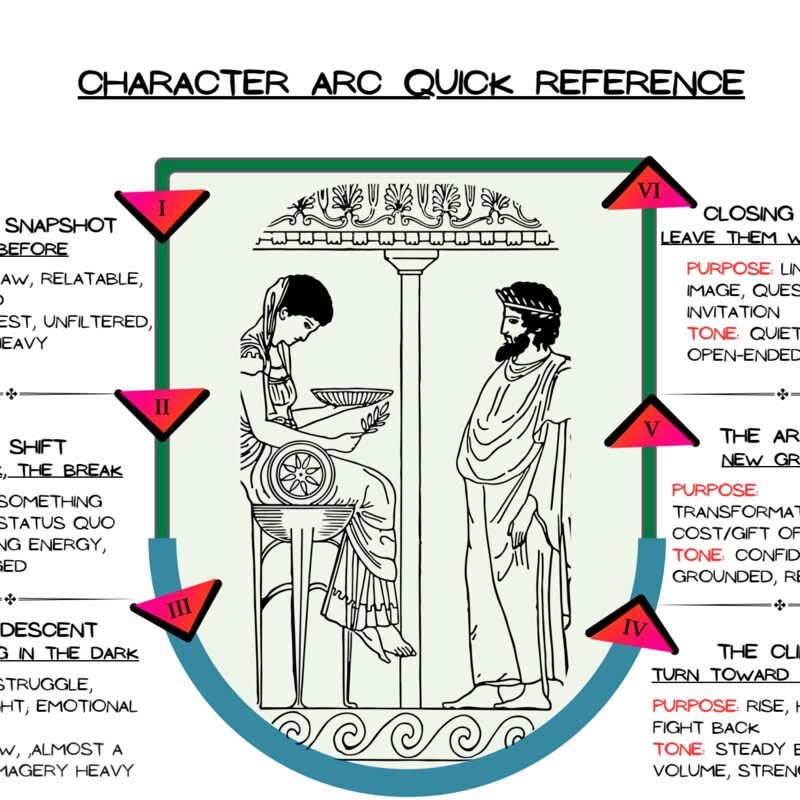
Character Arc Quick Reference Guide
A visual storytelling and creative writing guide outlining six essential stages of a character arc, detailing the emotional purpose and narrative tone for each phase.
The Hero's Journey Narrative Arc Overview
A visual diagram mapping the three acts and twelve stages of the Hero's Journey narrative structure, adapted from Joseph Campbell's 'The Hero with a Thousand Faces'.
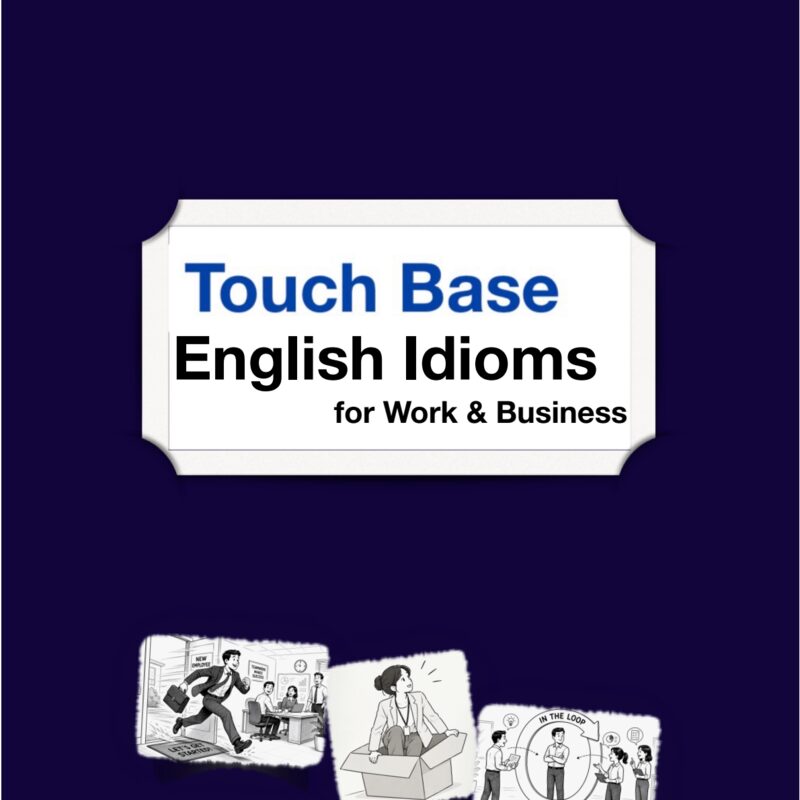
Idiom Touch Base
An illustrated lesson on the English idiom Touch Base, with particular focus on its use in professional settings. – Includes a few brief exercises for you to practice.
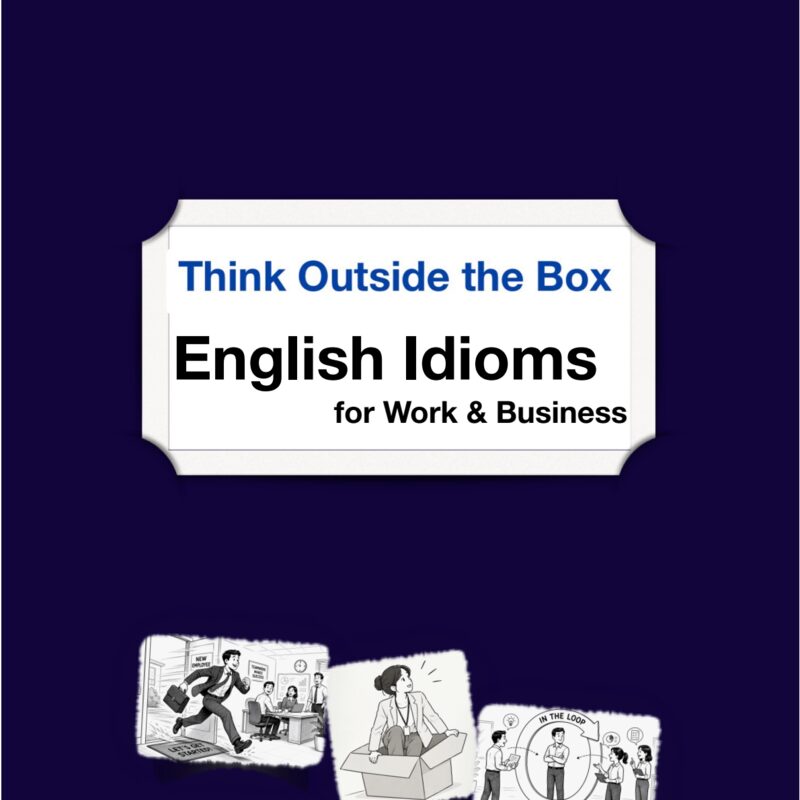
Idiom Think Outside the Box
An illustrated examination of the idiom Think Outside the Box, especially its use in workplace environments. – Includes a few brief exercises for you to practice.
Idiom Raise the Bar
An illustrated exploration of the idiom Raise the Bar, with particular focus on how it is used in professional English – Includes a few brief exercises for you to practice.
Idiom On the Same Page
Explore how the idiom On the Same Page is commonly used in professional English – Includes a few brief exercises for you to practice.
Idiom Learn the Ropes
Learn how the idiom Learn the Ropes is used in professional English – Includes a few brief exercises for you to practice.
Idiom In the Loop
Learn when to use the idiom In the Loop, and explore how it functions in professional English – Includes a few brief exercises for you to practice.
Idiom Hit the Ground Running
Learn how the idiom Hit the Ground Running is used in daily English, especially in the workplace – Includes a few brief exercises for you to practice.
Idiom Get the Ball Rolling
Learn the uses of the English idiom Get the Ball Rolling – Includes a few brief exercises for you to practice.
Idiom Go the Extra Mile
Explore the best use of the English idiom Go the Extra Mile – Includes a few brief exercises for you to practice.
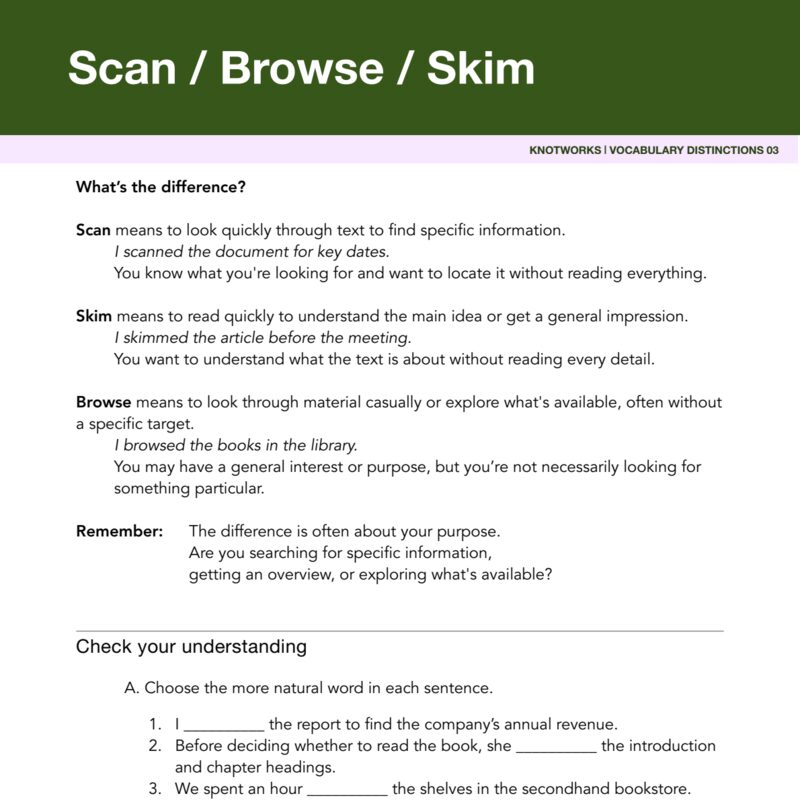
Vocabulary Distinctions: Scan, Browse, and Skim
Explains the nuances and differences in meaning between the reading verbs 'scan', 'skim', and 'browse' depending on the reader's purpose, complete with practice exercises and answer keys.
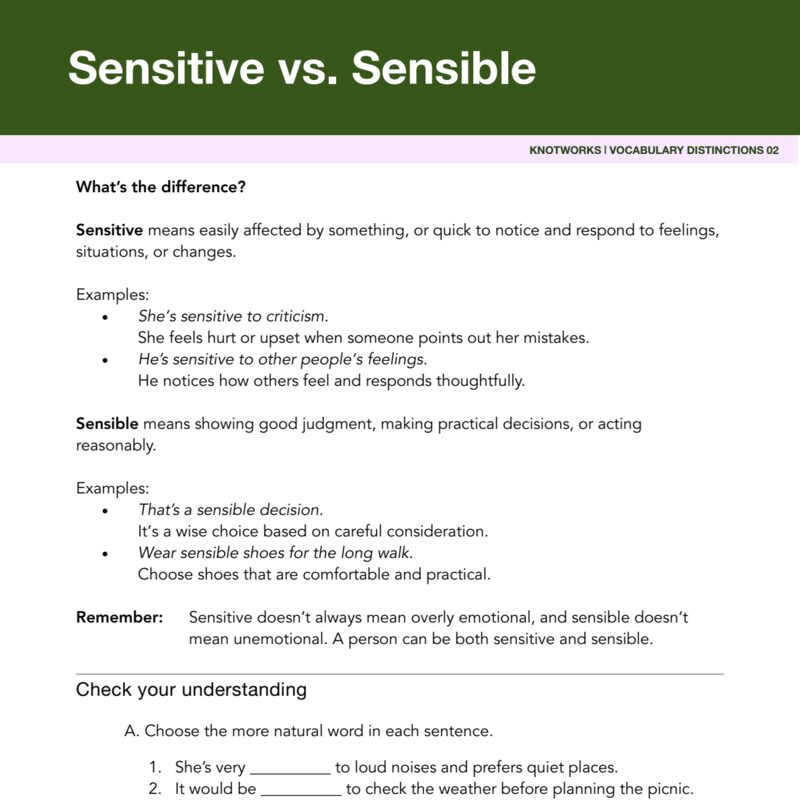
Sensitive vs. Sensible: Vocabulary Distinctions
A vocabulary worksheet clarifying the differences, definitions, and contextual nuances between the commonly confused words 'sensitive' and 'sensible', complete with practice exercises and an answer key.
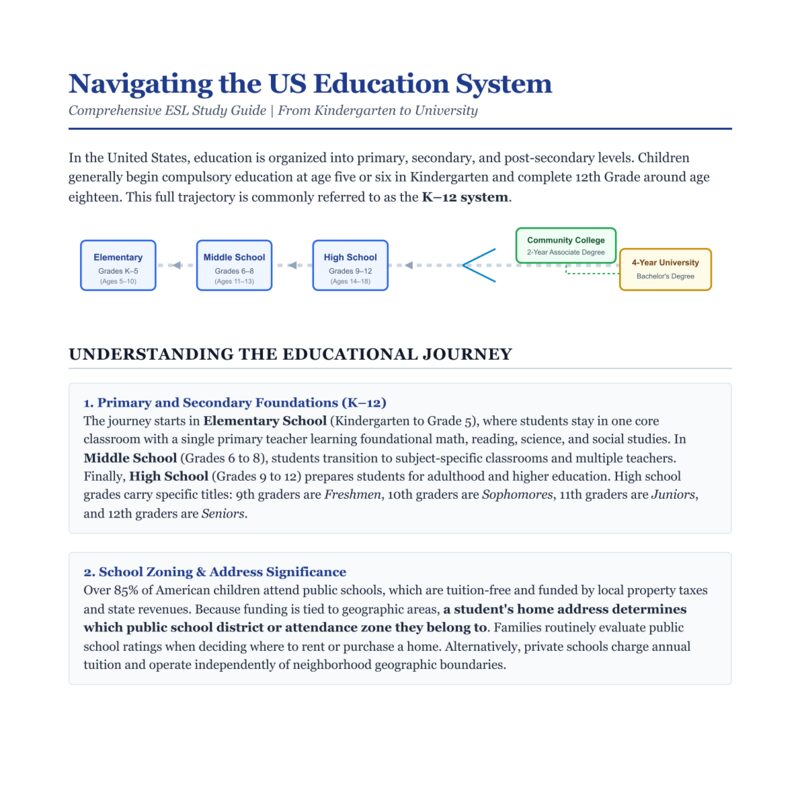
Navigating the US Education System: ESL Study Guide & Worksheet
An ESL guide explaining the K–12 system, school zoning, college admissions, and financial aid in the United States, complete with vocabulary definitions and comprehension exercises.

Fun in Human Language: Exploring Wordplay, Humor, and Translation
This document explores the role of fun, humor, and wordplay in human language, focusing on how cultural nuances, mistranslations, idioms, and slang reveal deeper insights into communication. It includes practical exercises for language learners to develop sensitivity to tone, rhythm, and cultural context.
The Past in English: Distance, Connection, Immersion and What Came Before
This document explores the nuances of English past tenses, focusing on how different forms (simple past, present perfect, past continuous, past perfect) shape the speaker's relationship to past events, rather than just marking time. It aims to help learners understand the expressive power of tense choices beyond basic grammatical rules.
English Prepositions and Chinese Localizers: Understanding Linguistic Logic Systems
This document explores the fundamental differences and underlying logic behind English prepositions and Chinese localizers, demonstrating how each language conceptualizes and expresses relationships in space, time, hierarchy, and emotion. It aims to help learners move beyond memorization by visualizing these linguistic systems and thinking naturally in both languages.
The Subtle Art of English Prepositions: A Stylistic Guide for Translators
This guide explores the subtle yet profound impact of English prepositions on meaning, tone, and emotional resonance, offering insights and examples for translators to enhance stylistic accuracy and depth in their work.
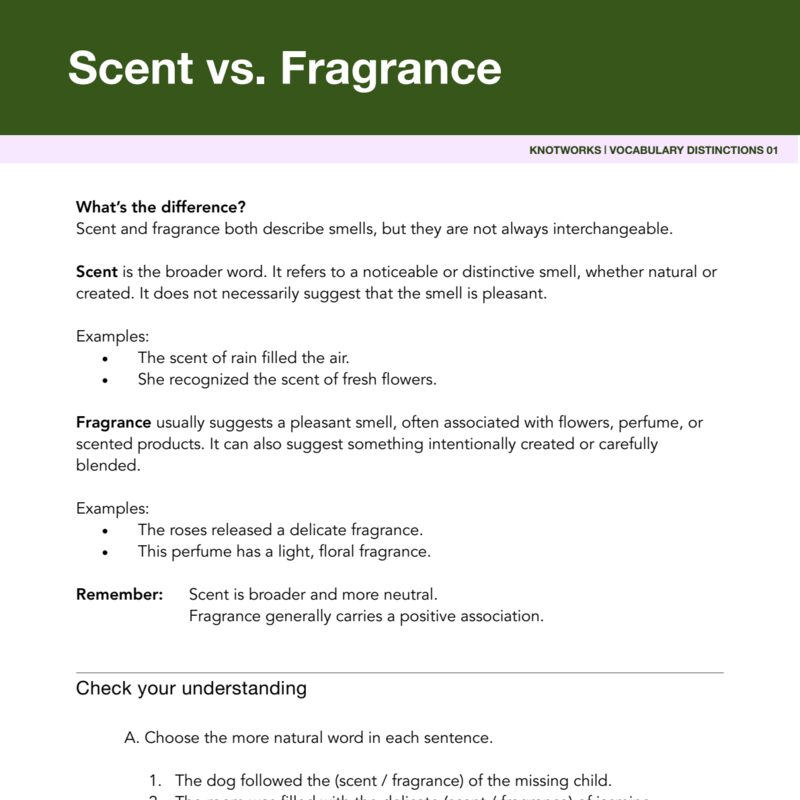
Vocabulary Distinctions: Scent vs. Fragrance
This document explains the nuanced differences between 'scent' and 'fragrance,' providing definitions, examples, and practice exercises to help distinguish when to use each word correctly in English.
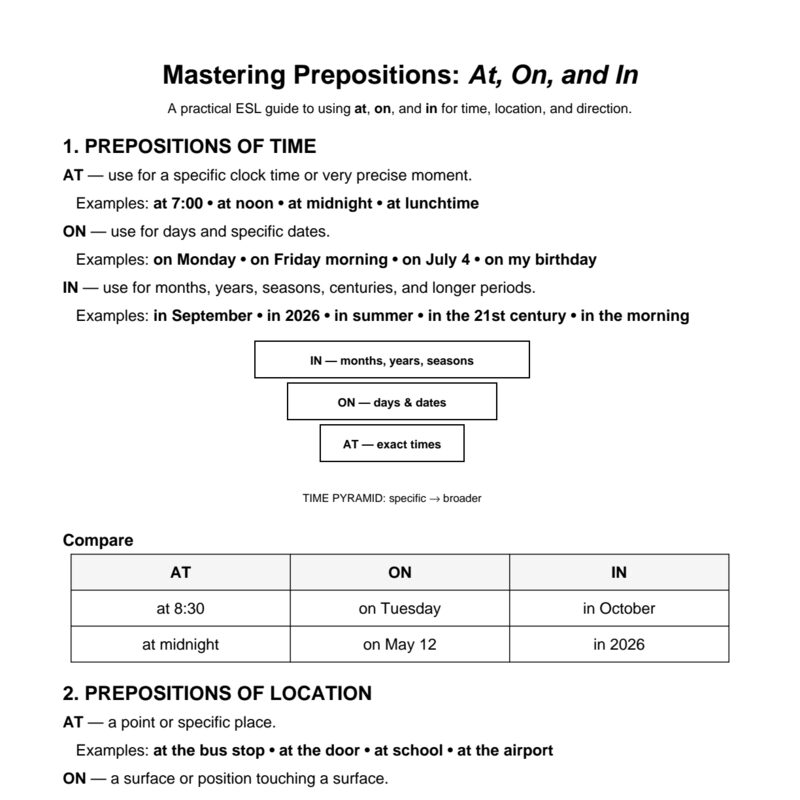
Mastering Prepositions: At, On, and In
A practical ESL guide explaining the usage of 'at', 'on', and 'in' for time, location, and direction, providing examples and a memory trick for easy recall.
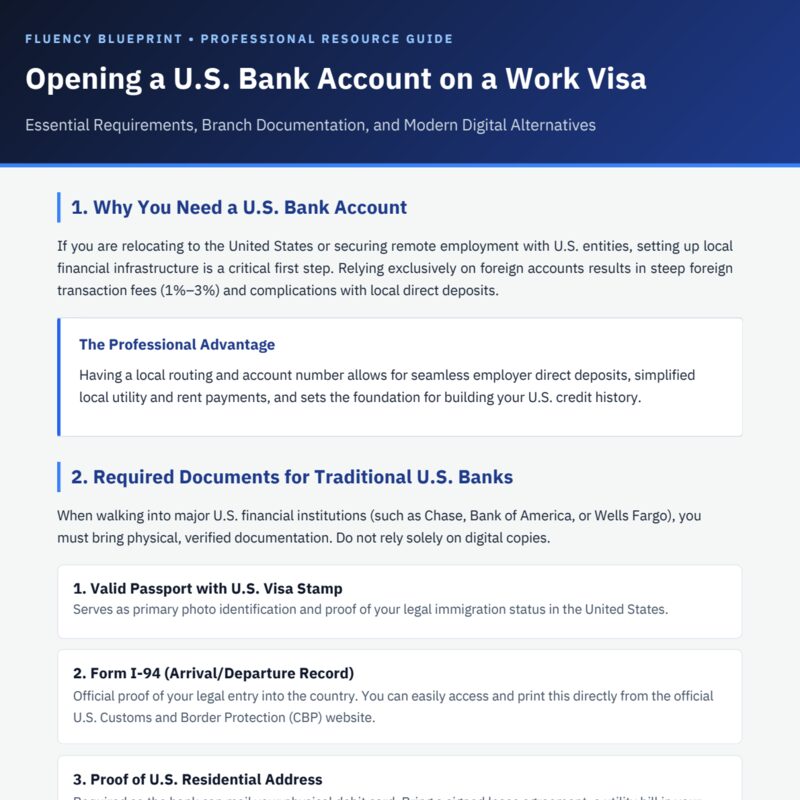
Opening a U.S. Bank Account on a Work Visa
This guide outlines the essential requirements, necessary documentation for traditional U.S. banks, and modern digital alternatives for professionals opening a U.S. bank account on a work visa.
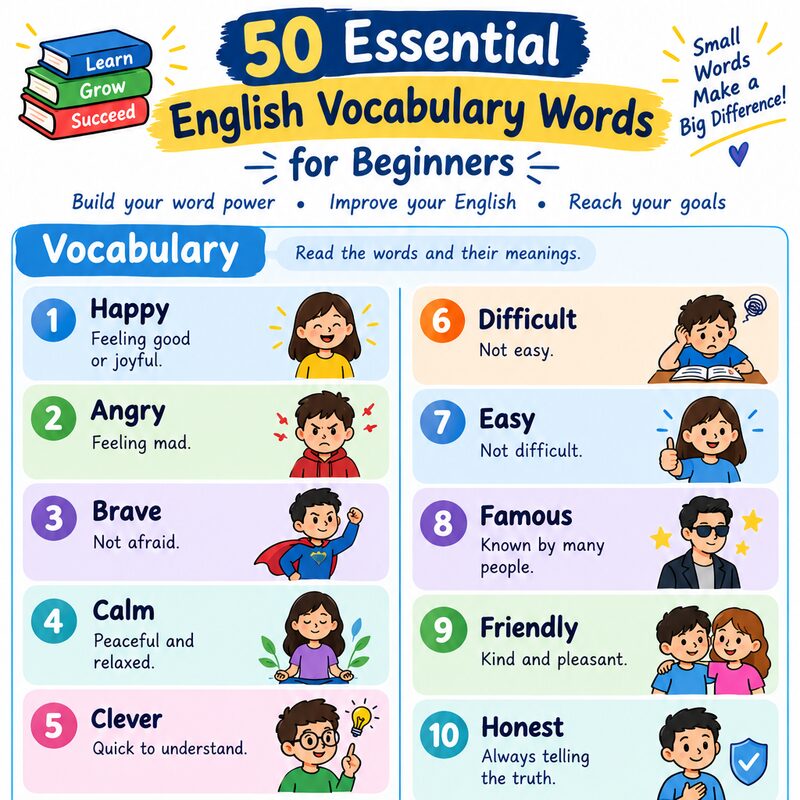
10 Essential English Vocabulary Words for Beginners
Learn 10 essential English vocabulary words with simple meanings and practice exercises. This beginner-friendly worksheet is useful for English learners, students, classroom activities, homework, and self-study.
Meeting Survival Guide: Speaking Up with Confidence
Do you ever sit in a fast-paced business meeting with a brilliant idea, but a small voice stops you from sharing it? If you are tired of letting native speakers dominate the discussion while you worry about grammar mistakes, your accent, or interrupting at the wrong time, this guide is for you. The Meeting Survival Guide by Fluency Blueprint is a highly practical, 6-page PDF toolkit designed specifically for non-native professionals who want to make their voices heard. We tackle the very real fear of judgment head-on and give you the exact conversational tools you need to claim your space in the boardroom. Stop holding back your valuable insights out of fear. Download this guide, keep your favorite phrases on a sticky note next to your webcam, and start speaking up with confidence today!
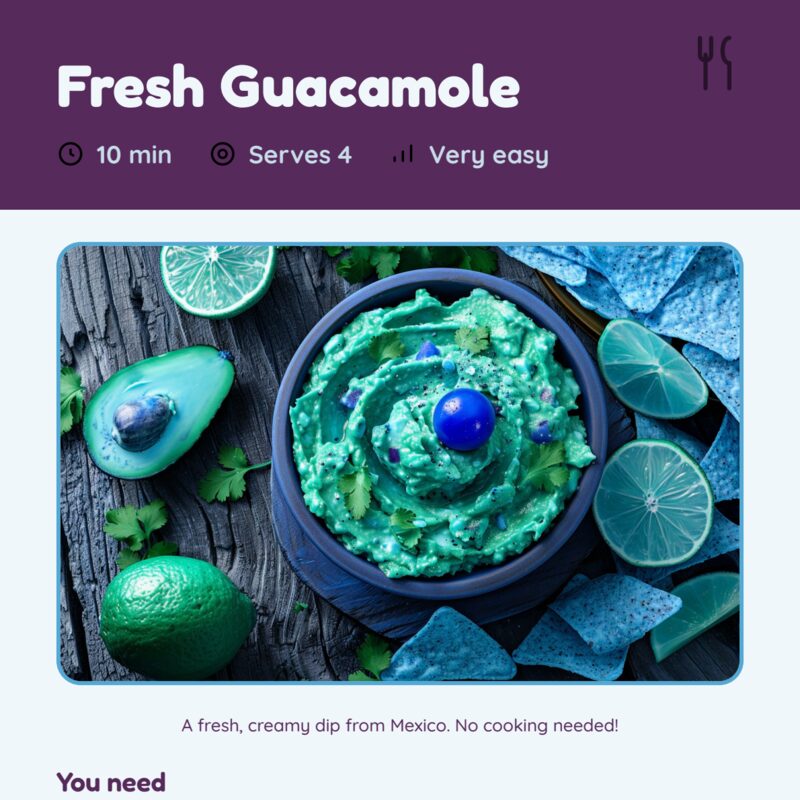
Fresh Guacamole Recipe
This document provides a simple, step-by-step recipe for making fresh guacamole, along with a vocabulary section explaining key cooking terms. It's designed for English learners to practice language in a practical context.
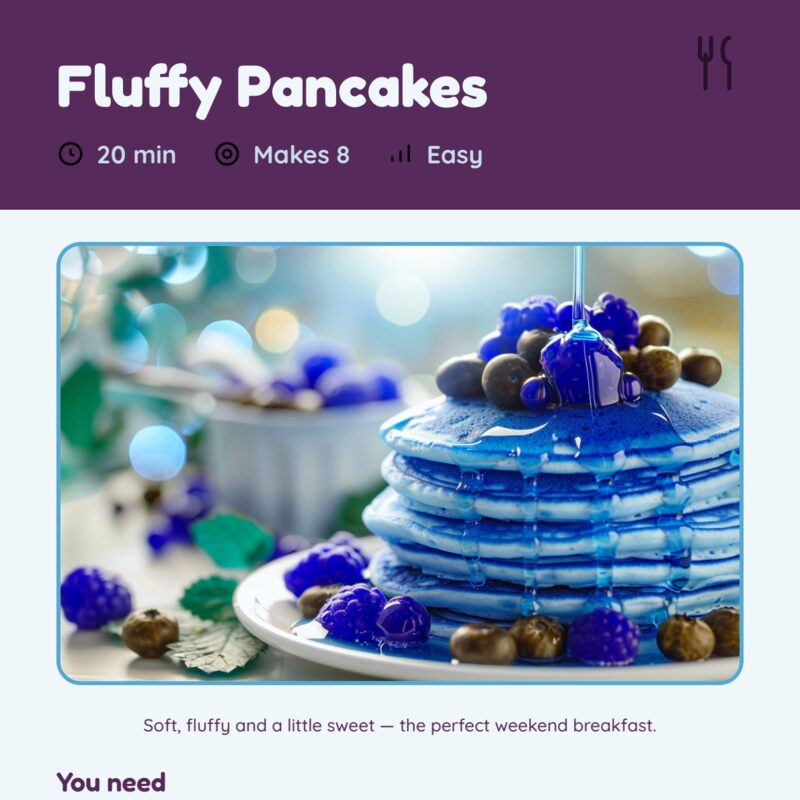
Fluffy Pancakes Recipe
This document provides a simple recipe for making fluffy pancakes, including ingredients, step-by-step instructions, and key vocabulary related to cooking. It is designed for English learners to practice language in a kitchen context.
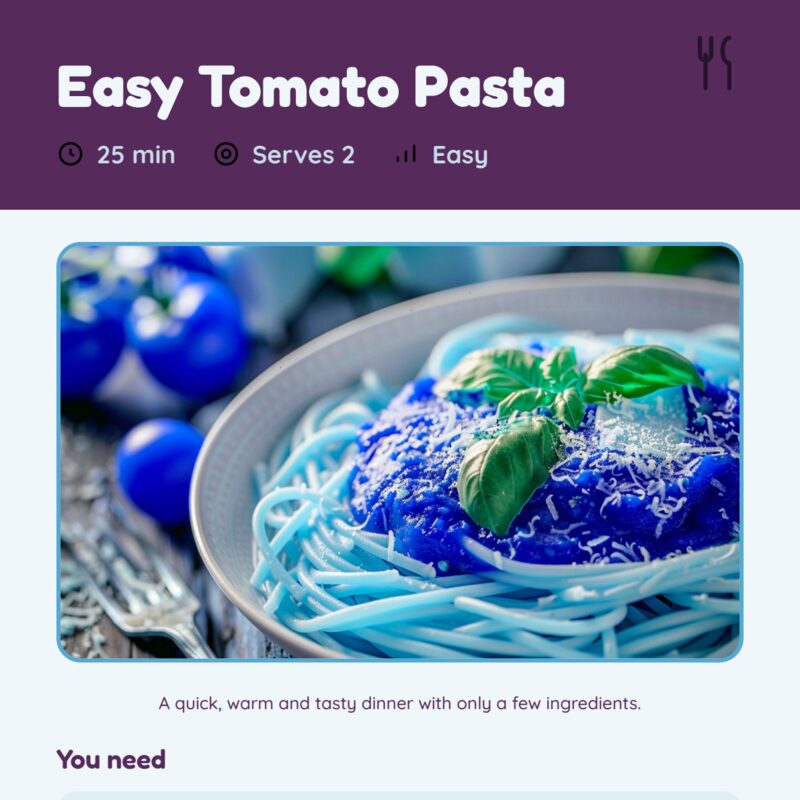
Easy Tomato Pasta Recipe
This document provides a simple recipe for Easy Tomato Pasta, including ingredients, step-by-step cooking instructions, and a 'Words to know' section explaining cooking verbs and terms.
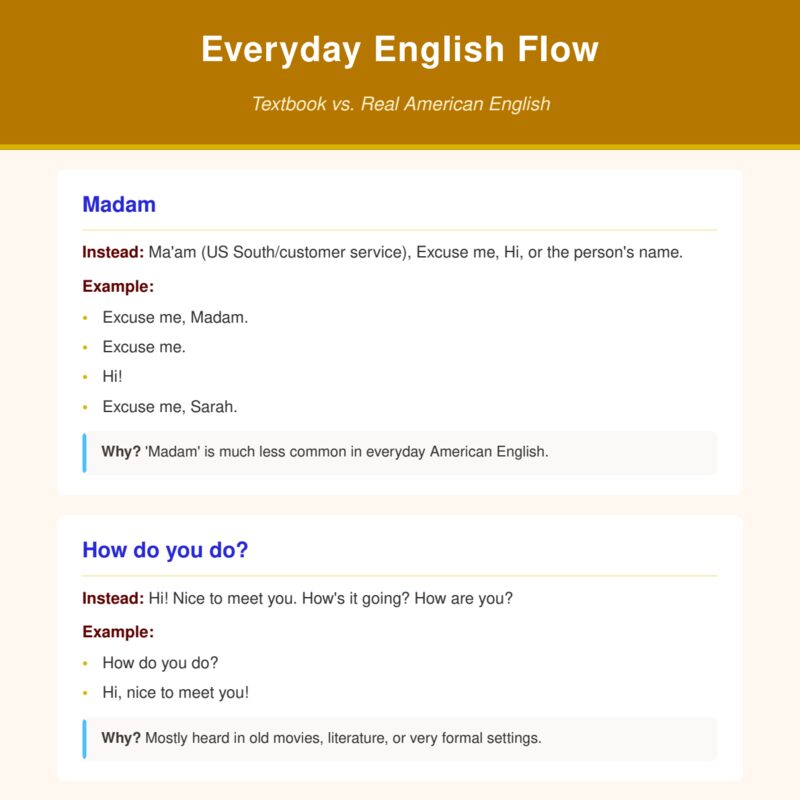
Everyday English Flow: Textbook vs. Real American English
This document highlights common formal English phrases taught in textbooks and provides more natural, everyday alternatives used in American English, explaining why the textbook phrases are less common.
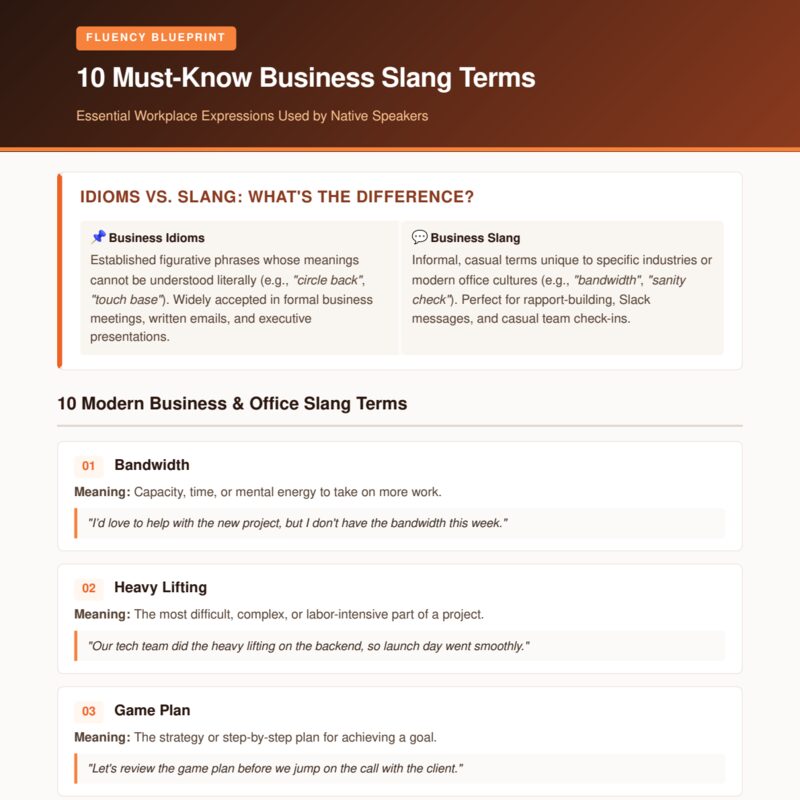
10 Must-Know Business Slang Terms
This document introduces ten essential business slang terms used by native English speakers in workplace settings, differentiating between idioms and slang and providing definitions and example sentences for each term.
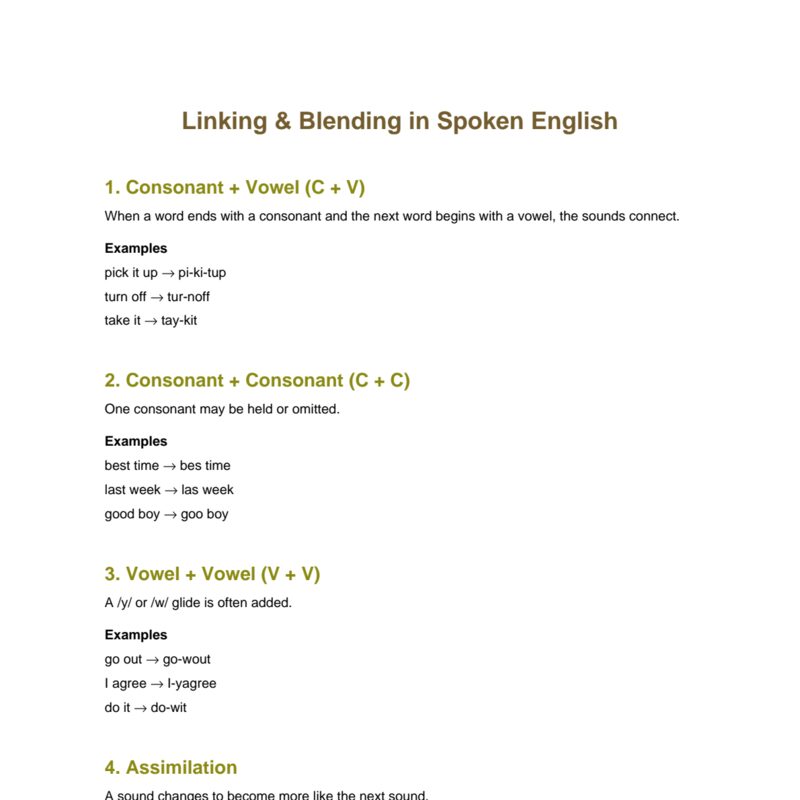
Linking & Blending in Spoken English
This document explains four common types of sound linking and blending rules in spoken English (consonant+vowel, consonant+consonant, vowel+vowel, and assimilation) with examples for each.

American Business Culture: Vacation Time & Lunch Breaks
This document explores how professionals in the United States balance work responsibilities, taking breaks, and managing personal time off, focusing on vacation time and lunch breaks.
Get more English resources
Sign up free to download, favorite and share materials — or upload your own.
Sign up free