German Worksheets
German worksheets contributed by the Parlora community across grammar, vocabulary, conversation and more.
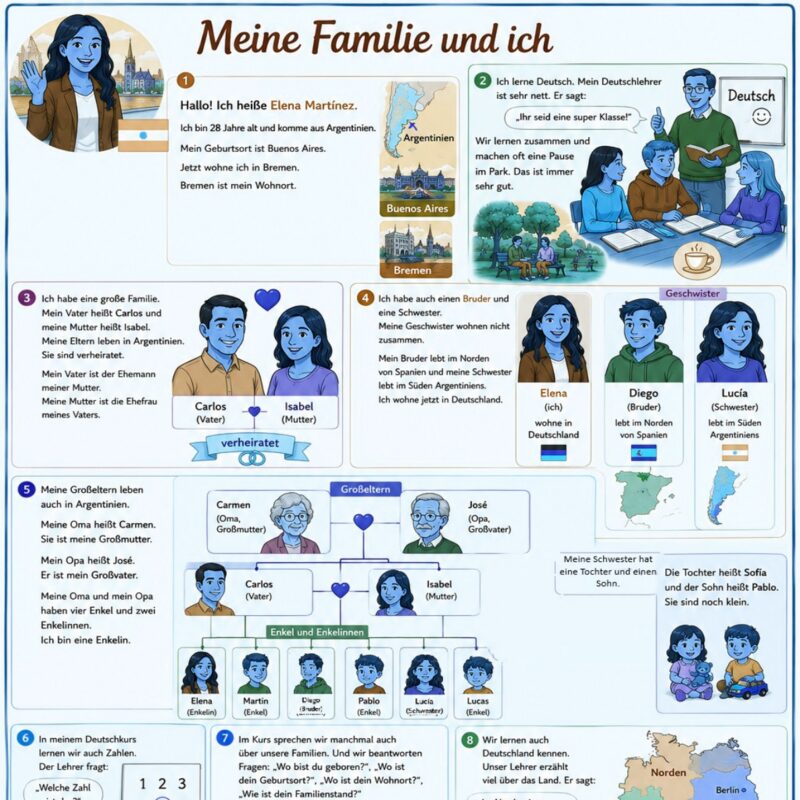
Family, Possessive Pronouns and Verbs in the Present Tense
This document introduces basic German vocabulary related to family and personal information, along with explanations and exercises for possessive pronouns and present tense verbs (haben/sein).
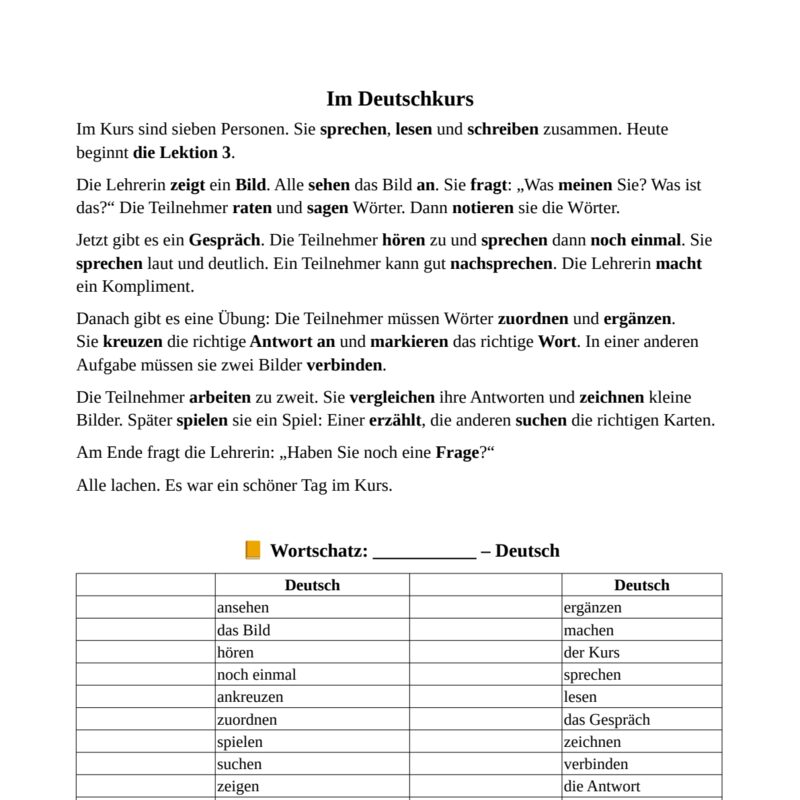
German Classroom Vocabulary, Verbs and Question Words Practice
This document provides an introduction to common German classroom activities and vocabulary, followed by exercises focusing on conjugating verbs in the present tense and using interrogative pronouns.
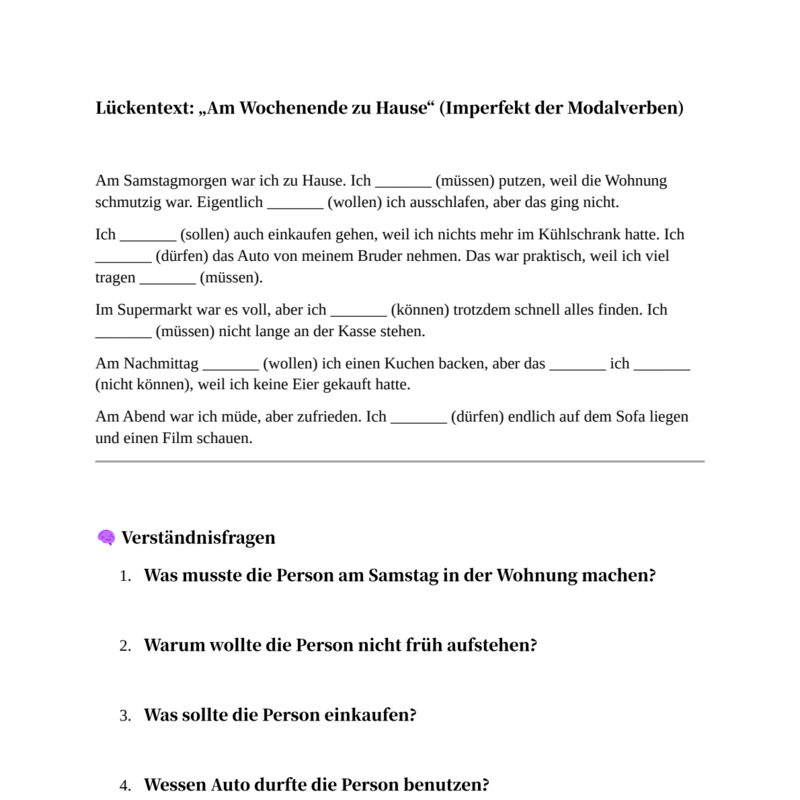
Am Wochenende zu Hause: Imperfekt der Modalverben Lückentext
This document presents a fill-in-the-blanks exercise focusing on the imperfect tense of modal verbs in German, followed by comprehension questions.
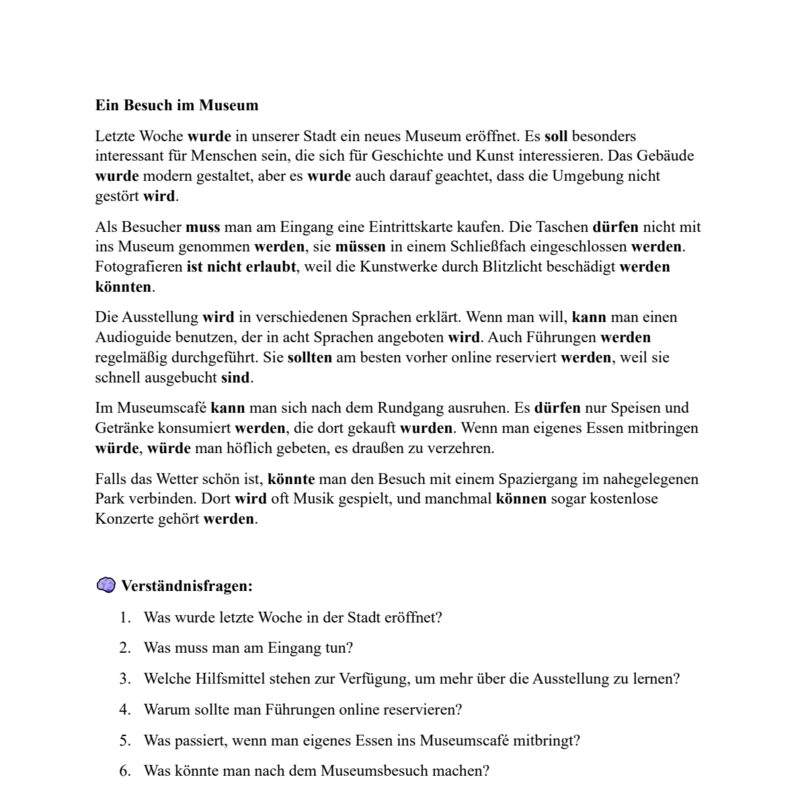
A Museum Visit: Modal Verbs and Passive Voice
This document focuses on German modal verbs and the passive voice, using a narrative about a museum visit. It includes comprehension questions, fill-in-the-blank exercises, and sentence transformation tasks.
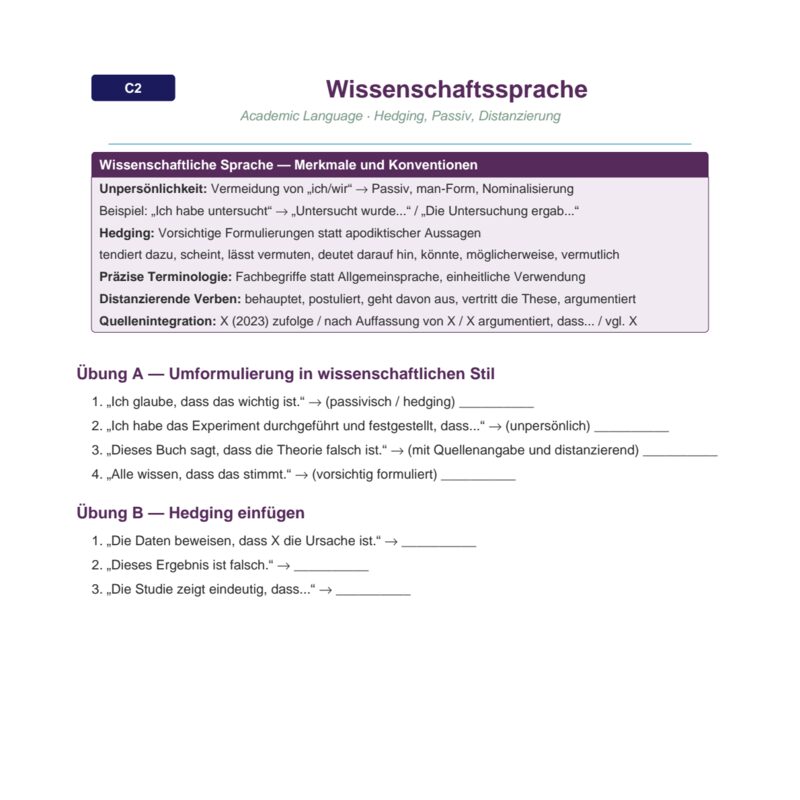
Wissenschaftssprache verstehen und verwenden
Akademische Redemittel, Fachterminologie und wissenschaftlicher Schreibstil.
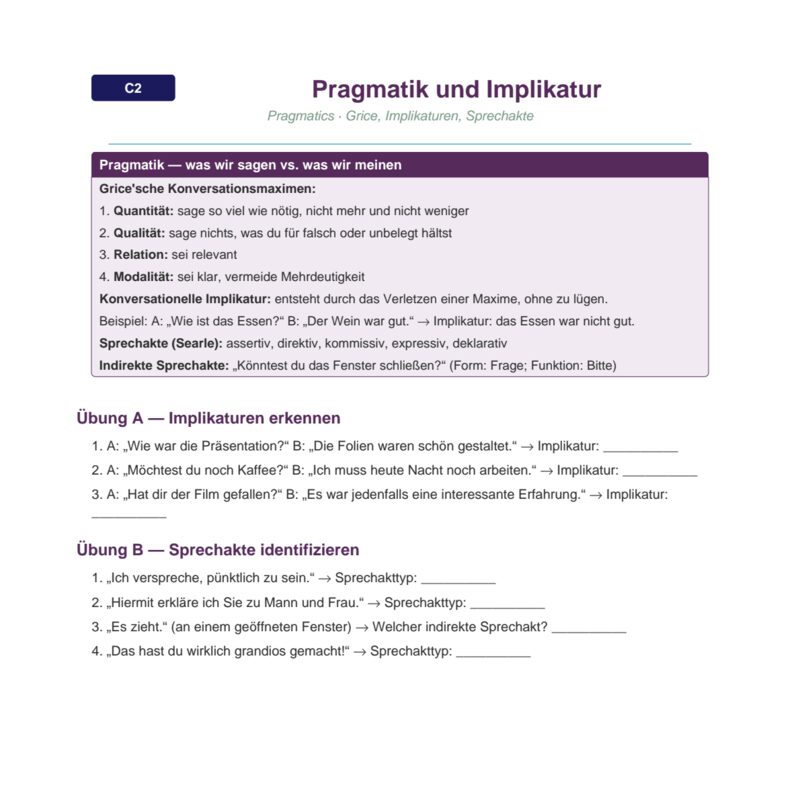
Pragmatik: Sprache im Kontext
Sprechakte, Implikaturen und Höflichkeitsstrategien in der deutschen Kommunikation.
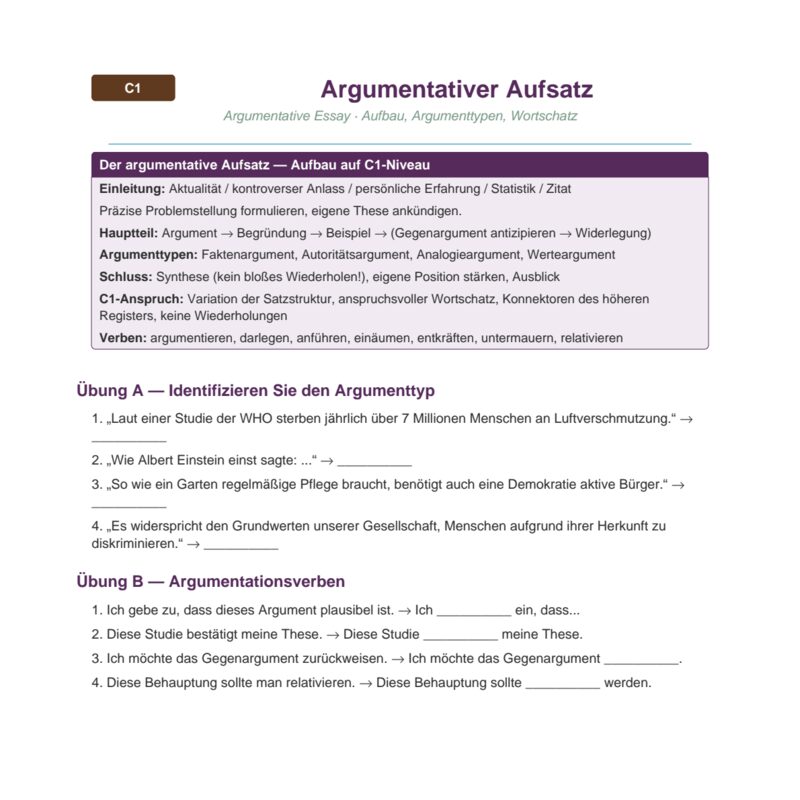
Argumentativer Aufsatz schreiben
Aufbau und Formulierung eines überzeugenden argumentativen Aufsatzes auf C1-Niveau.
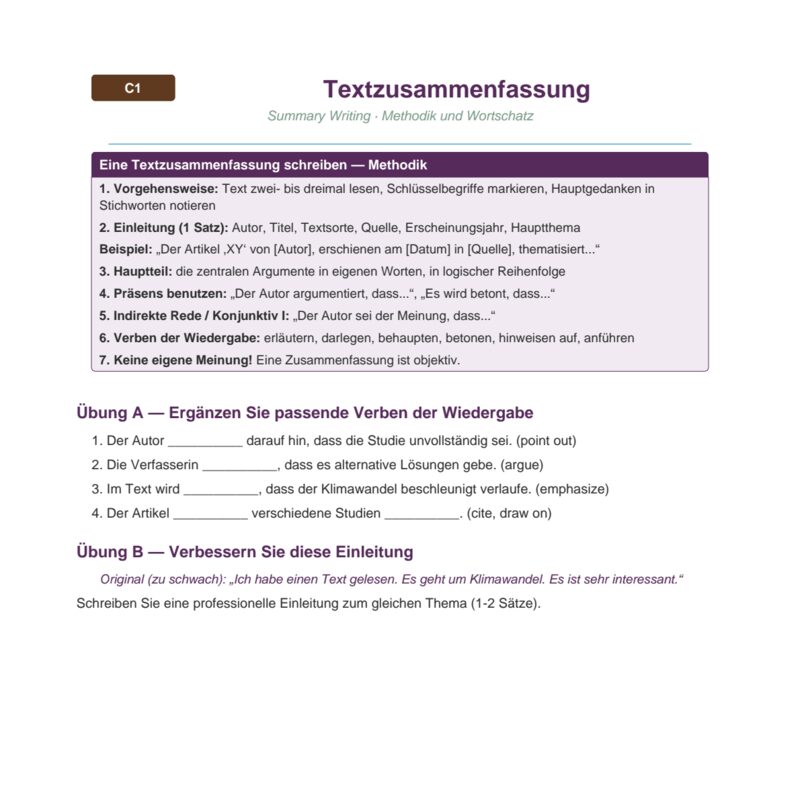
Textzusammenfassung auf C1-Niveau
Strategien und Übungen zum Zusammenfassen komplexer Sachtexte und Fachartikel.
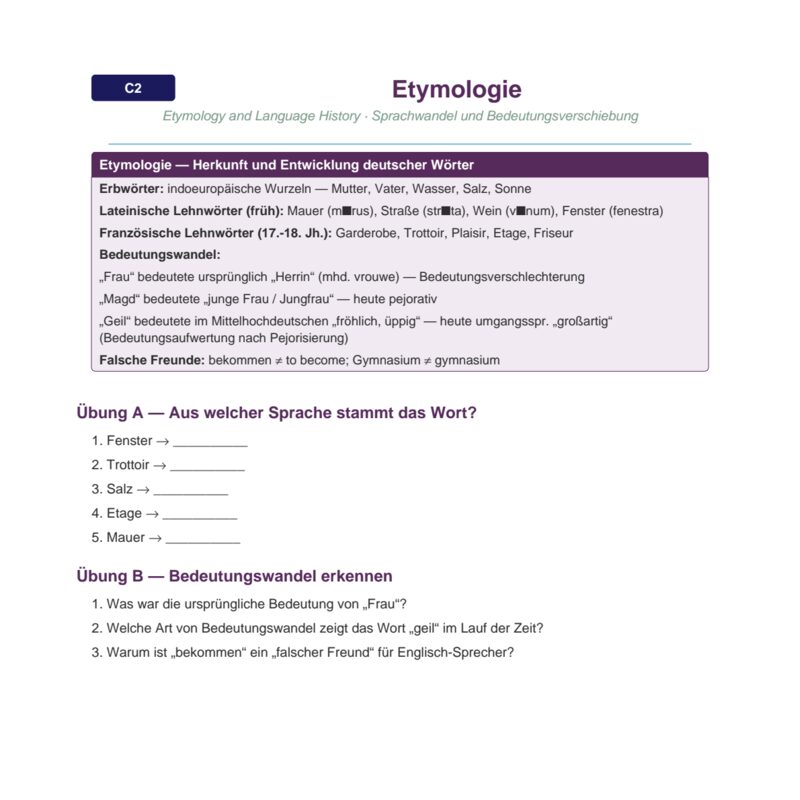
Etymologie deutscher Wörter
Wortgeschichten und etymologische Zusammenhänge im deutschen Wortschatz erforschen.
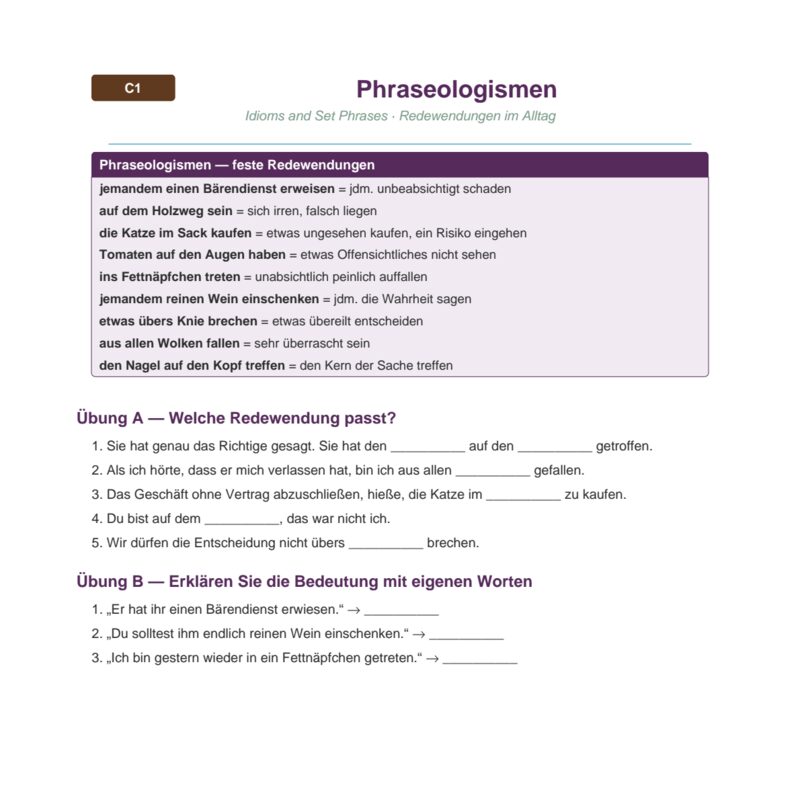
Phraseologismen und Redewendungen
Deutsche Redewendungen und feste Wendungen verstehen und kontextgerecht verwenden.
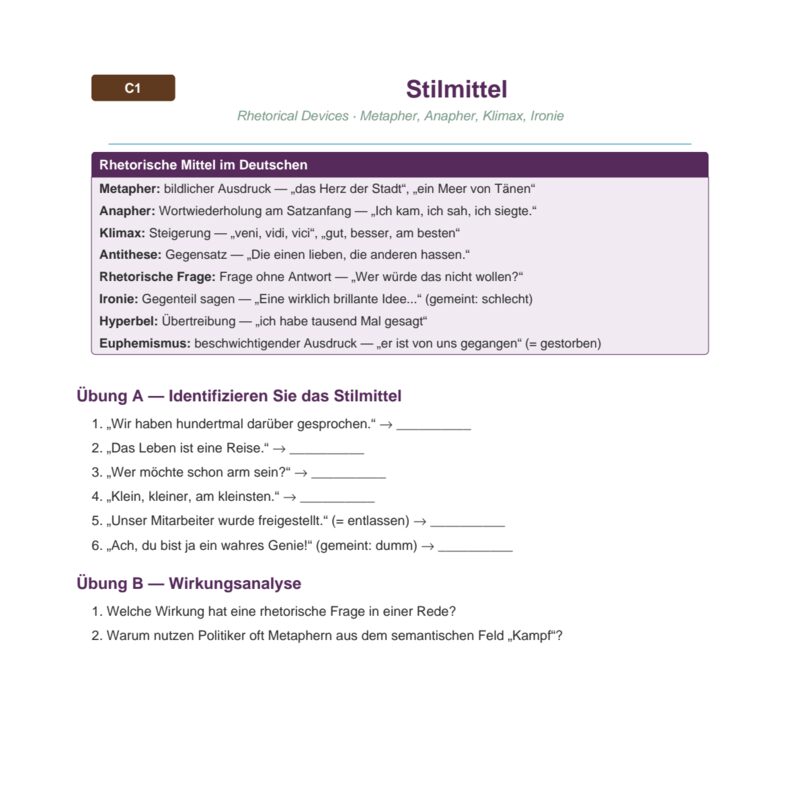
Stilmittel erkennen und anwenden
Rhetorische Stilmittel wie Metapher, Ironie und Hyperbel identifizieren und in eigenen Texten anwenden.
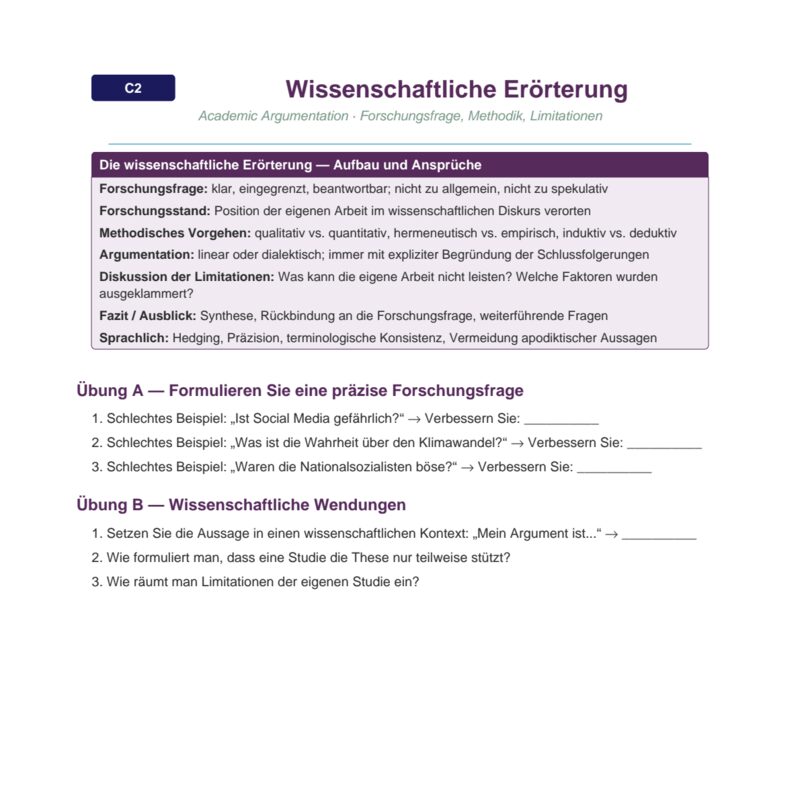
Wissenschaftliche Erörterung
Aufbau und Formulierung einer wissenschaftlichen Erörterung mit Quellenarbeit und Argumentation.
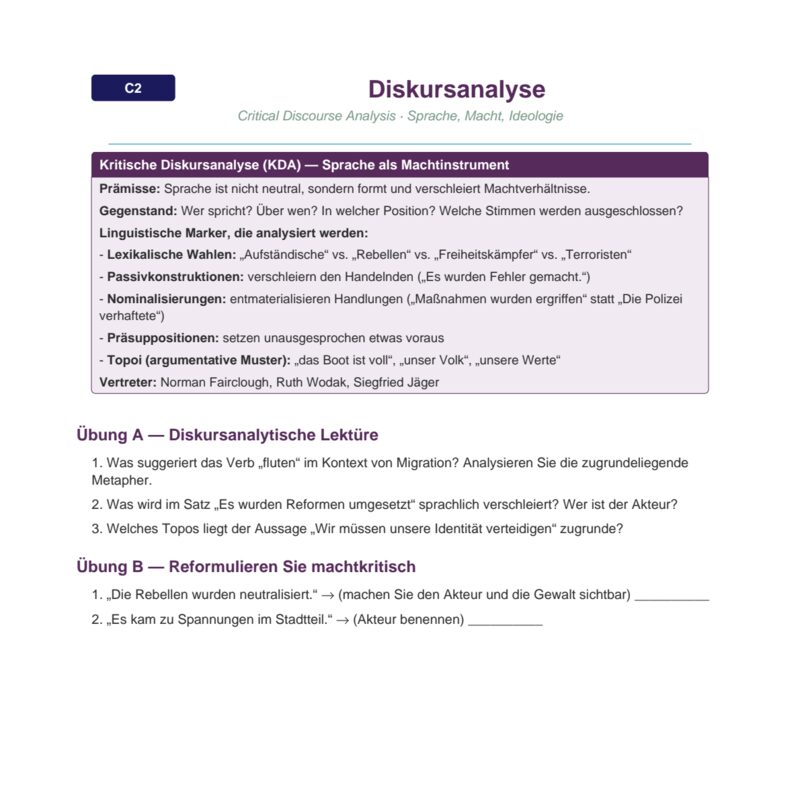
Diskursanalyse
Einführung in die linguistische Diskursanalyse: Texte im gesellschaftlichen Kontext untersuchen.
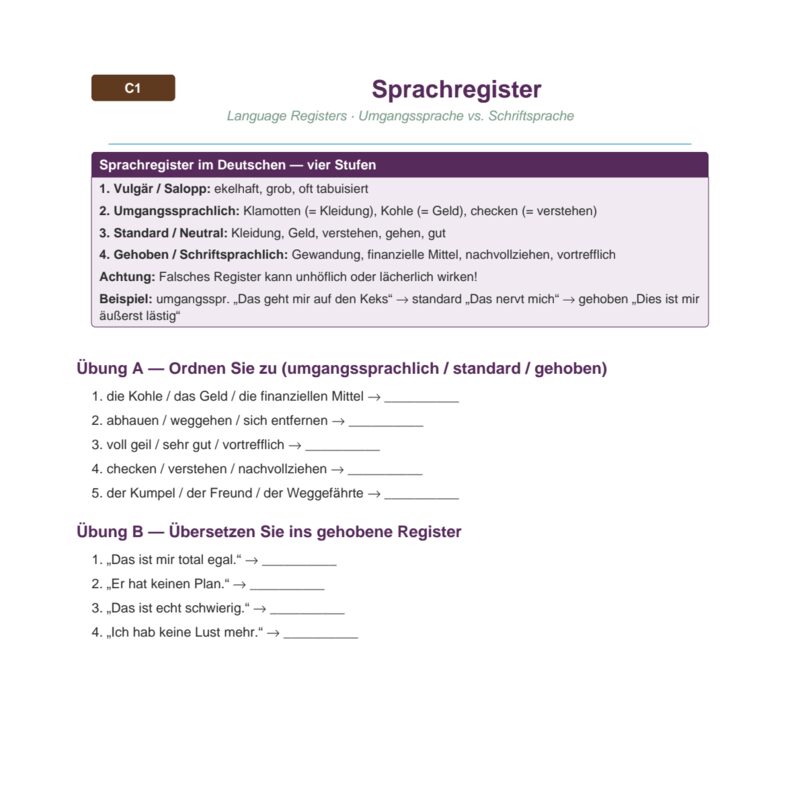
Sprachregister: Formal und Informal
Unterschiede zwischen formellen und informellen Sprachregistern erkennen und situationsgerecht wechseln.
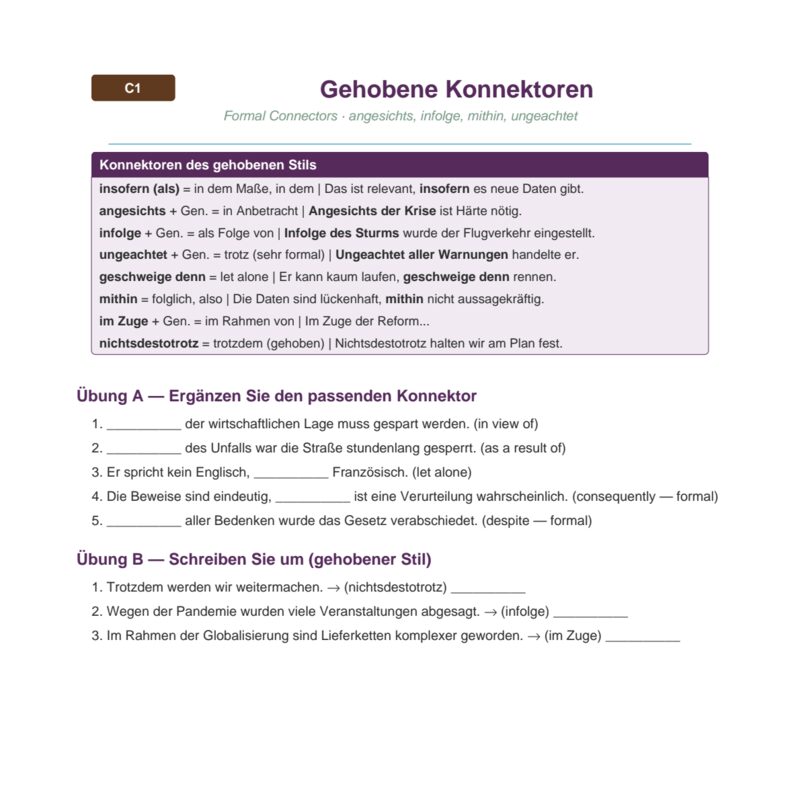
Gehobene Konnektoren
Komplexe Satzverbindungen mit gehobenen Konnektoren wie indes, zumal, wenngleich und nichtsdestotrotz.
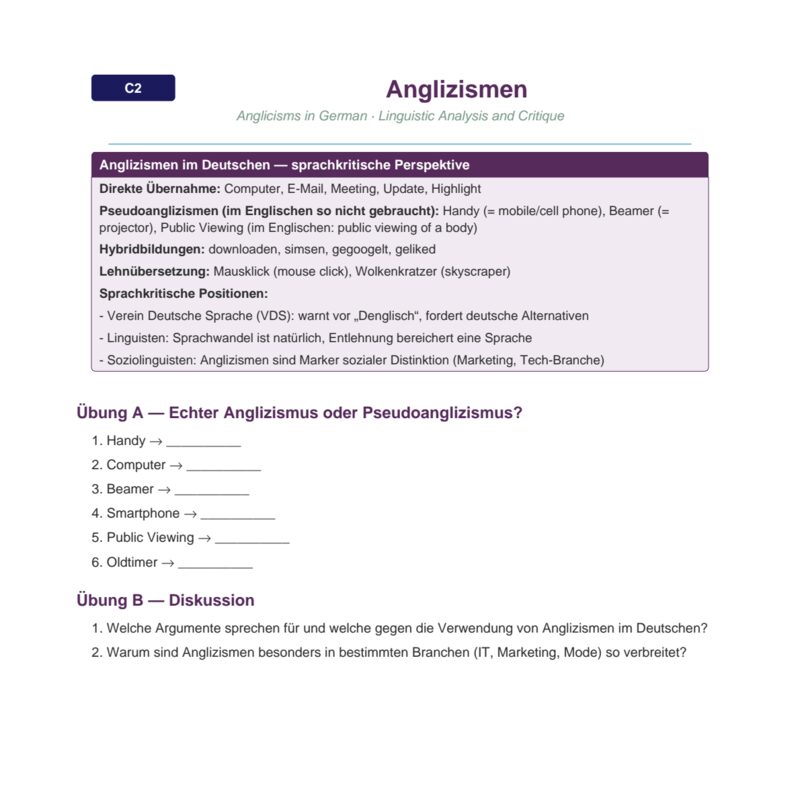
Anglizismen in der deutschen Sprache
Analyse von Anglizismen: Sprachpurismus, Integration und Sprachkontakt im modernen Deutsch.
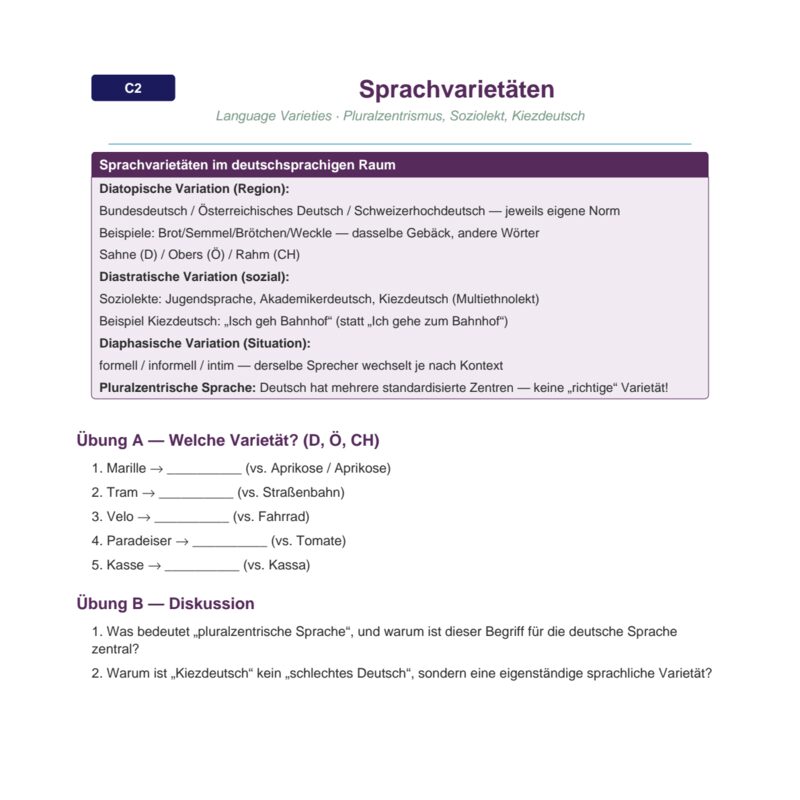
Sprachvarietäten des Deutschen
Dialekte, Soziolekte und Regiolekte: die Vielfalt der deutschen Sprache verstehen.
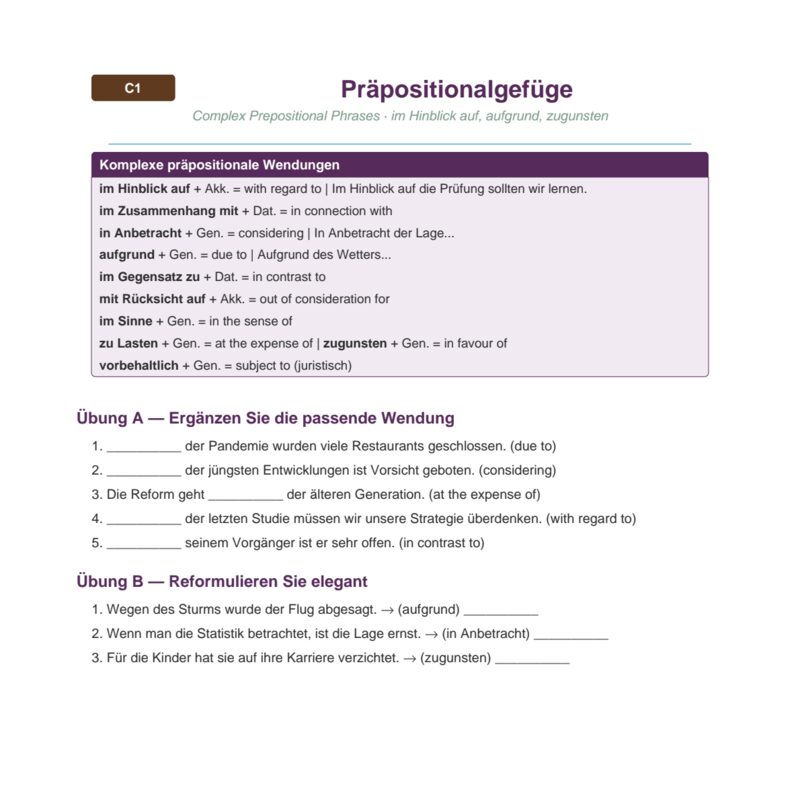
Präpositionalgefüge in der Schriftsprache
Komplexe Präpositionalausdrücke für gehobene schriftliche Kommunikation.
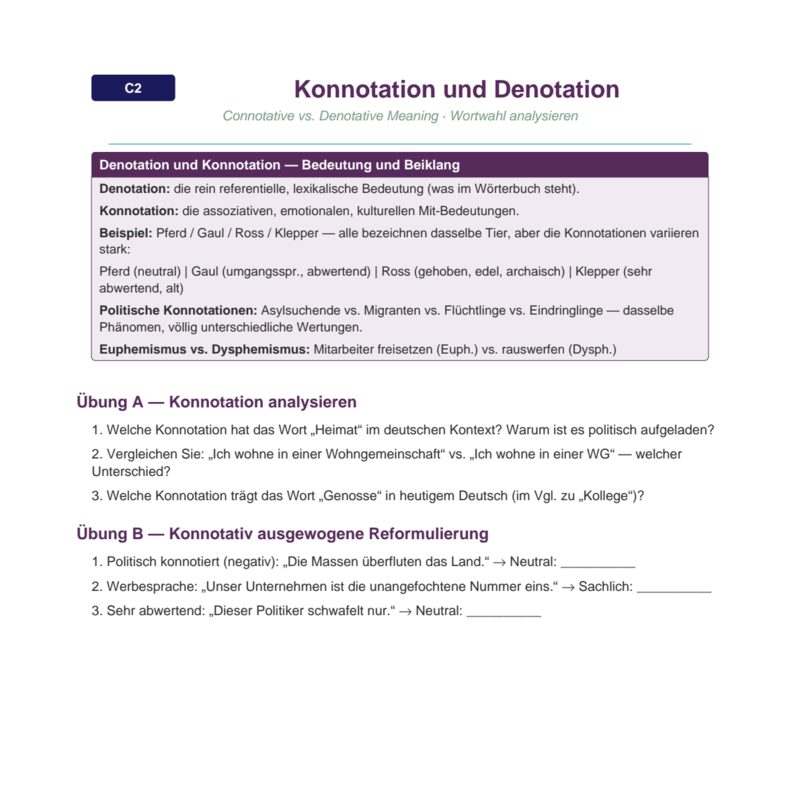
Konnotation und Denotation
Übungen zu Wortbedeutungen: denotative vs. konnotative Bedeutungsebenen in der deutschen Sprache.
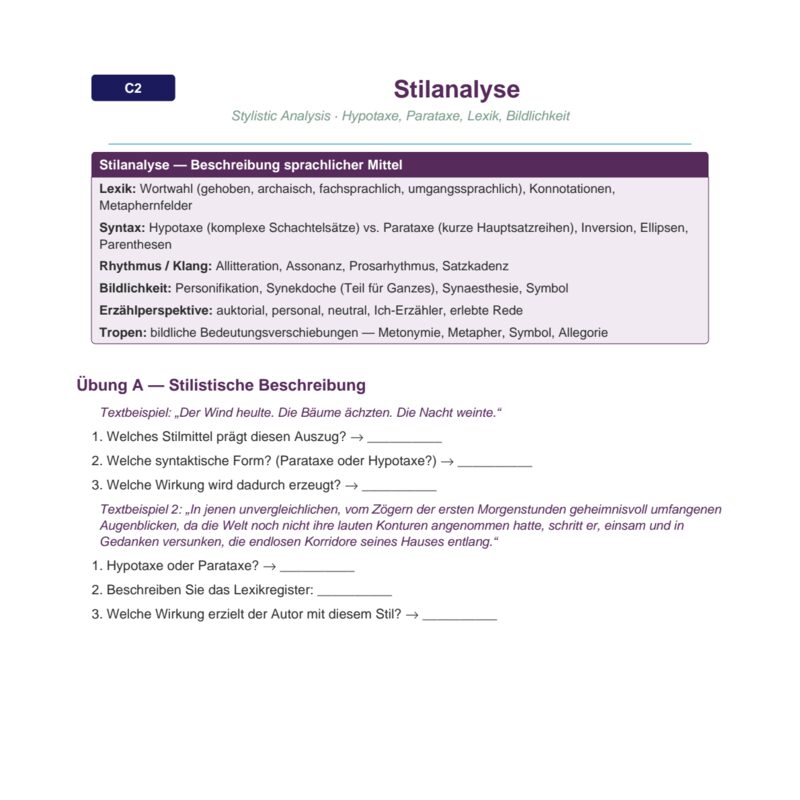
Stilanalyse literarischer Texte
Methoden der Stilanalyse anhand literarischer und journalistischer Texte auf höchstem Niveau.
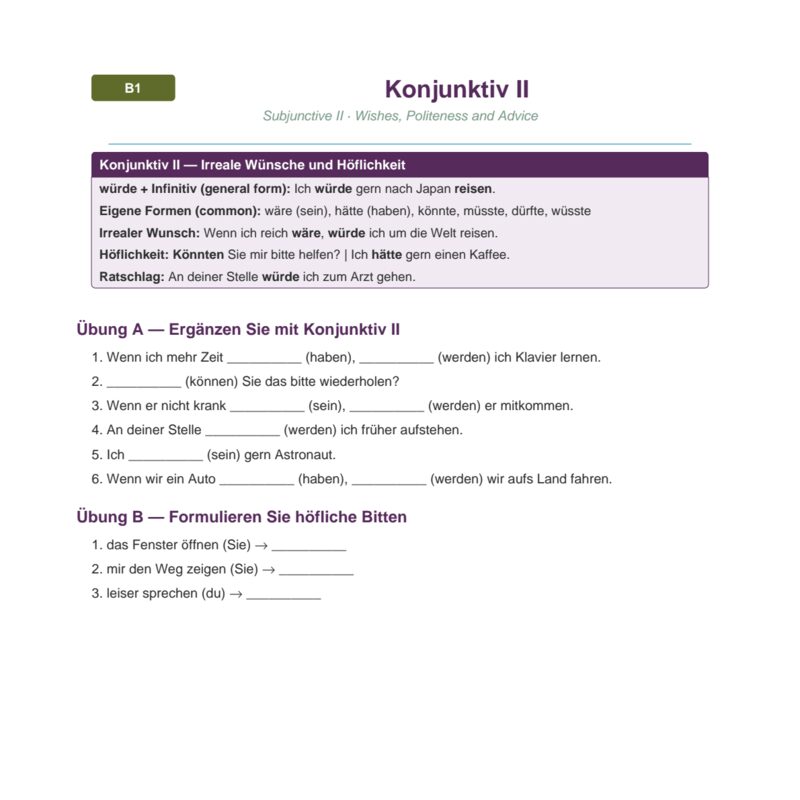
Konjunktiv II – Irreale Wünsche und Höflichkeit
Practice the Subjunctive II for wishes, polite requests, and advice using würde + Infinitiv and special forms.
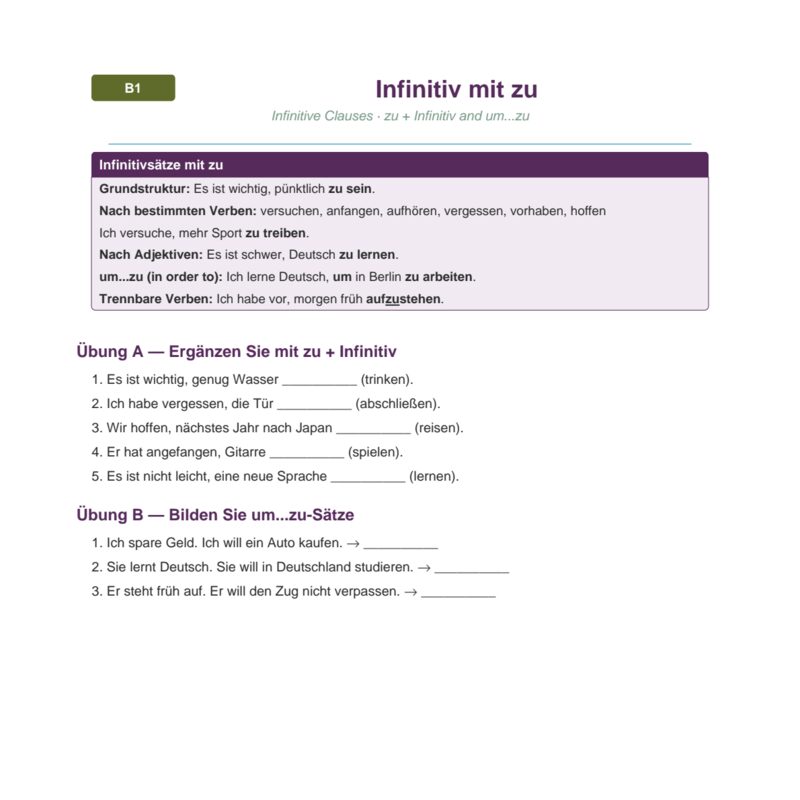
Infinitiv mit zu – Infinitive with zu
Practice infinitive constructions with zu, um...zu, ohne...zu, and anstatt...zu.
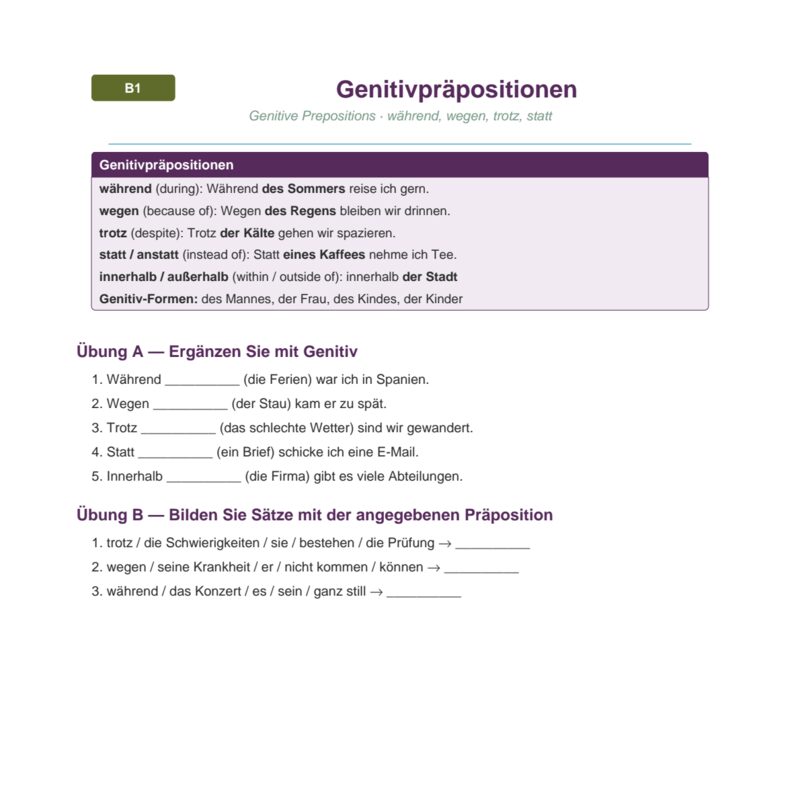
Genitivpräpositionen – Genitive Prepositions
Exercises on prepositions that take the genitive case: wegen, trotz, während, innerhalb, etc.
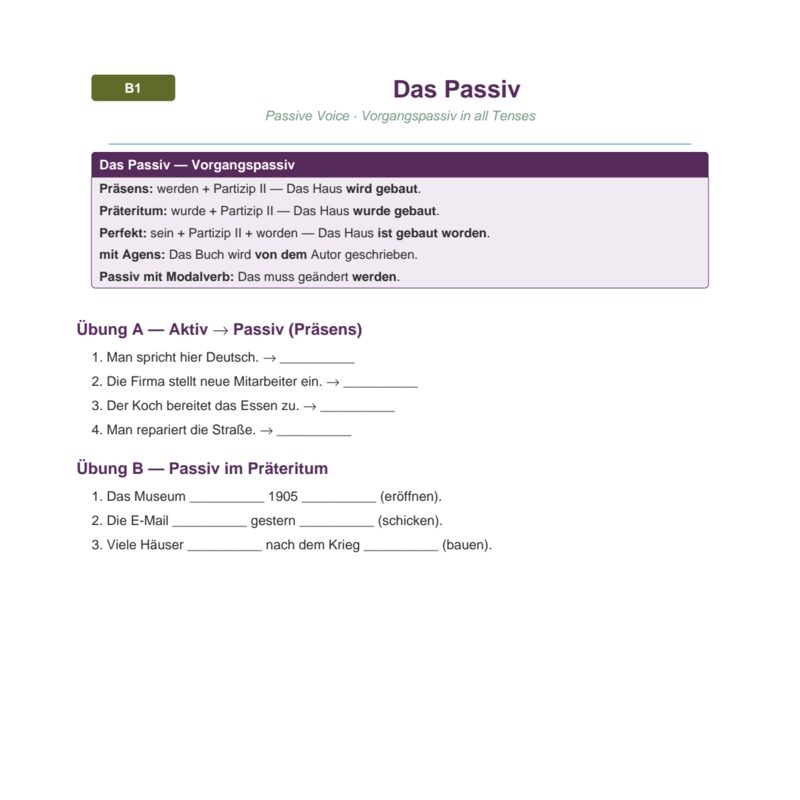
Passiv – Passive Voice
Learn and practise the German passive voice (Vorgangspassiv) with werden + Partizip II.
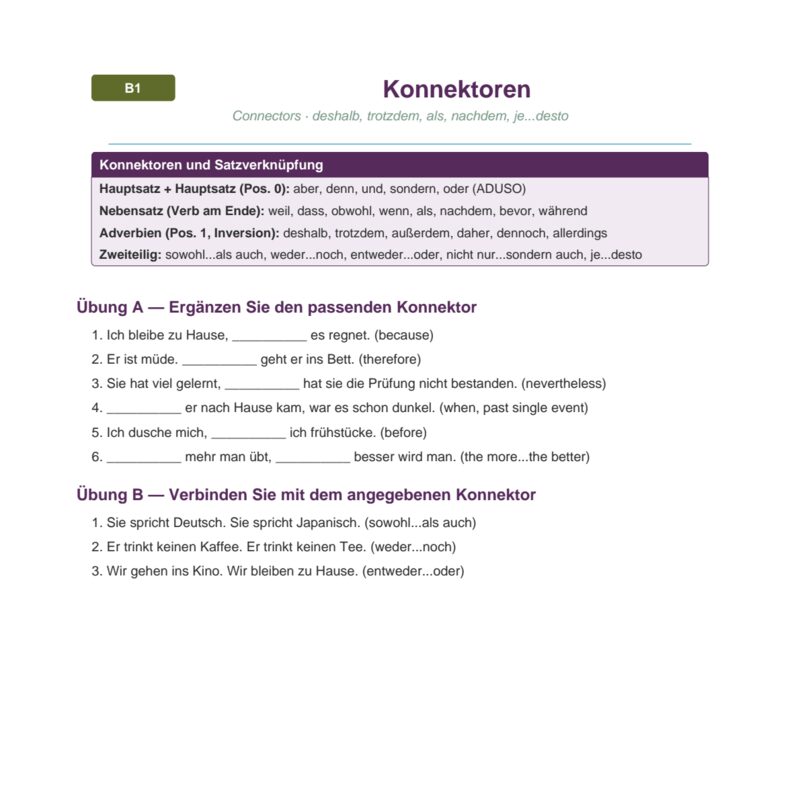
Konnektoren – Connectors
Exercises on two-part and subordinating connectors (obwohl, damit, sodass, etc.).
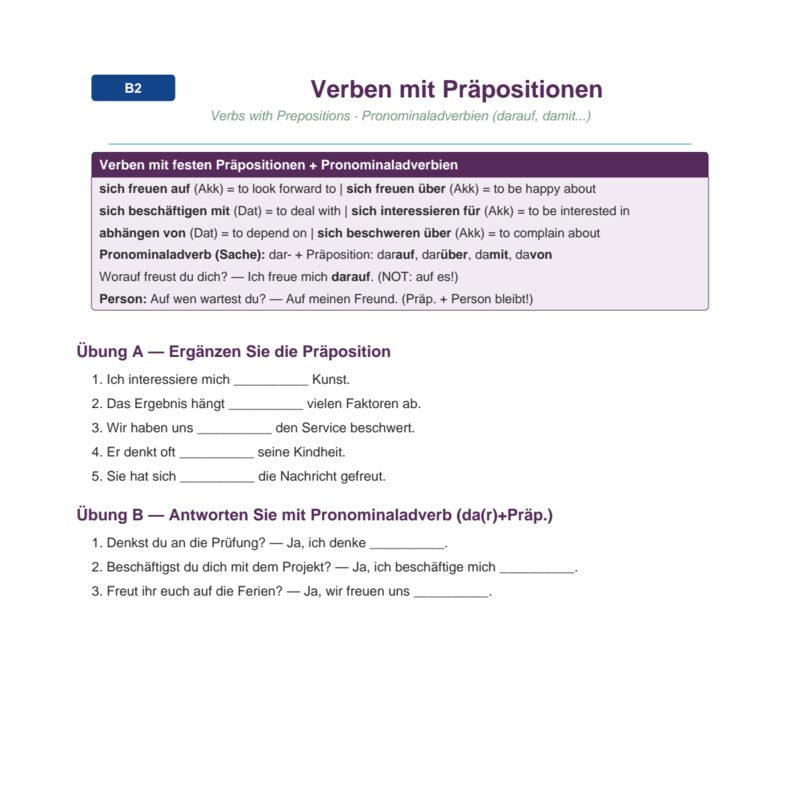
Verben mit Präpositionen – Verbs with Prepositions
Practice verbs with fixed prepositions and their corresponding pronominal adverbs (darauf, woran, etc.).
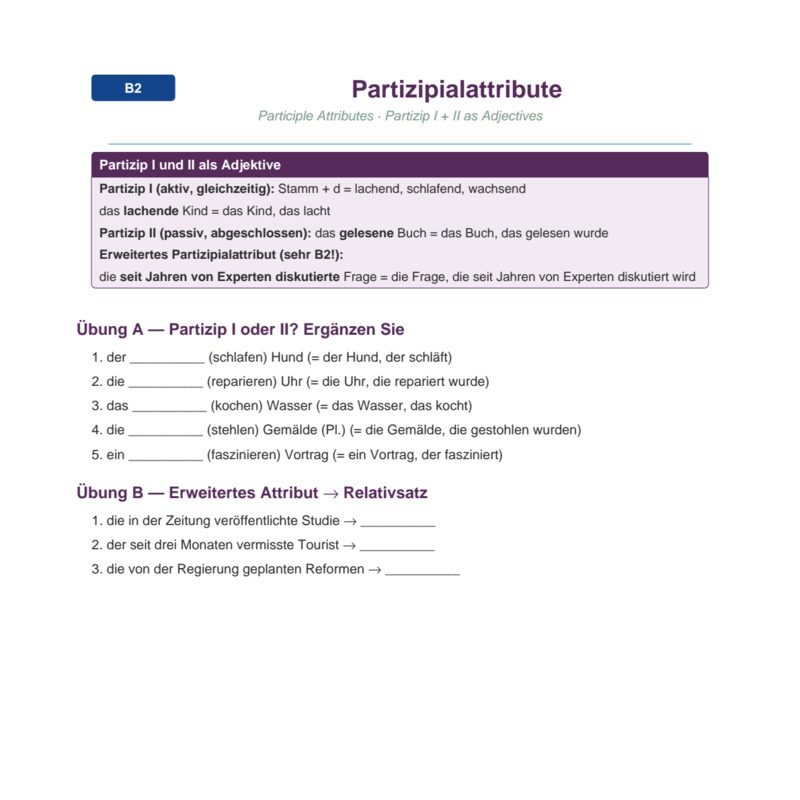
Partizipialattribute – Participial Attributes
Exercises on extended participial attributes (erweiterte Partizipialattribute) in German.
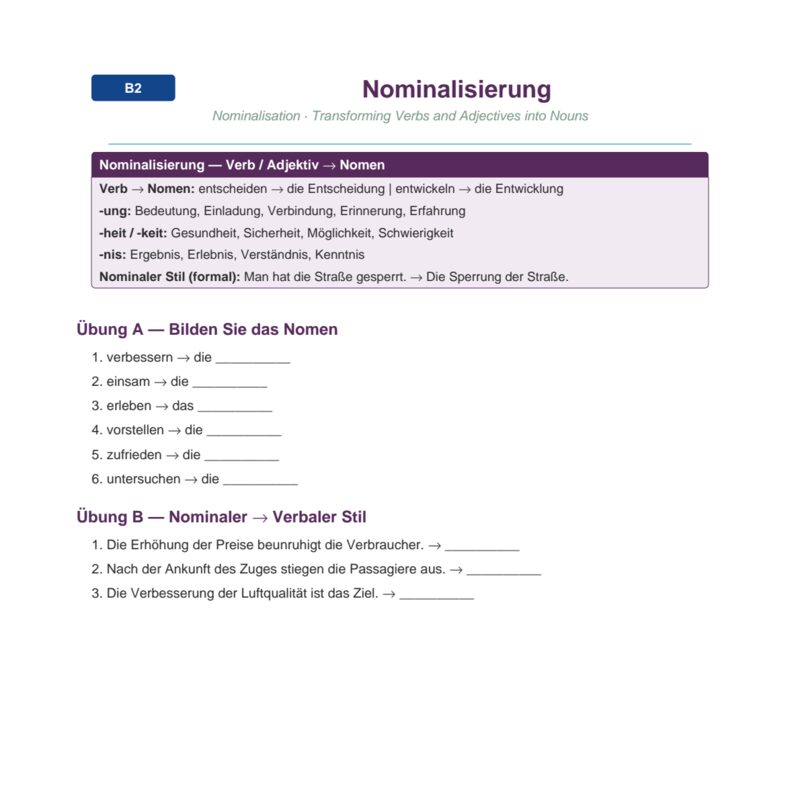
Nominalisierung – Nominalisation
Practice converting verbal expressions into nominal style commonly used in formal German.
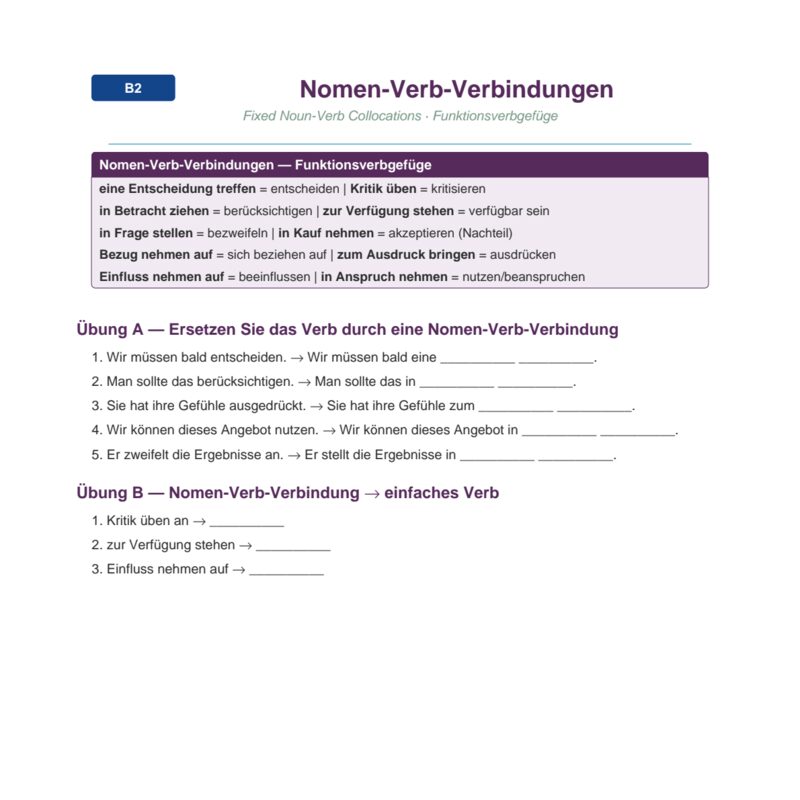
Nomen-Verb-Verbindungen – Noun-Verb Collocations
Practice common fixed noun-verb combinations used in formal and written German.
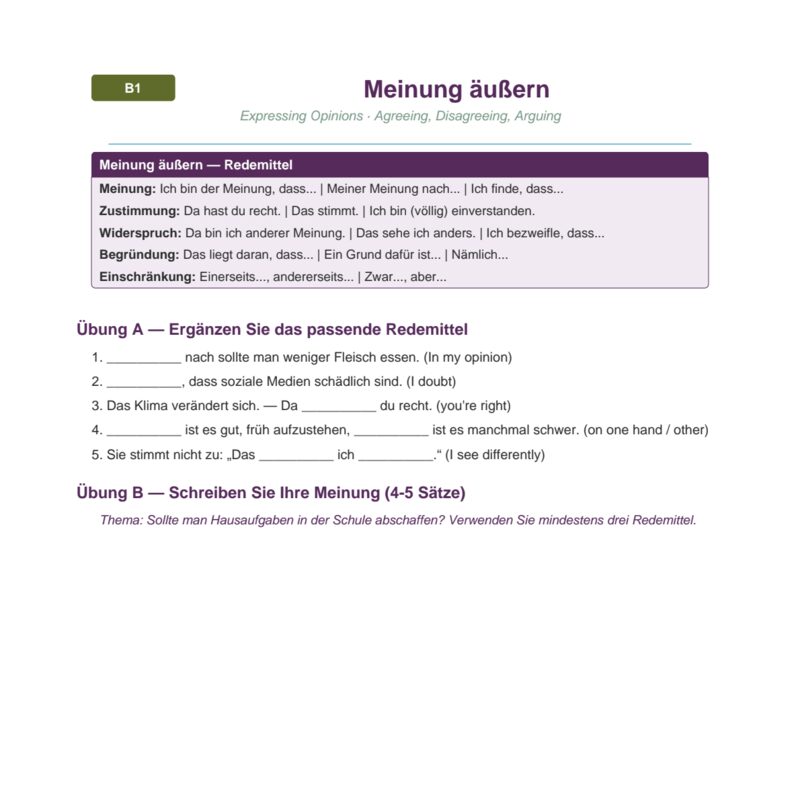
Meinung äußern – Expressing Opinions
Practice phrases and structures for expressing, supporting, and contrasting opinions in German.
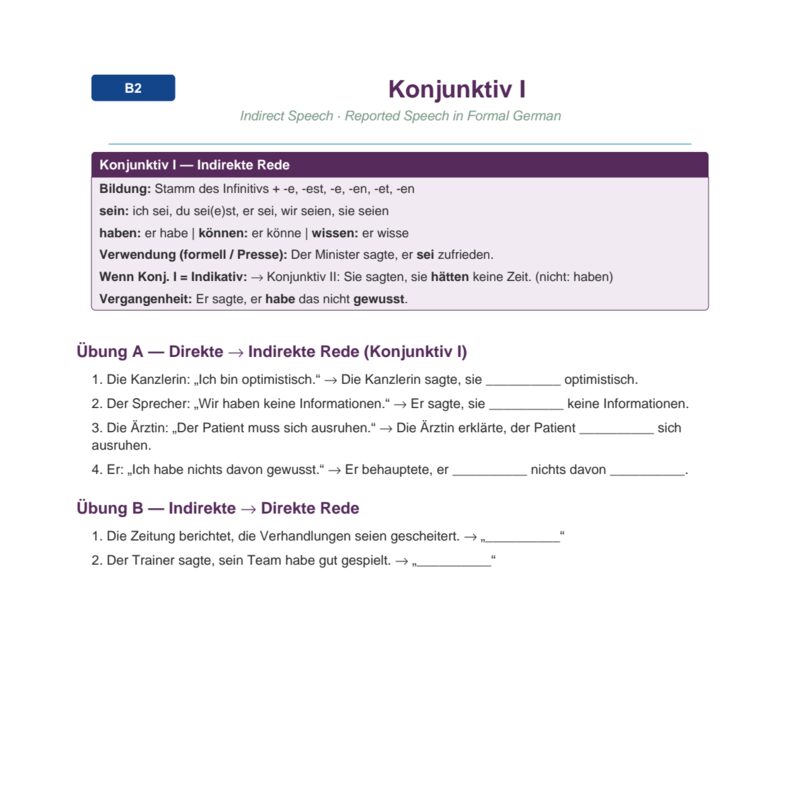
Konjunktiv I – Reported Speech
Exercises on indirect speech using Konjunktiv I in journalistic and formal contexts.
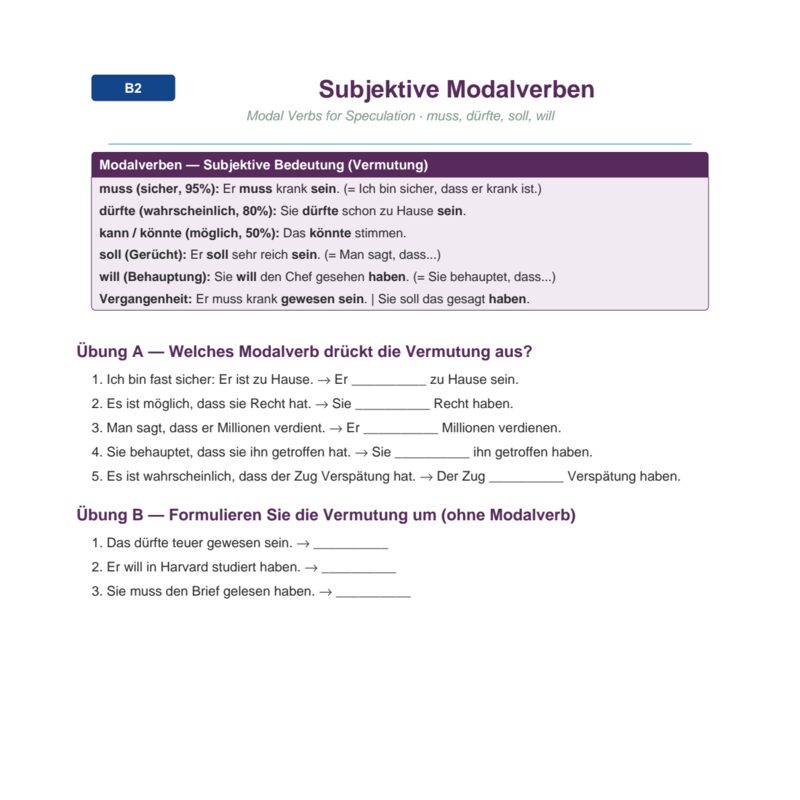
Subjektive Modalverben – Subjective Modal Verbs
Exercises on using modal verbs to express probability, rumour, and speaker attitude.
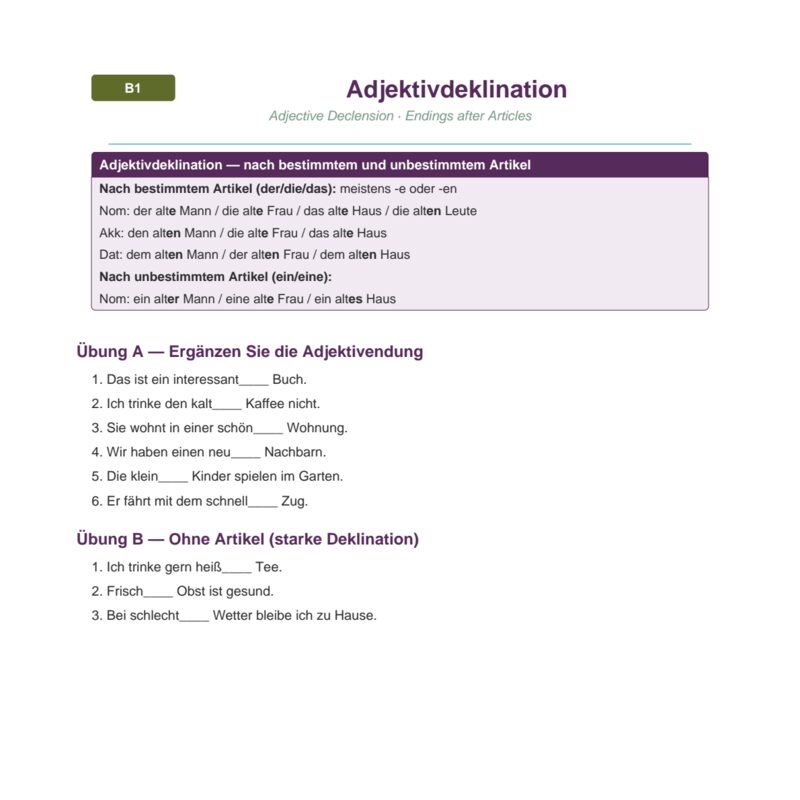
Adjektivdeklination – Adjective Declension
Comprehensive practice on adjective endings with definite, indefinite, and zero articles.
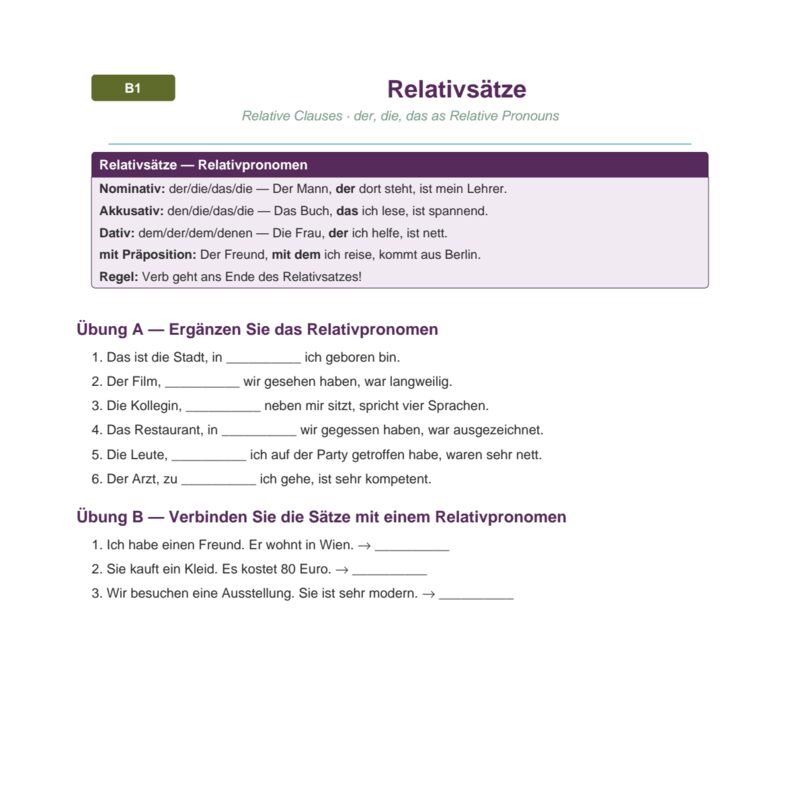
Relativsätze – Relative Clauses
Exercises on forming and using relative clauses with correct relative pronouns in German.
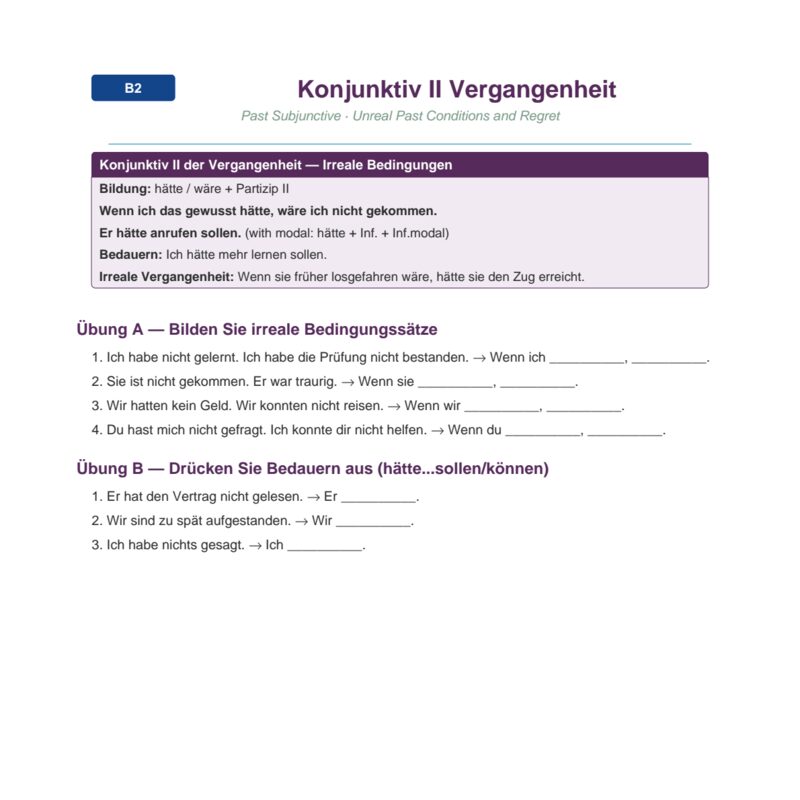
Konjunktiv II Vergangenheit – Past Subjunctive
Practice unreal past conditions and expressing regret with hätte/wäre + Partizip II.
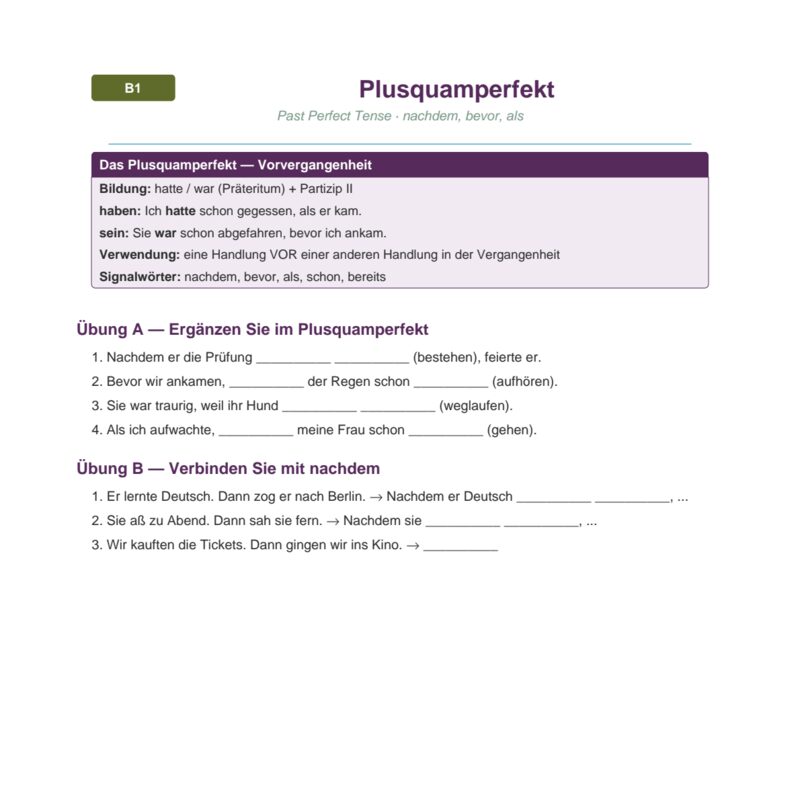
Plusquamperfekt – Past Perfect
Exercises on forming and using the Plusquamperfekt with hatte/war + Partizip II.
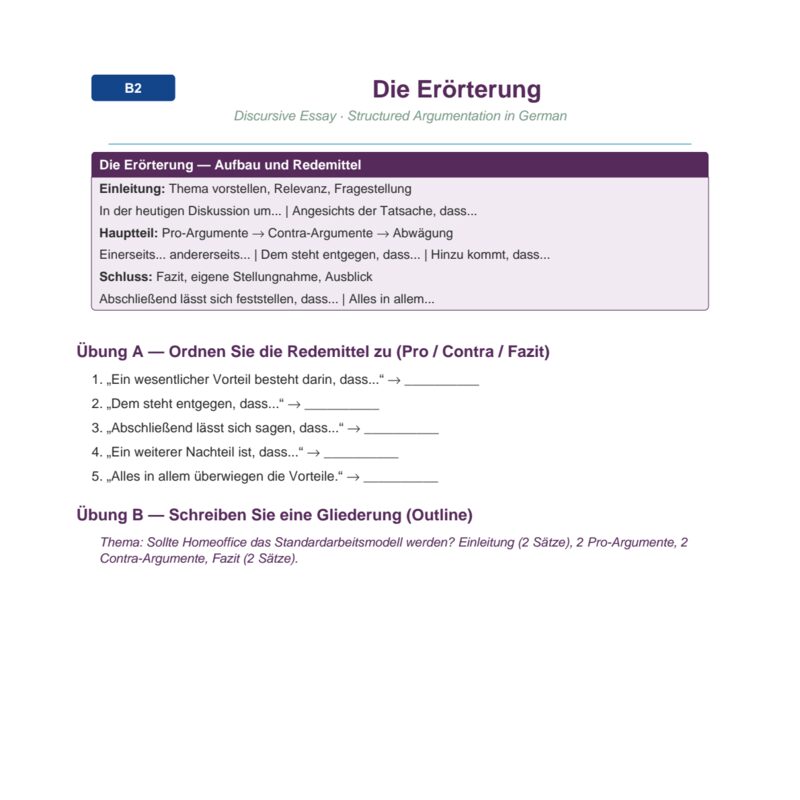
Erörterung – Argumentative Writing
Structured exercises for writing a balanced argumentative essay (Erörterung) in German.
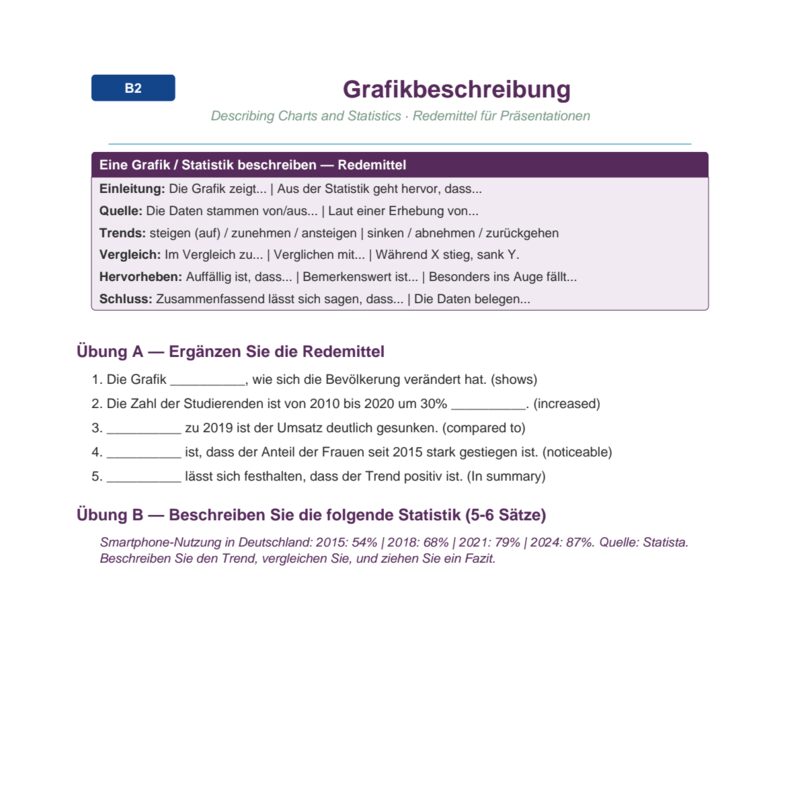
Grafikbeschreibung – Describing Charts and Graphs
Phrases and exercises for describing statistical data, trends, and charts in German.
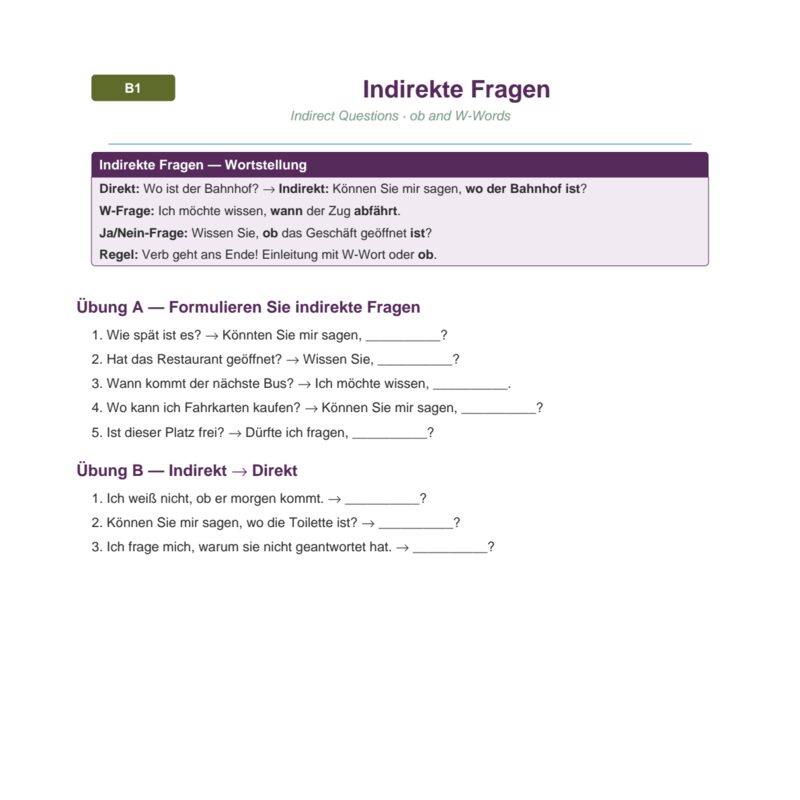
Indirekte Fragen – Indirect Questions
Practice transforming direct questions into indirect questions using ob and W-Fragewörter.
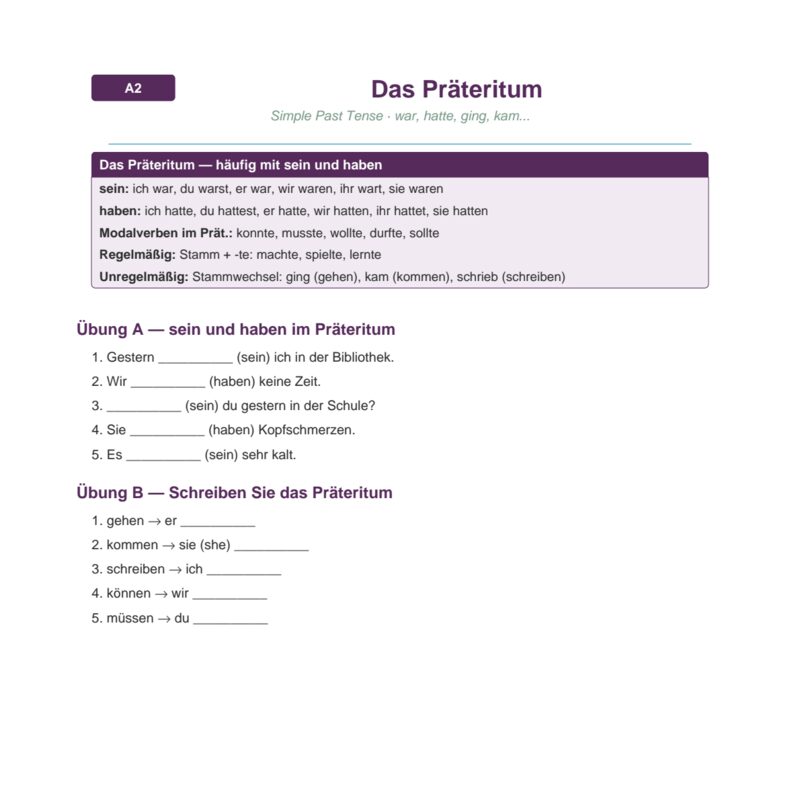
Präteritum – Simple Past Tense
Learn the German simple past tense (Präteritum) for narration and formal writing.
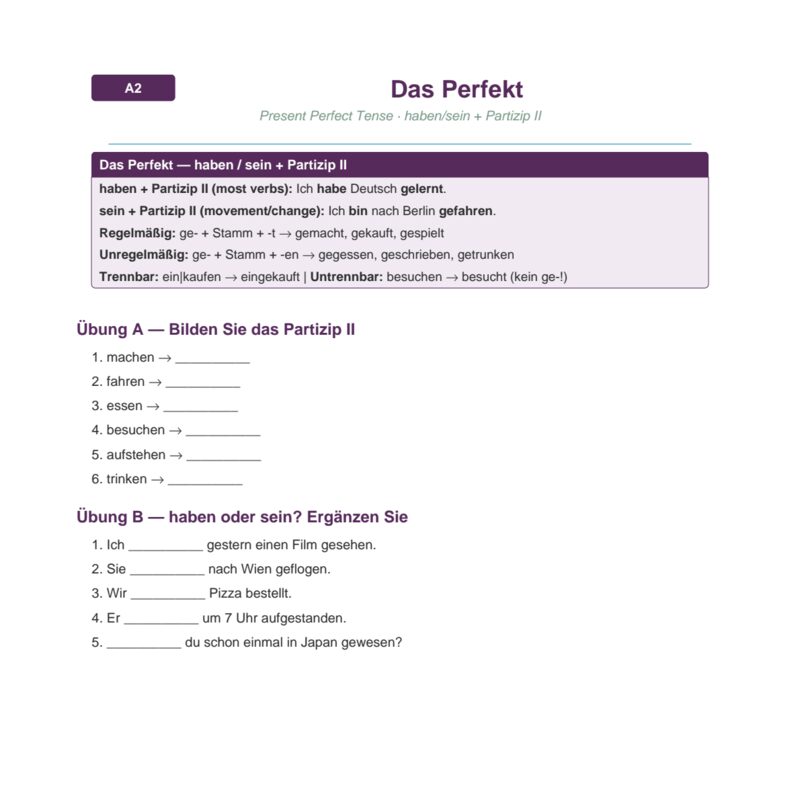
Perfekt – The Perfect Tense
Learn how to form and use the German perfect tense (Perfekt) with haben and sein.
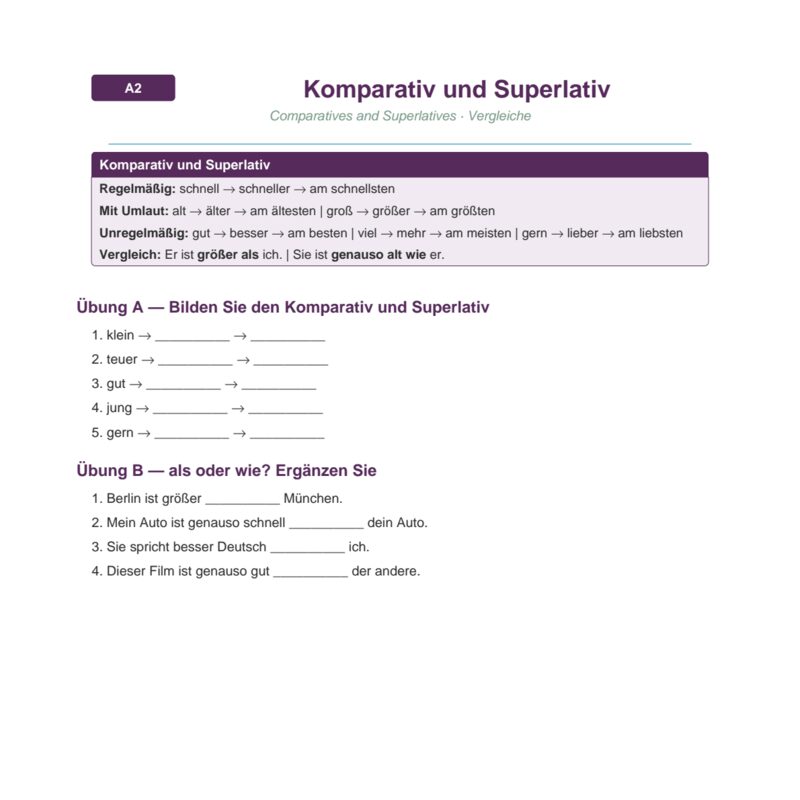
Komparativ und Superlativ – Comparatives and Superlatives
Compare things in German using comparative and superlative adjective forms.
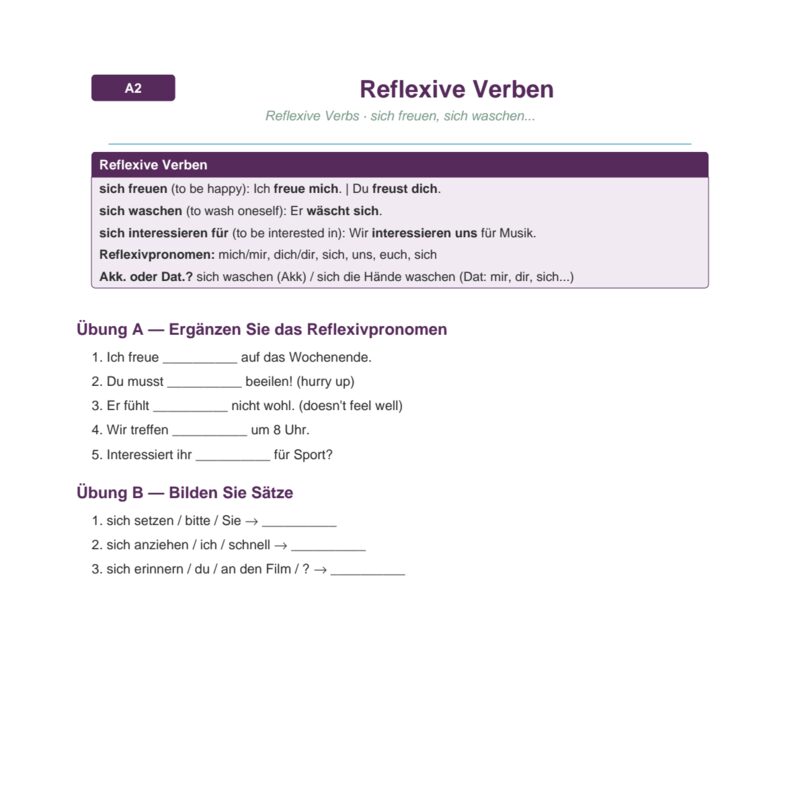
Reflexive Verben – Reflexive Verbs
Understand and practise German reflexive verbs and their pronouns.
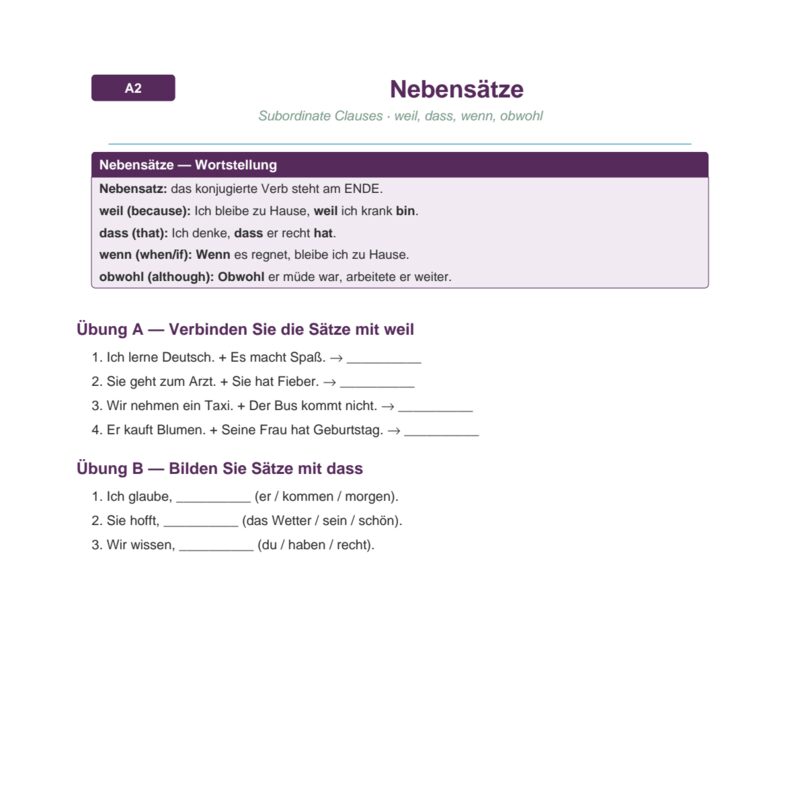
Nebensätze – Subordinate Clauses
Learn how to build subordinate clauses in German with weil, dass, wenn, and more.
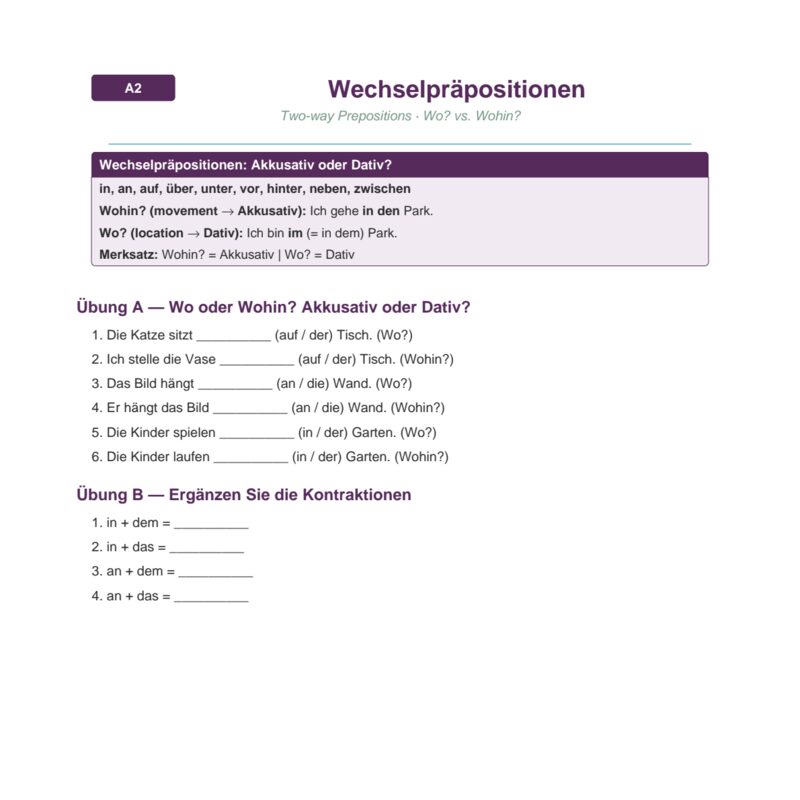
Wechselpräpositionen – Two-Way Prepositions
Master German two-way prepositions that take either accusative or dative case.
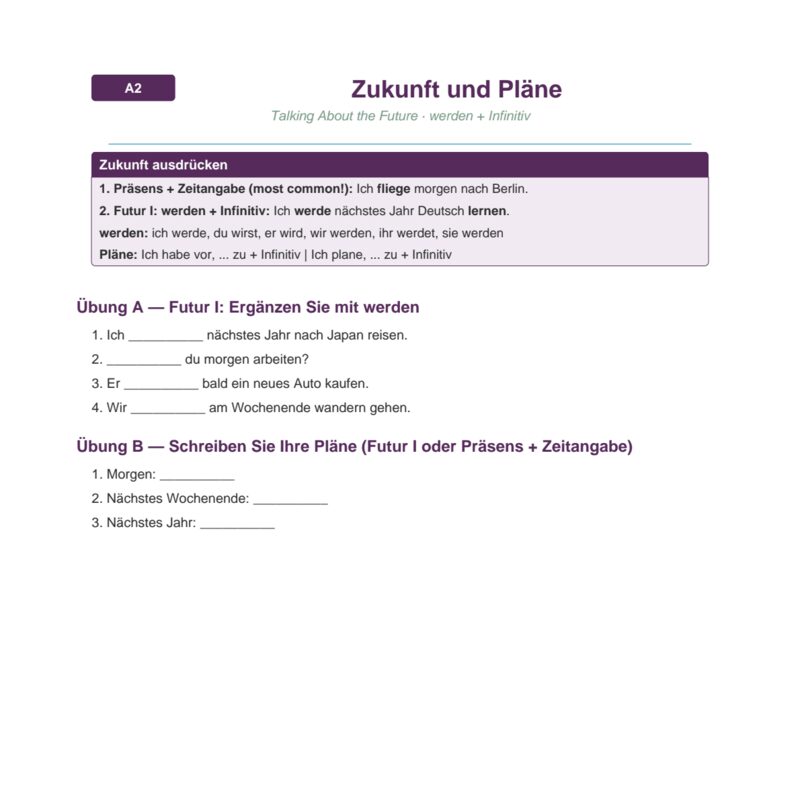
Zukunft und Pläne – Future and Plans
Express future intentions and make plans using werden and present tense in German.
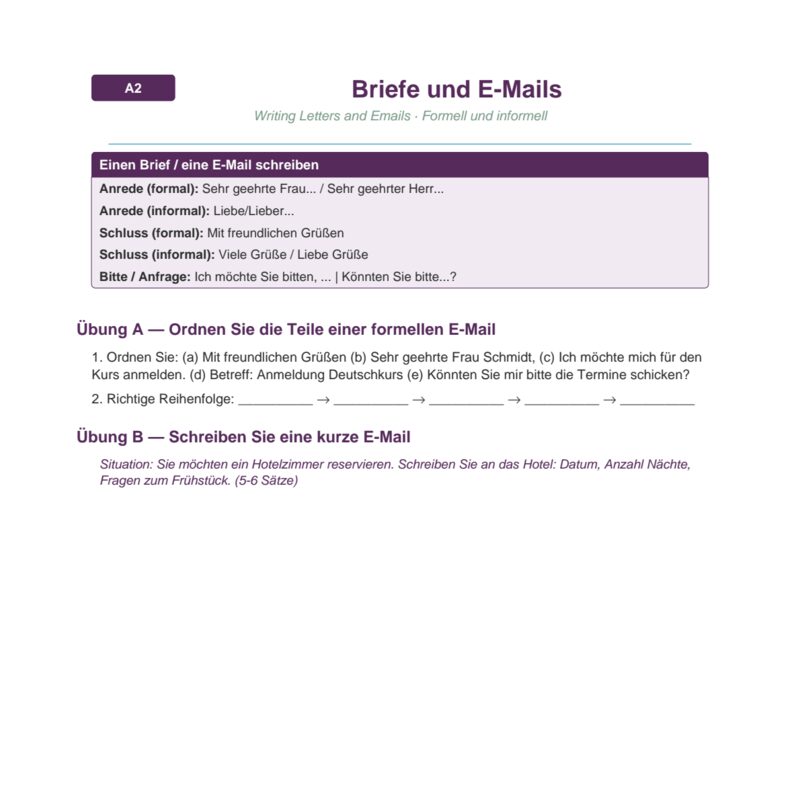
Briefe und E-Mails – Letters and Emails
Learn how to write formal and informal letters and emails in German.
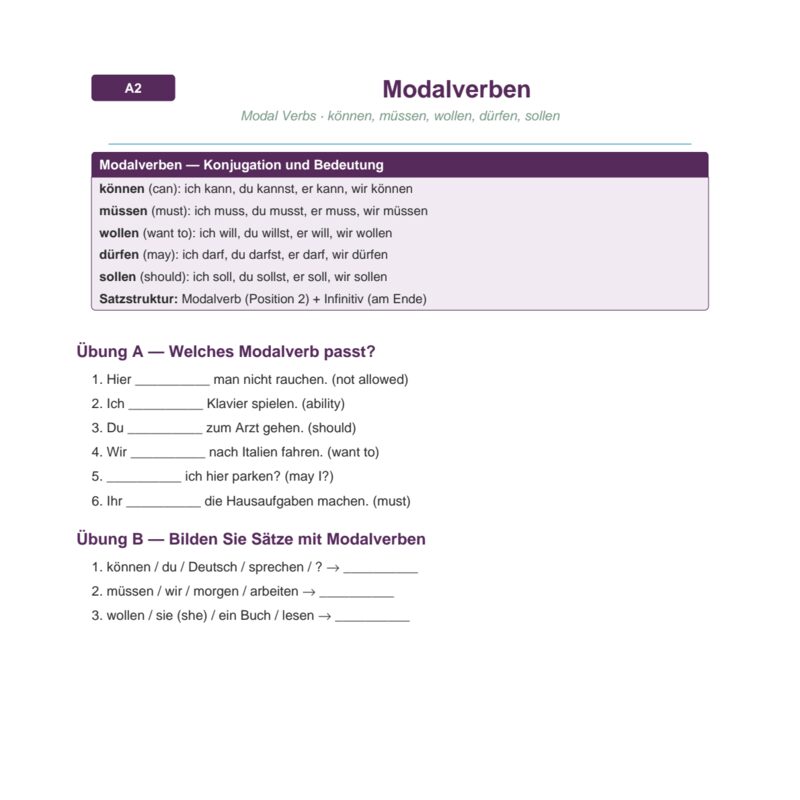
Modalverben – Modal Verbs
Master German modal verbs: können, müssen, wollen, sollen, dürfen, and mögen.
Get more German resources
Sign up free to download, favorite and share materials — or upload your own.
Sign up free