German Learning Resources
Everything in the Parlora Library tagged German. Browse by category or format, or open the full library to filter further.
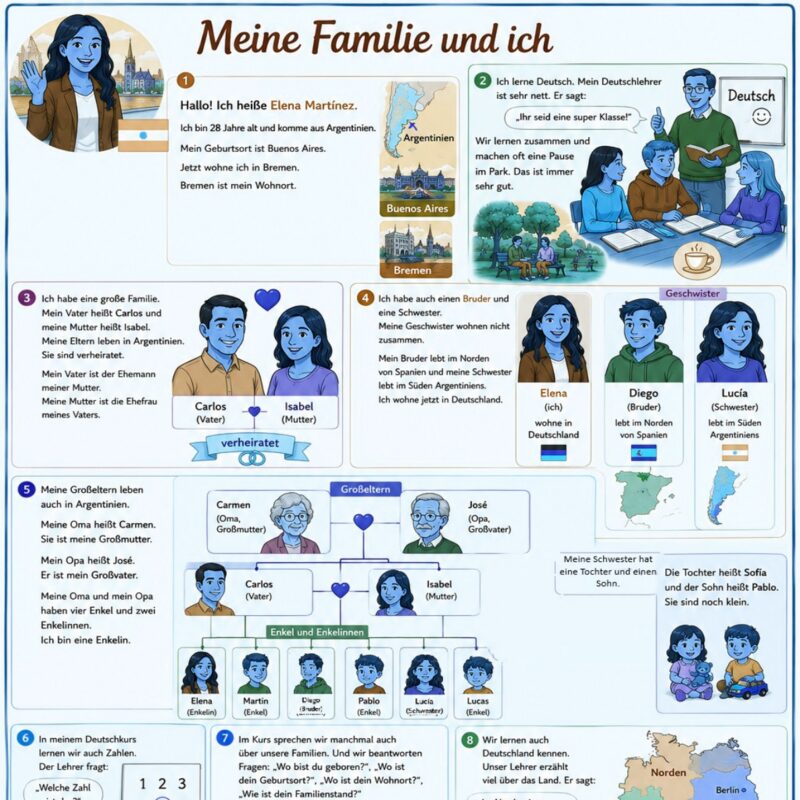
Family, Possessive Pronouns and Verbs in the Present Tense
This document introduces basic German vocabulary related to family and personal information, along with explanations and exercises for possessive pronouns and present tense verbs (haben/sein).
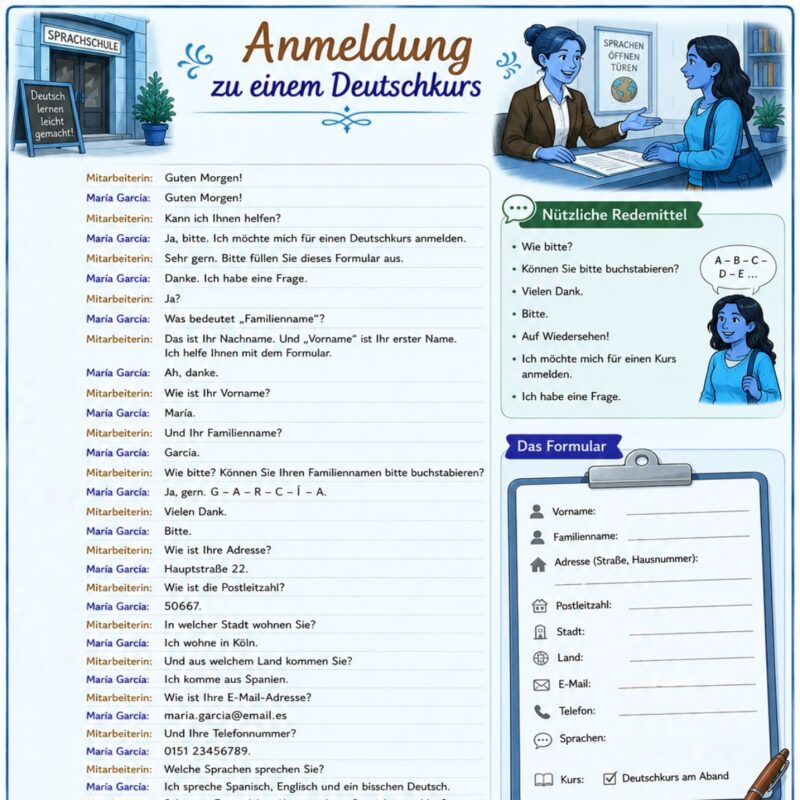
German Class Registration Conversation
This document provides a sample conversation in German for registering for a German language course, including common phrases and vocabulary related to personal information and course enrollment. It is suitable for A1 level learners.
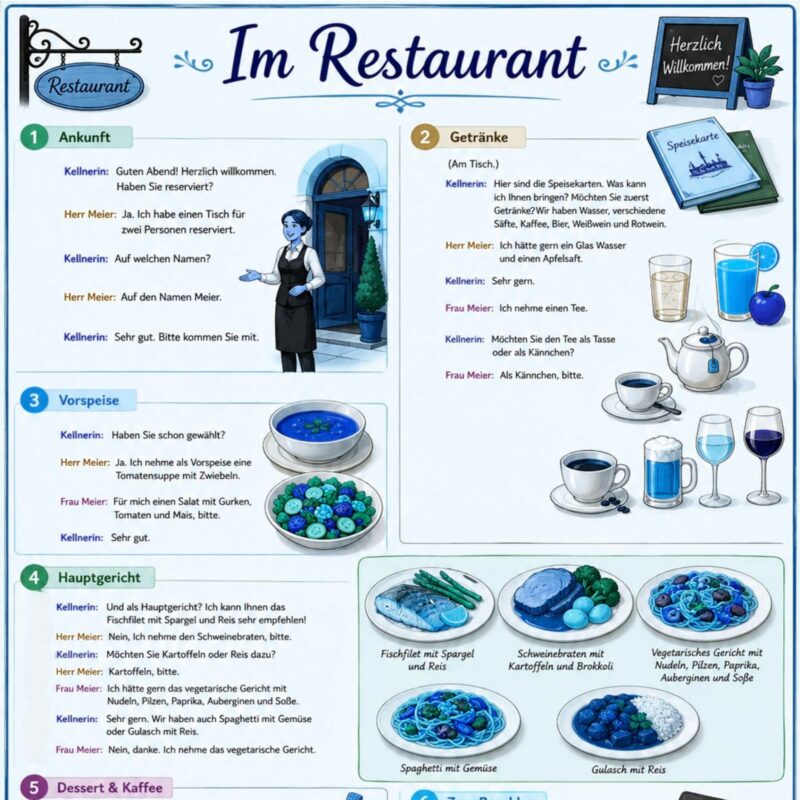
Im Restaurant: German Conversation and Comprehension
This document provides a German dialogue illustrating a restaurant interaction, accompanied by comprehension questions and a creative writing task to practice restaurant-related vocabulary and phrases.
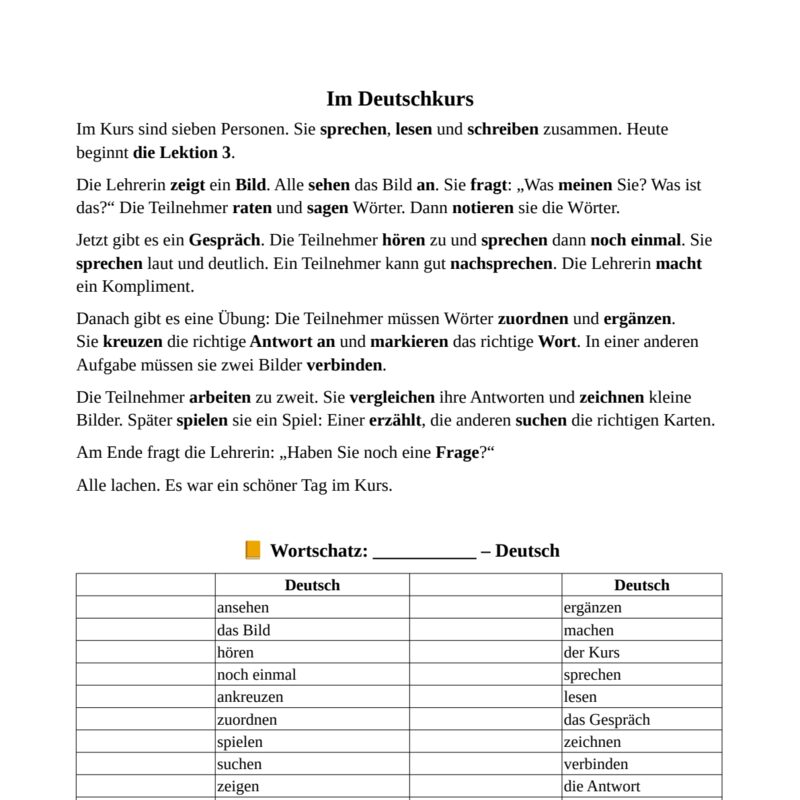
German Classroom Vocabulary, Verbs and Question Words Practice
This document provides an introduction to common German classroom activities and vocabulary, followed by exercises focusing on conjugating verbs in the present tense and using interrogative pronouns.
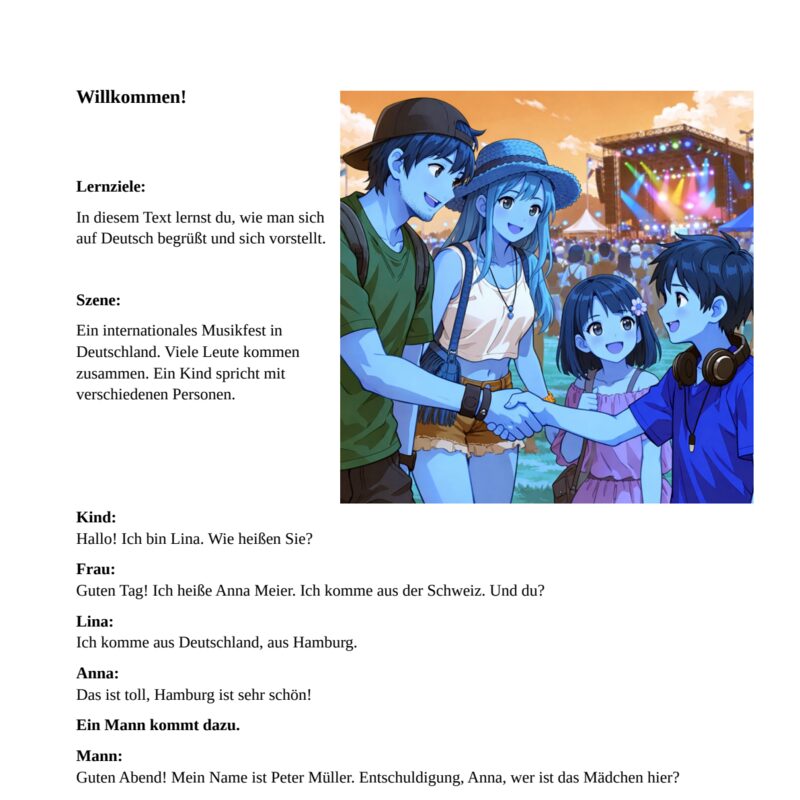
Greeting and Introducing Oneself
This document teaches how to greet people and introduce oneself in German through an example conversation at an international music festival. It covers basic introductions and asking about origins and languages.
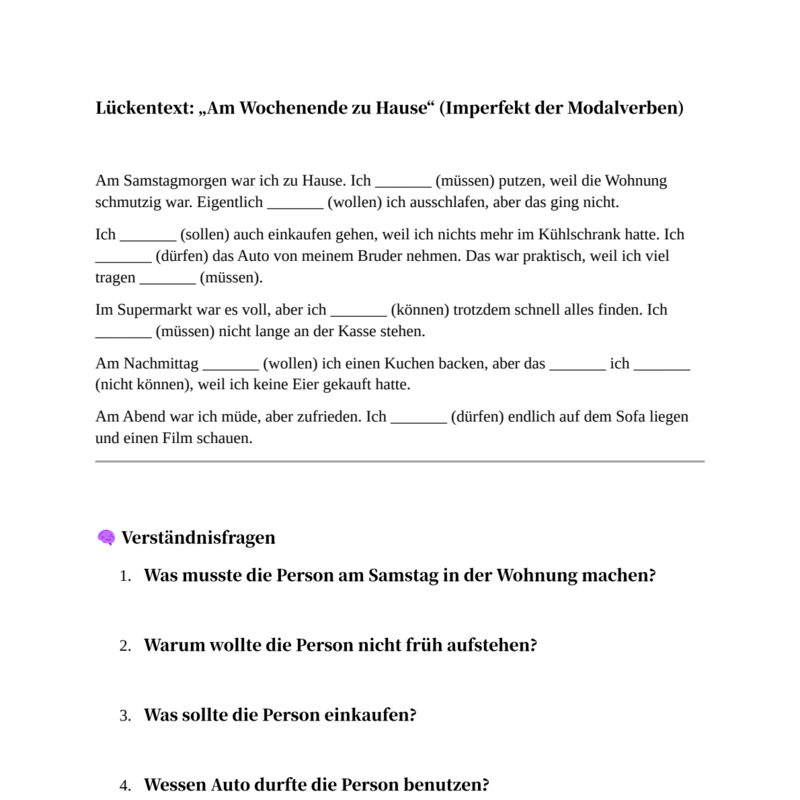
Am Wochenende zu Hause: Imperfekt der Modalverben Lückentext
This document presents a fill-in-the-blanks exercise focusing on the imperfect tense of modal verbs in German, followed by comprehension questions.
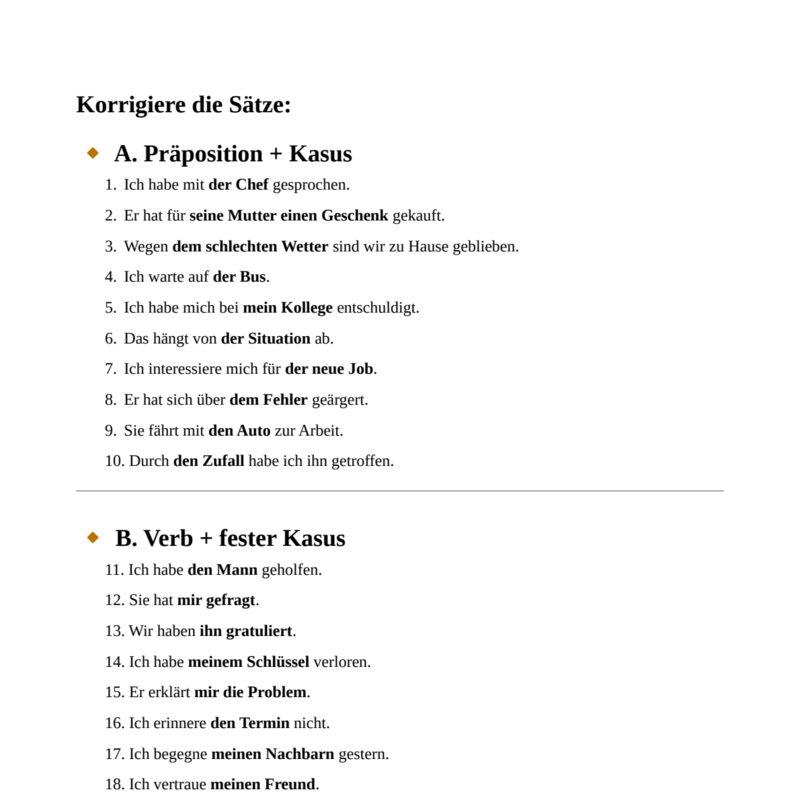
German Case Correction Exercises
This document provides a series of German sentences for correction, focusing on common errors related to prepositions and cases, verb-case dependencies, article usage, and dative/accusative confusion.
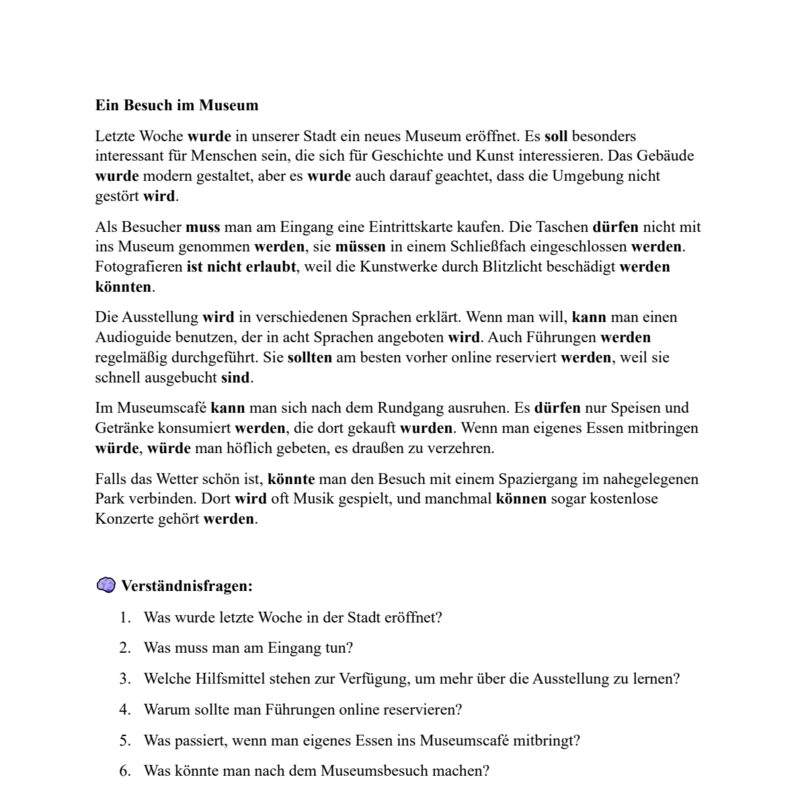
A Museum Visit: Modal Verbs and Passive Voice
This document focuses on German modal verbs and the passive voice, using a narrative about a museum visit. It includes comprehension questions, fill-in-the-blank exercises, and sentence transformation tasks.
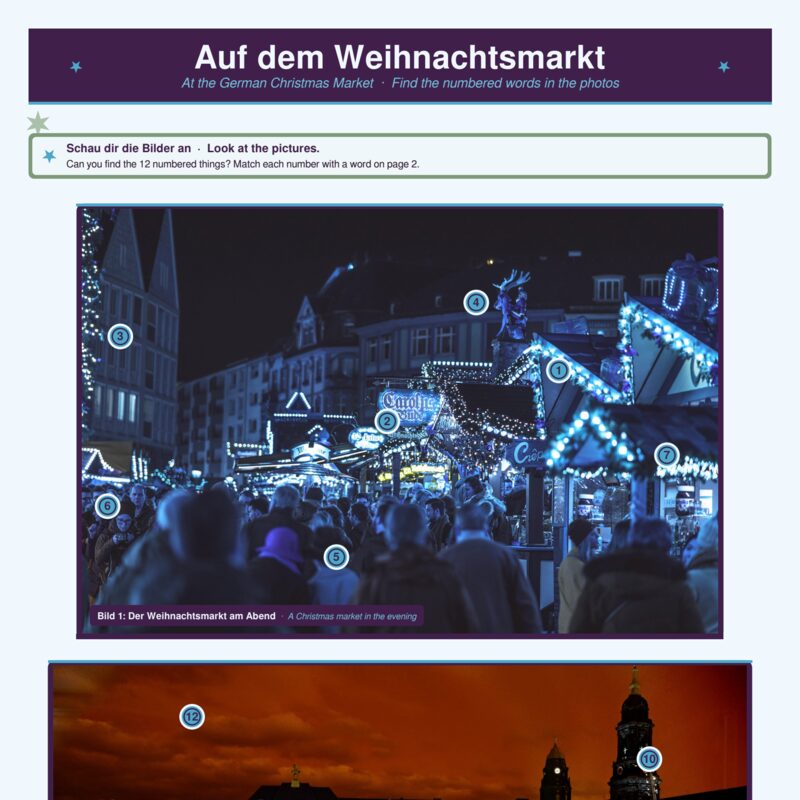
Auf dem Weihnachtsmarkt (At the German Christmas Market)
This document helps beginners learn German vocabulary related to Christmas markets by matching numbered items in photos with words and then provides discussion questions about Christmas traditions.
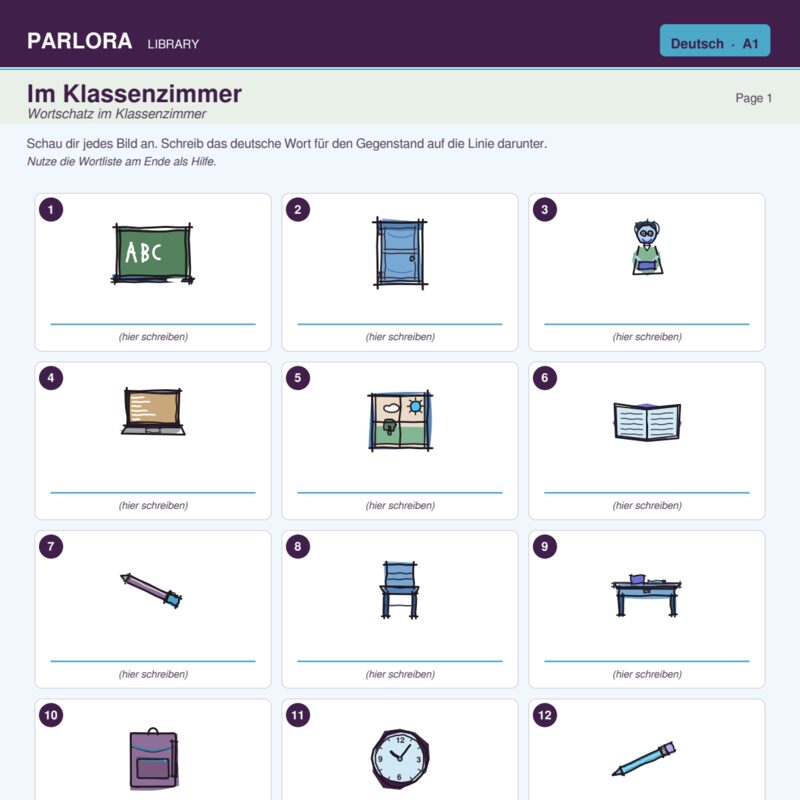
Im Klassenzimmer: Wortschatz im Klassenzimmer
This document helps A1 German learners identify and write German vocabulary words for common classroom objects by matching them with pictures. It includes a word list for assistance and extra exercises for practice.
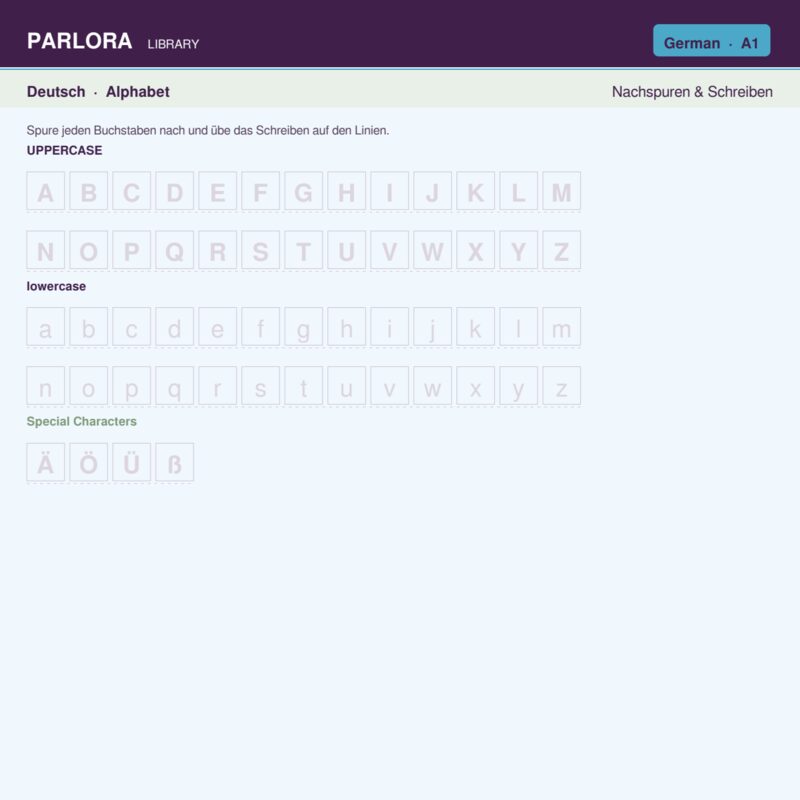
German Alphabet Practice
This document provides practice for writing and recognizing the German alphabet, including uppercase, lowercase, and special characters, along with a letter-to-word matching exercise.
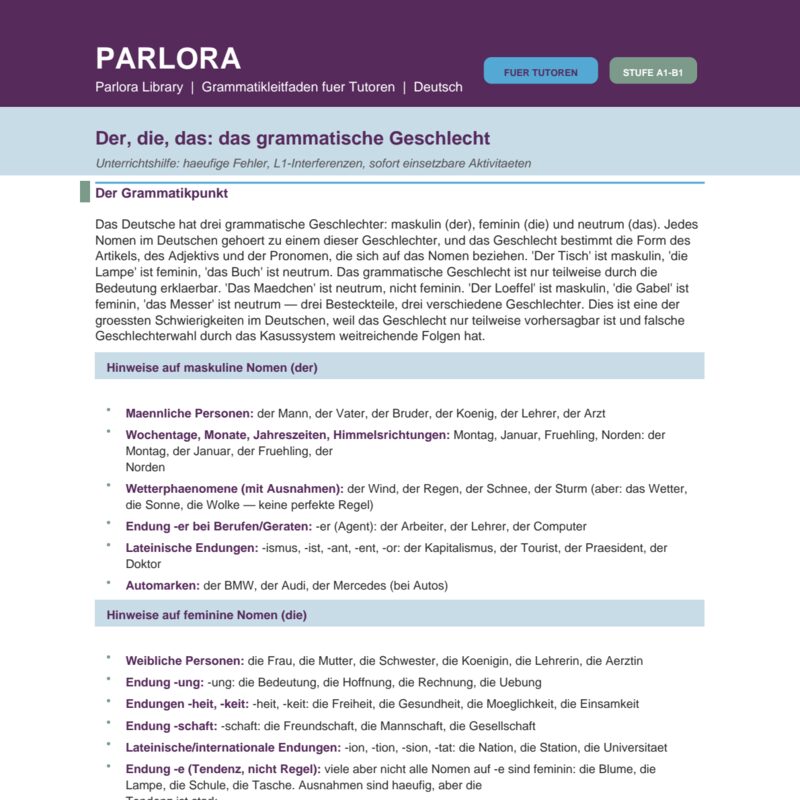
Der, die, das: das grammatische Geschlecht
This document provides a comprehensive guide for tutors on teaching German noun genders (der, die, das), including rules, common errors, and practical activities for different proficiency levels.
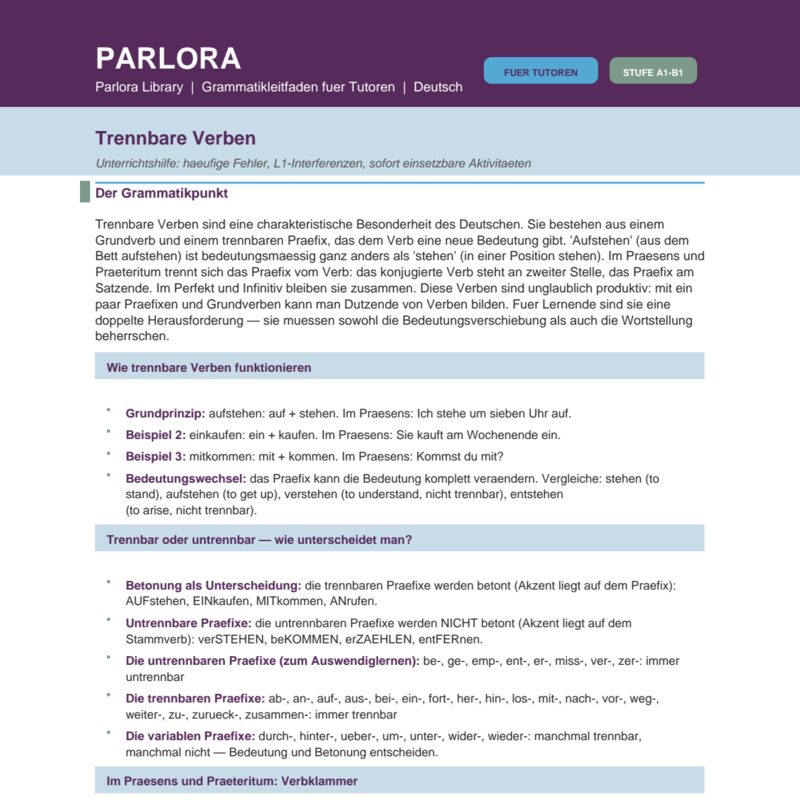
Trennbare Verben (Separable Verbs) - Unterrichtshilfe
This document provides a guide for German language tutors on how to teach separable verbs, covering their function, common errors, L1 interferences, and practical classroom activities to reinforce learning.
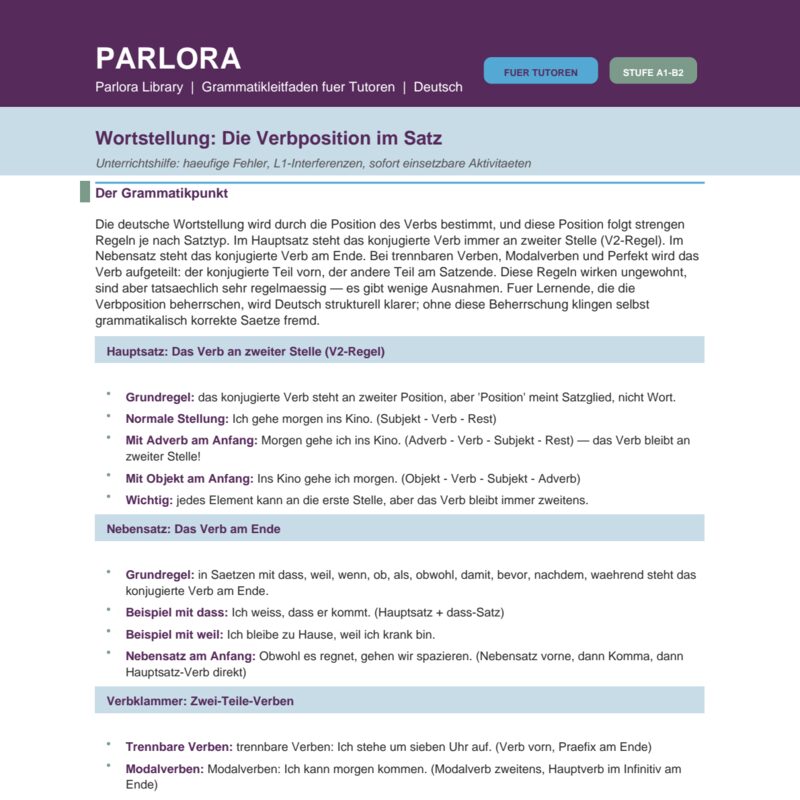
Wortstellung: Die Verbposition im Satz - Unterrichtshilfe:
This document provides a comprehensive guide to German sentence structure and verb position, covering main clauses, subordinate clauses, and special cases like separable verbs. It also addresses common learner errors and offers practical teaching activities.
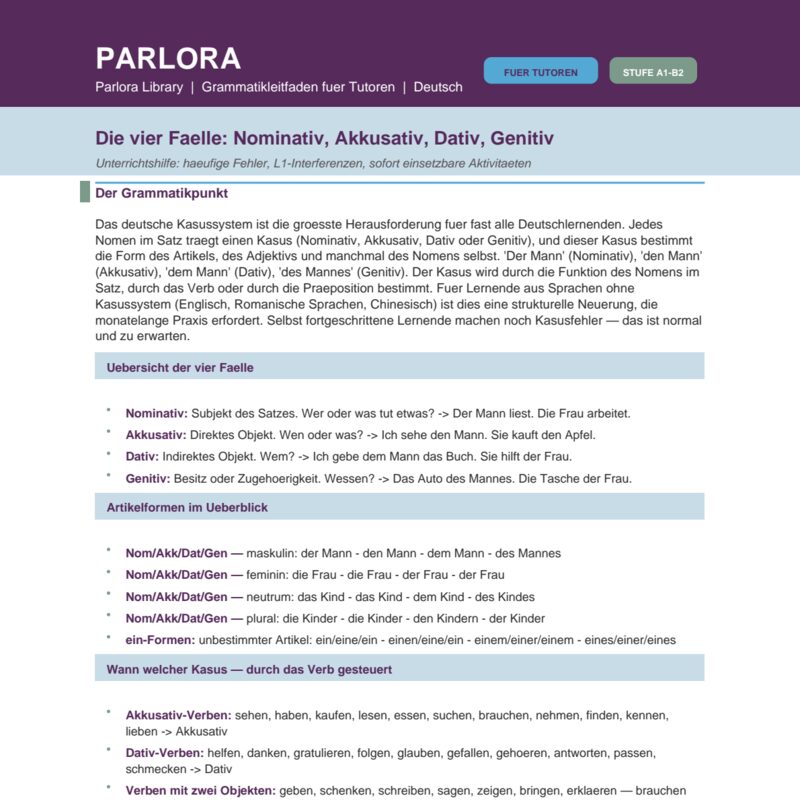
The Four Cases: Nominative, Accusative, Dative, Genitive in German - Unterrichtshilfe:
This document offers a guide for German language tutors on teaching the four grammatical cases (Nominative, Accusative, Dative, Genitive), including common errors, L1 interferences, and practical activities.
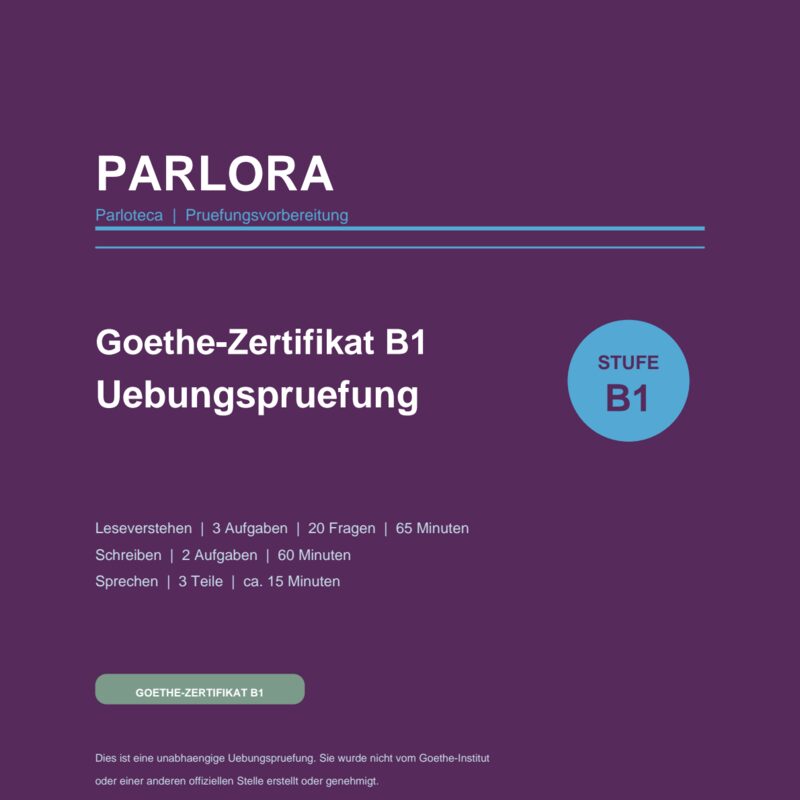
Goethe-Zertifikat B1 Practice Exam
This document is a practice exam for the Goethe-Zertifikat B1, including sections for reading comprehension, writing, and speaking, along with an answer key for the reading tasks.
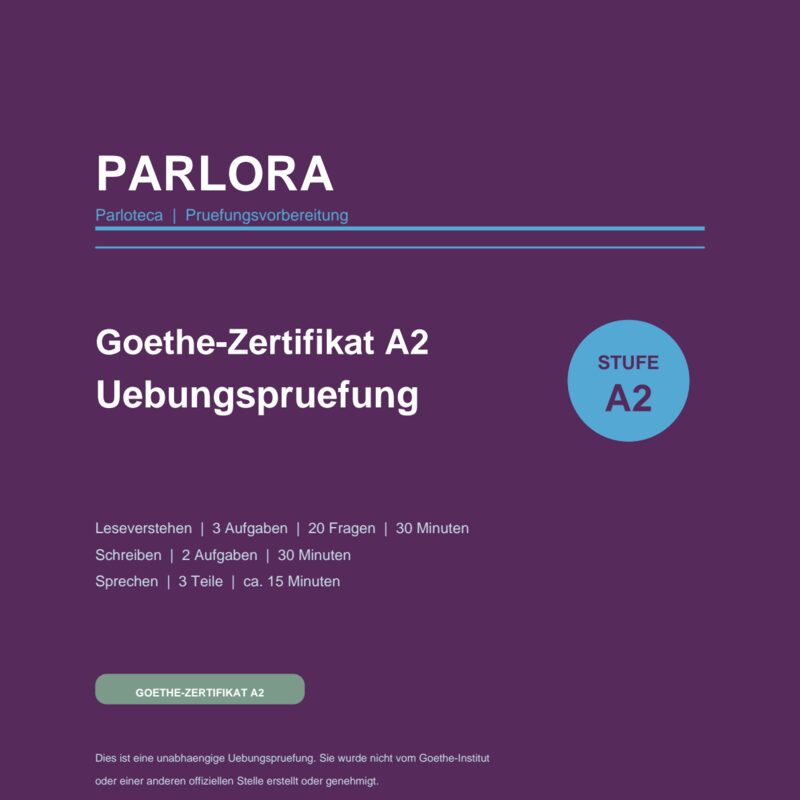
Goethe-Zertifikat A2 Übungsprüfung
This document provides a complete practice test for the Goethe-Zertifikat A2 examination, covering reading comprehension, writing, and speaking sections with example tasks and a solution key.
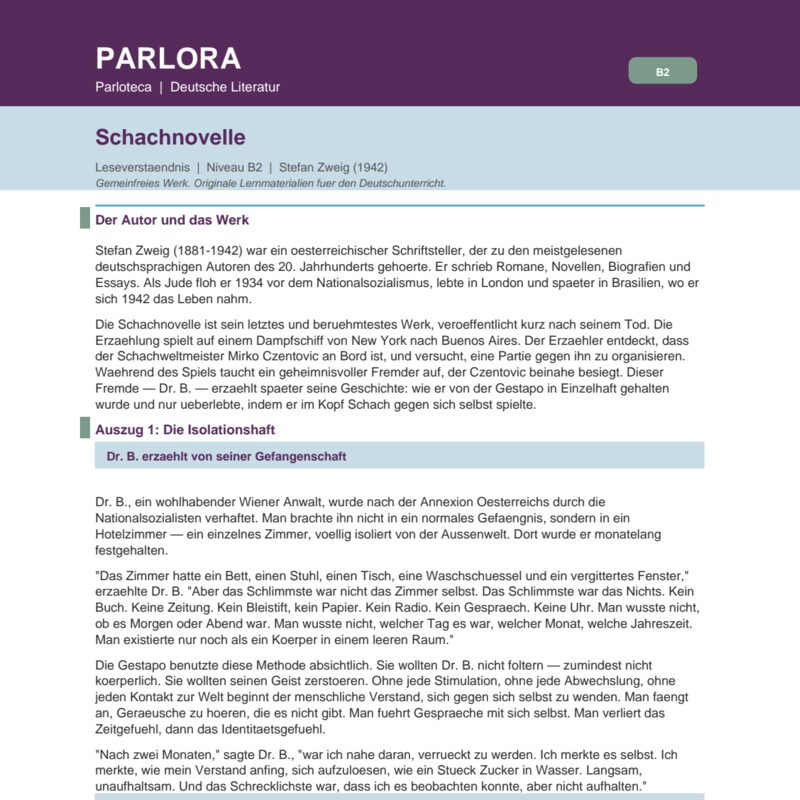
Schachnovelle: Textauszug und Verstehensfragen
This document provides an excerpt from Stefan Zweig's 'Schachnovelle' (Chess Novella) at a B2 proficiency level, followed by comprehension questions and a vocabulary list. It covers the protagonist's isolation, his discovery of chess, and the psychological impact of playing against himself.
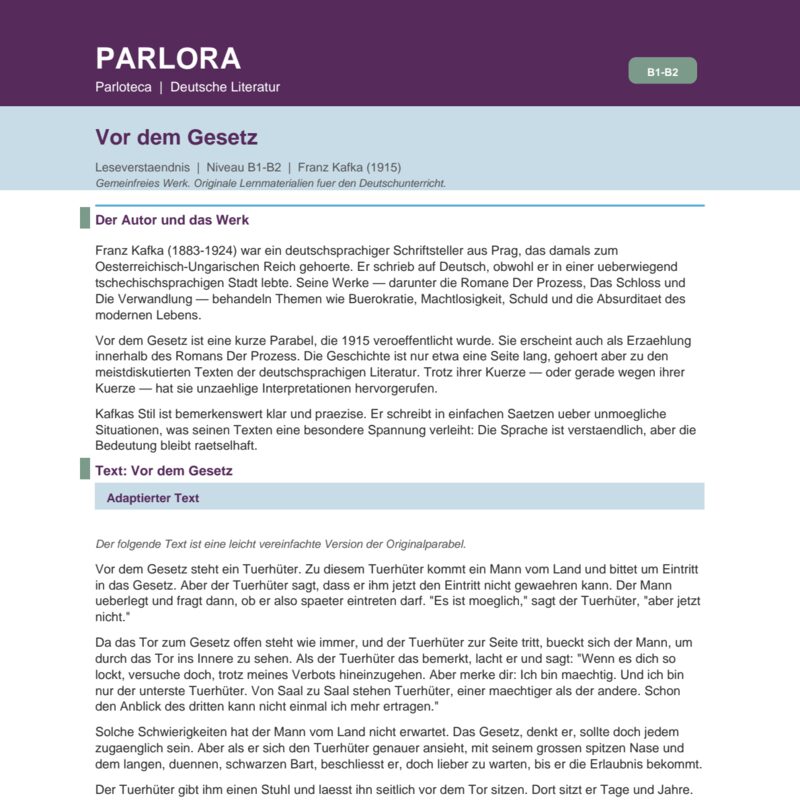
Vor dem Gesetz (Before the Law) by Franz Kafka - Reading Comprehension B1-B2
This document presents an adapted version of Franz Kafka's parable 'Vor dem Gesetz' (Before the Law) for reading comprehension practice. It includes background information on Kafka and the work, the simplified text, comprehension questions, and a vocabulary list.
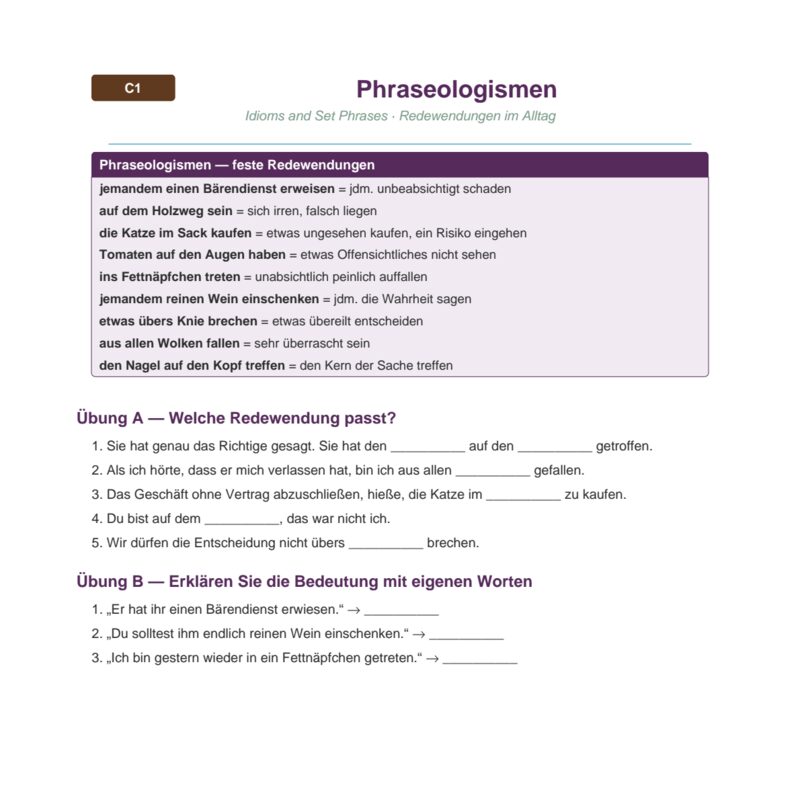
Phraseologismen und Redewendungen
Deutsche Redewendungen und feste Wendungen verstehen und kontextgerecht verwenden.
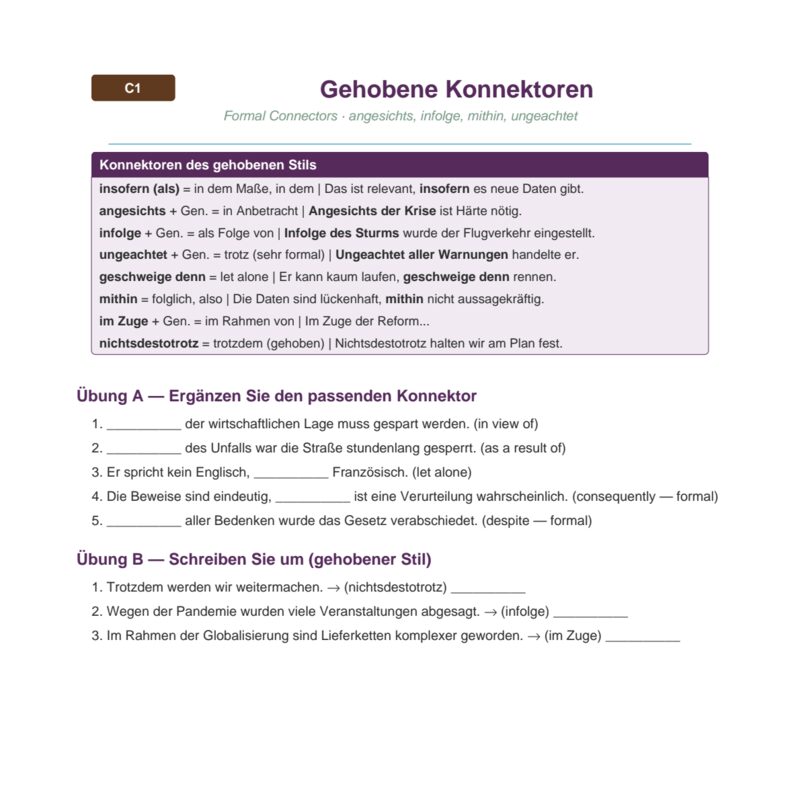
Gehobene Konnektoren
Komplexe Satzverbindungen mit gehobenen Konnektoren wie indes, zumal, wenngleich und nichtsdestotrotz.
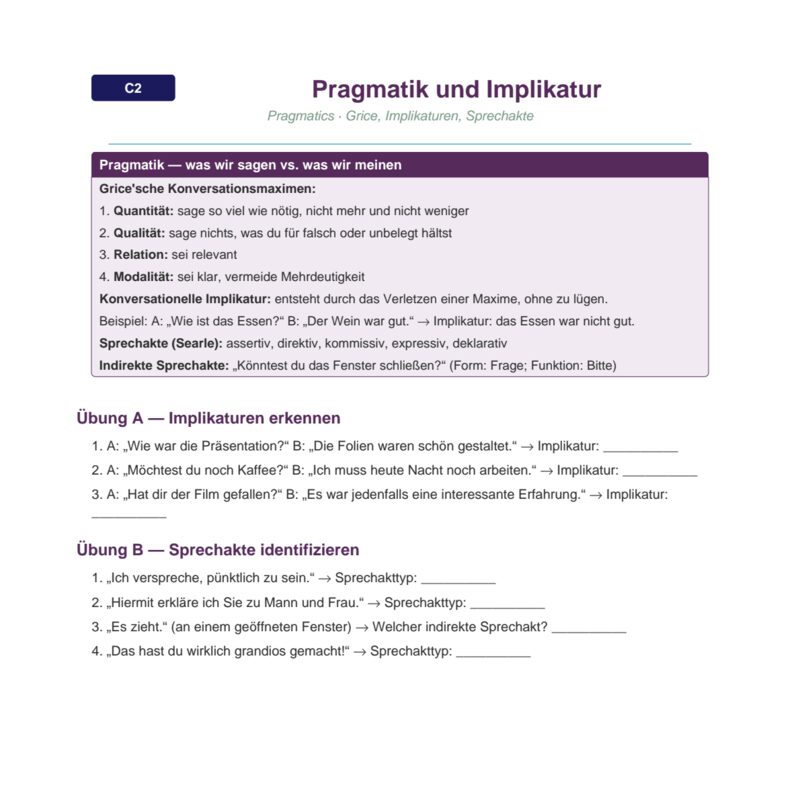
Pragmatik: Sprache im Kontext
Sprechakte, Implikaturen und Höflichkeitsstrategien in der deutschen Kommunikation.
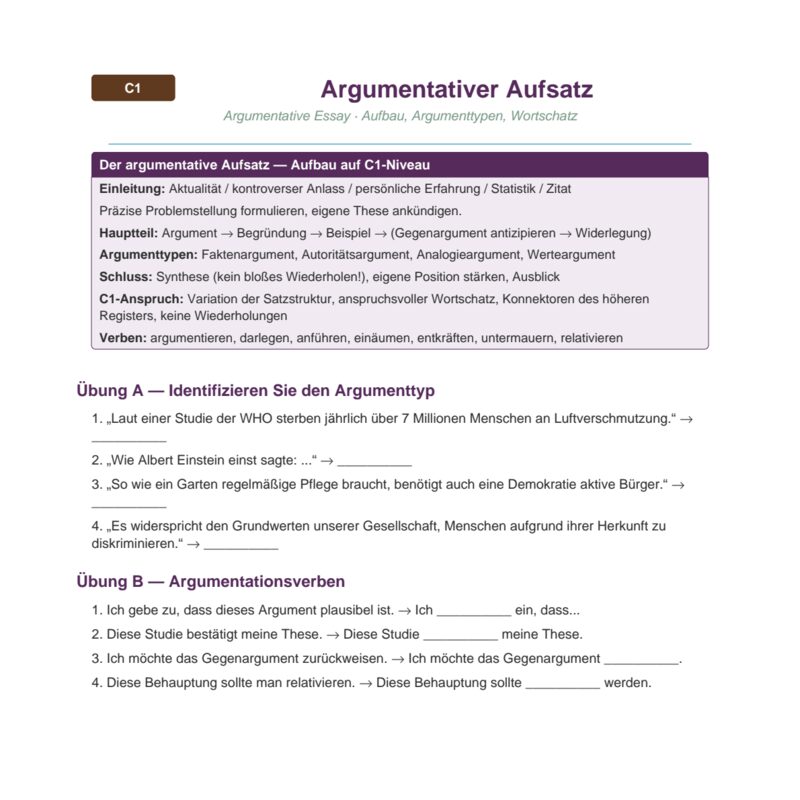
Argumentativer Aufsatz schreiben
Aufbau und Formulierung eines überzeugenden argumentativen Aufsatzes auf C1-Niveau.
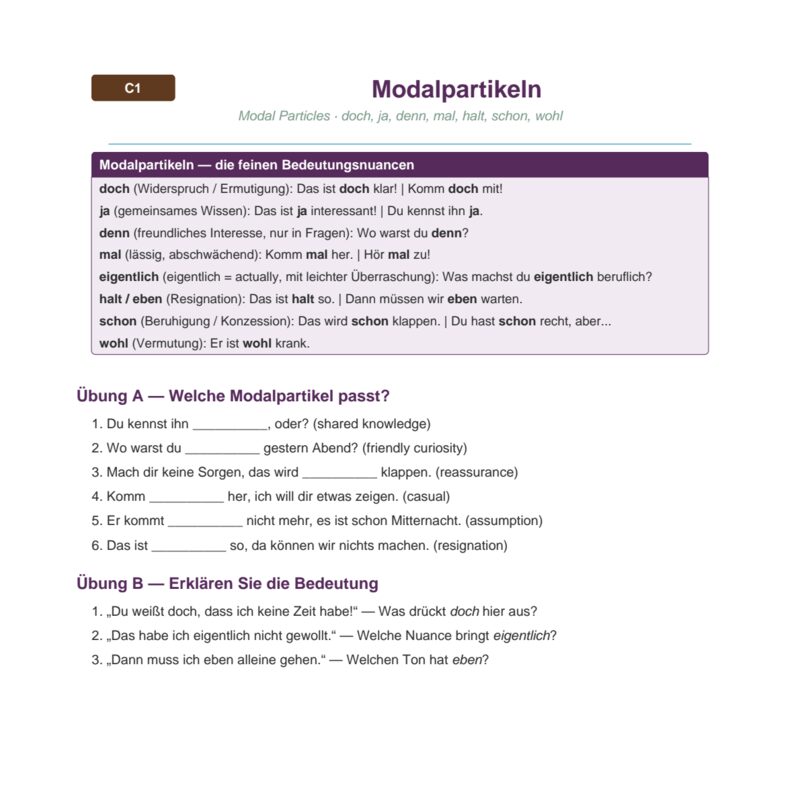
Modalpartikeln im Deutschen
Übungen zu deutschen Modalpartikeln (doch, mal, ja, eben, halt) mit Kontextübungen und Dialogergänzungen.
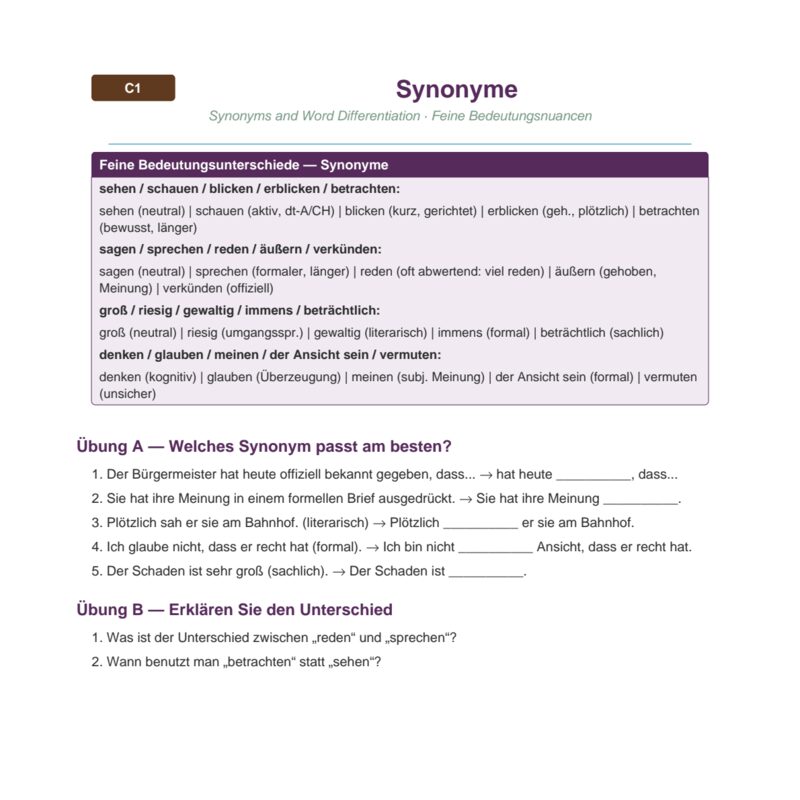
Synonyme und Bedeutungsnuancen
Feinheiten in der Wortwahl: Synonyme unterscheiden und präzise verwenden.
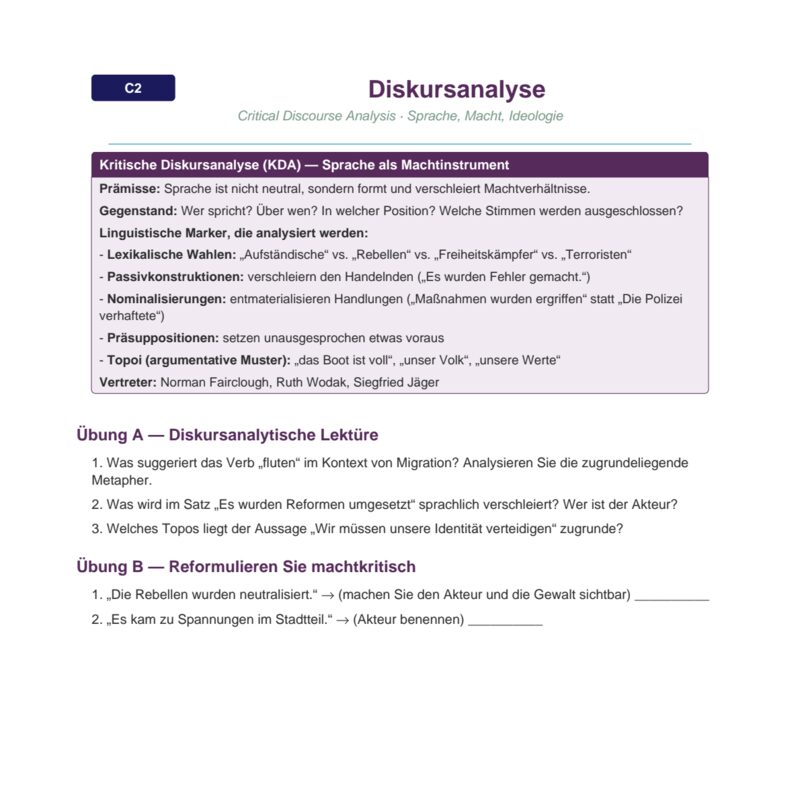
Diskursanalyse
Einführung in die linguistische Diskursanalyse: Texte im gesellschaftlichen Kontext untersuchen.
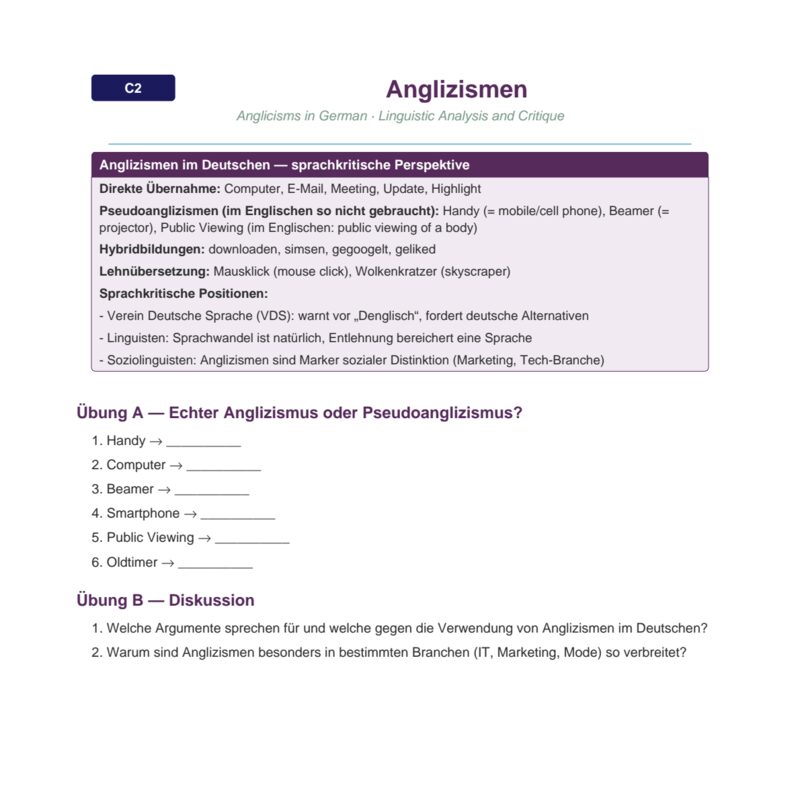
Anglizismen in der deutschen Sprache
Analyse von Anglizismen: Sprachpurismus, Integration und Sprachkontakt im modernen Deutsch.
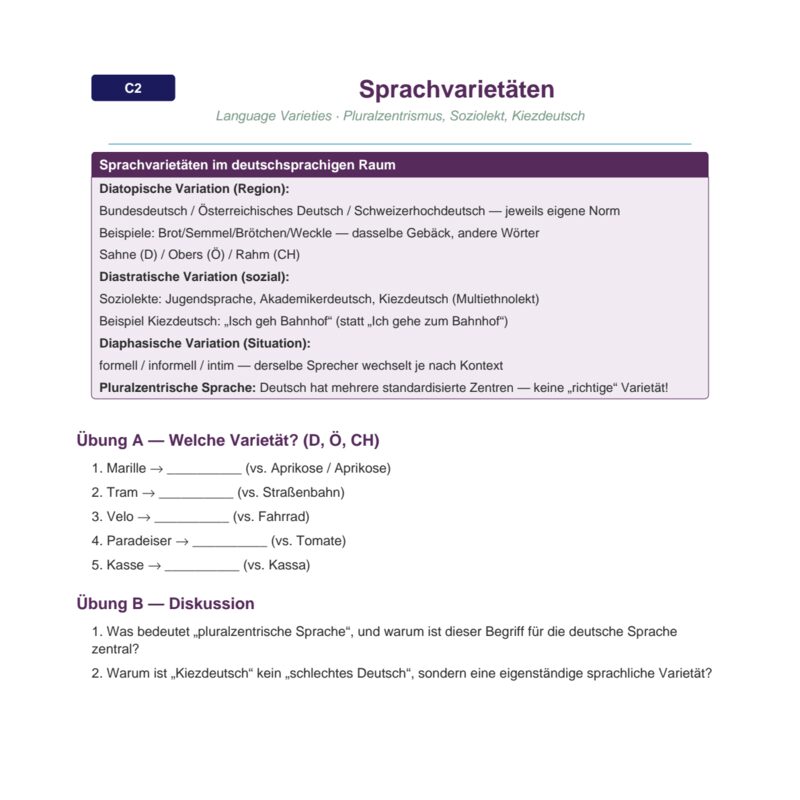
Sprachvarietäten des Deutschen
Dialekte, Soziolekte und Regiolekte: die Vielfalt der deutschen Sprache verstehen.
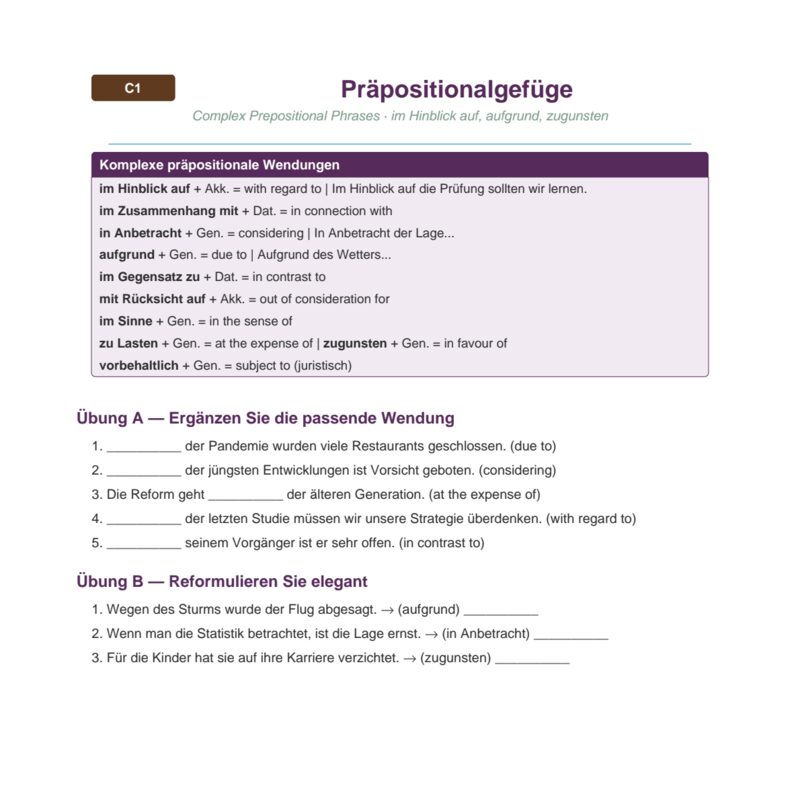
Präpositionalgefüge in der Schriftsprache
Komplexe Präpositionalausdrücke für gehobene schriftliche Kommunikation.
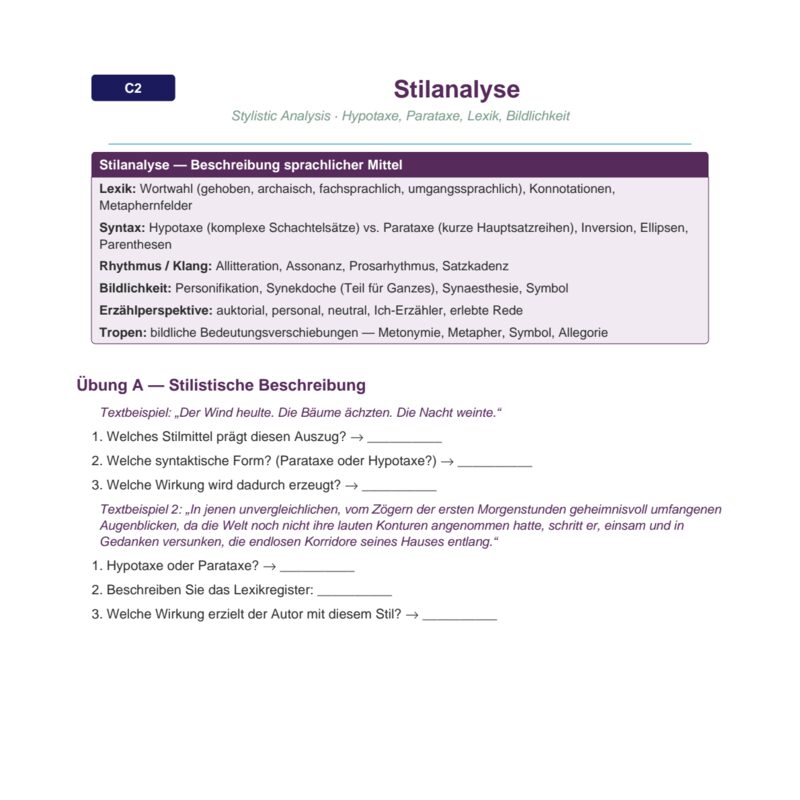
Stilanalyse literarischer Texte
Methoden der Stilanalyse anhand literarischer und journalistischer Texte auf höchstem Niveau.
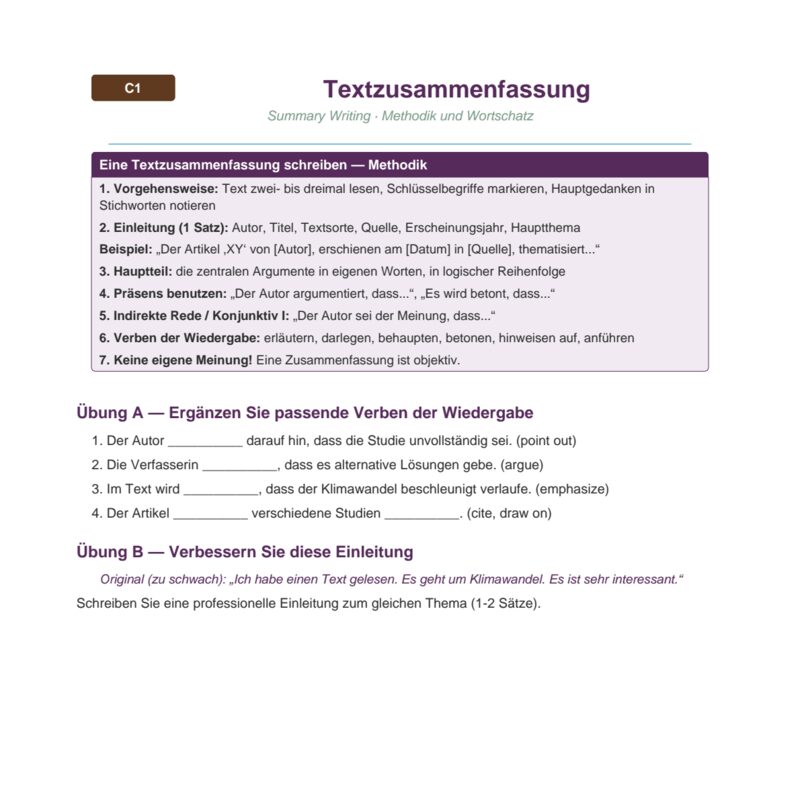
Textzusammenfassung auf C1-Niveau
Strategien und Übungen zum Zusammenfassen komplexer Sachtexte und Fachartikel.
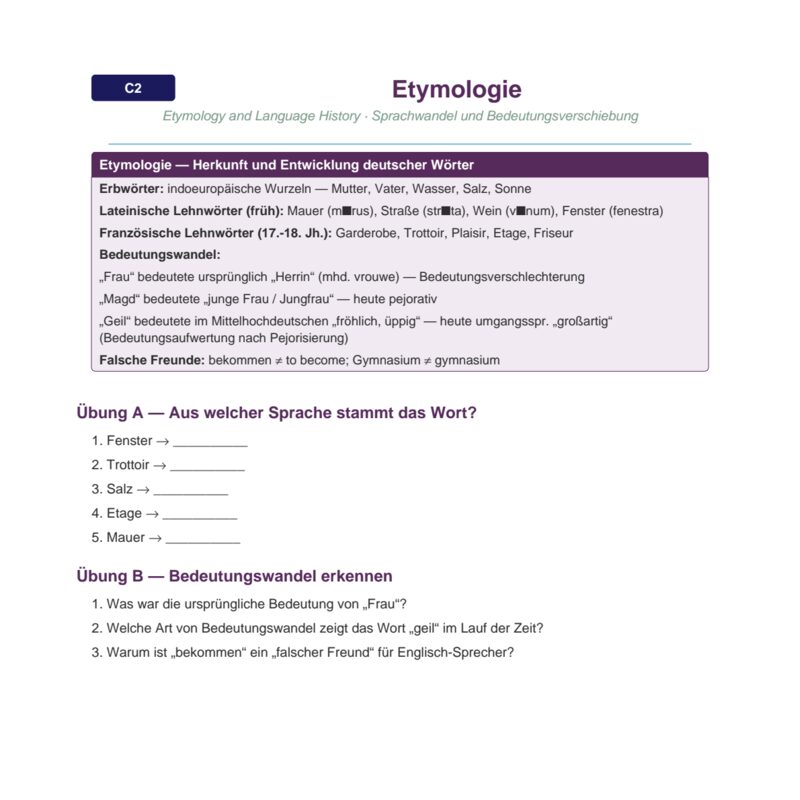
Etymologie deutscher Wörter
Wortgeschichten und etymologische Zusammenhänge im deutschen Wortschatz erforschen.
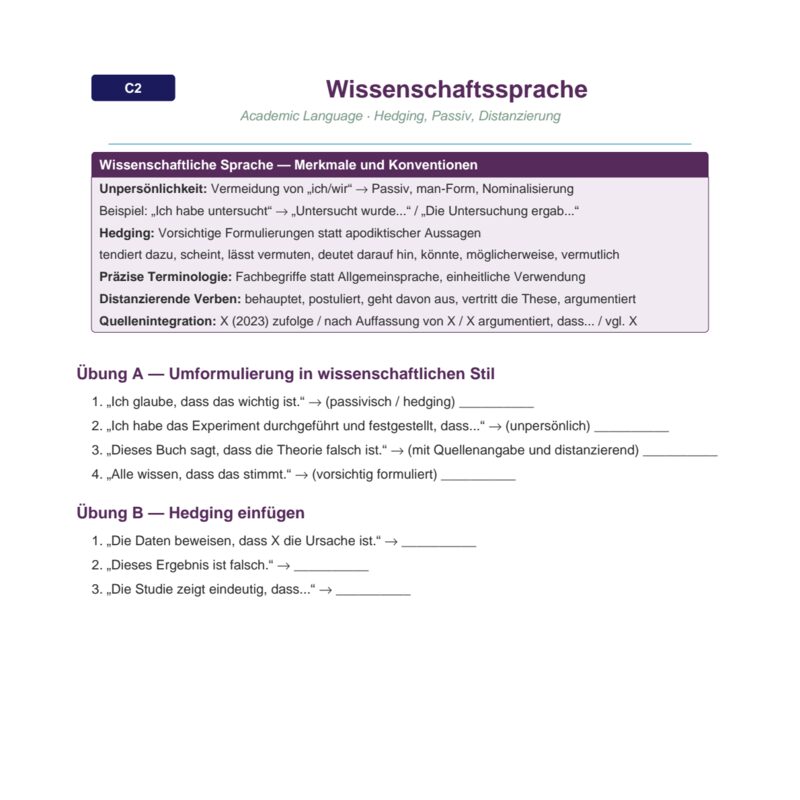
Wissenschaftssprache verstehen und verwenden
Akademische Redemittel, Fachterminologie und wissenschaftlicher Schreibstil.
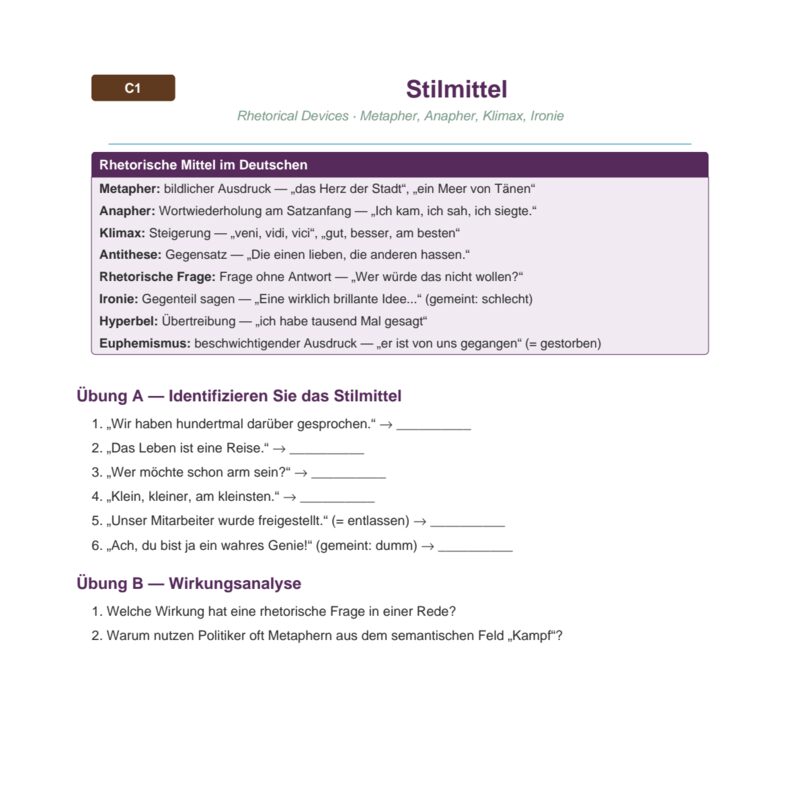
Stilmittel erkennen und anwenden
Rhetorische Stilmittel wie Metapher, Ironie und Hyperbel identifizieren und in eigenen Texten anwenden.
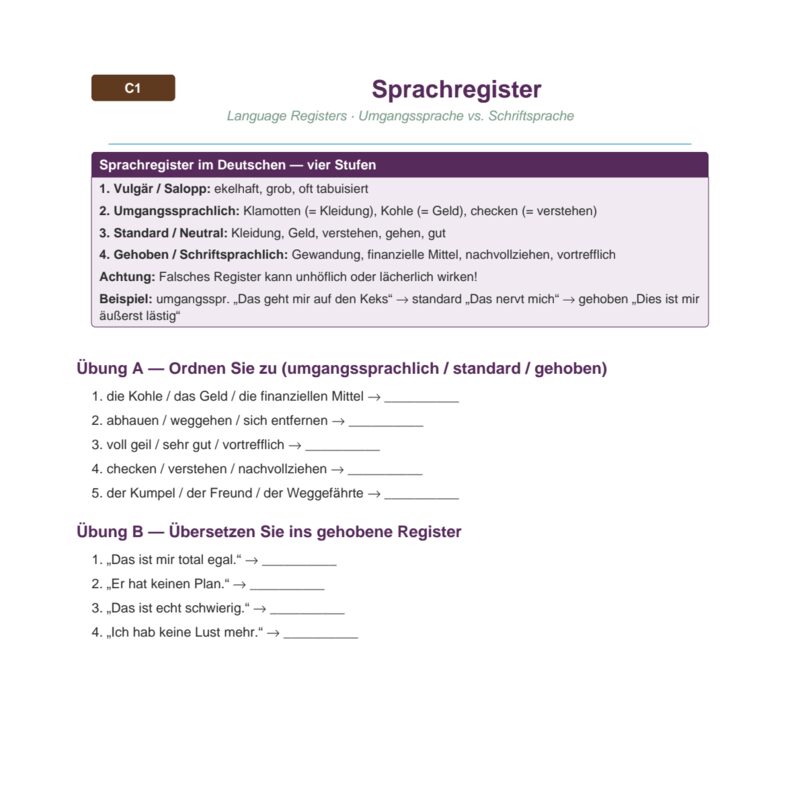
Sprachregister: Formal und Informal
Unterschiede zwischen formellen und informellen Sprachregistern erkennen und situationsgerecht wechseln.
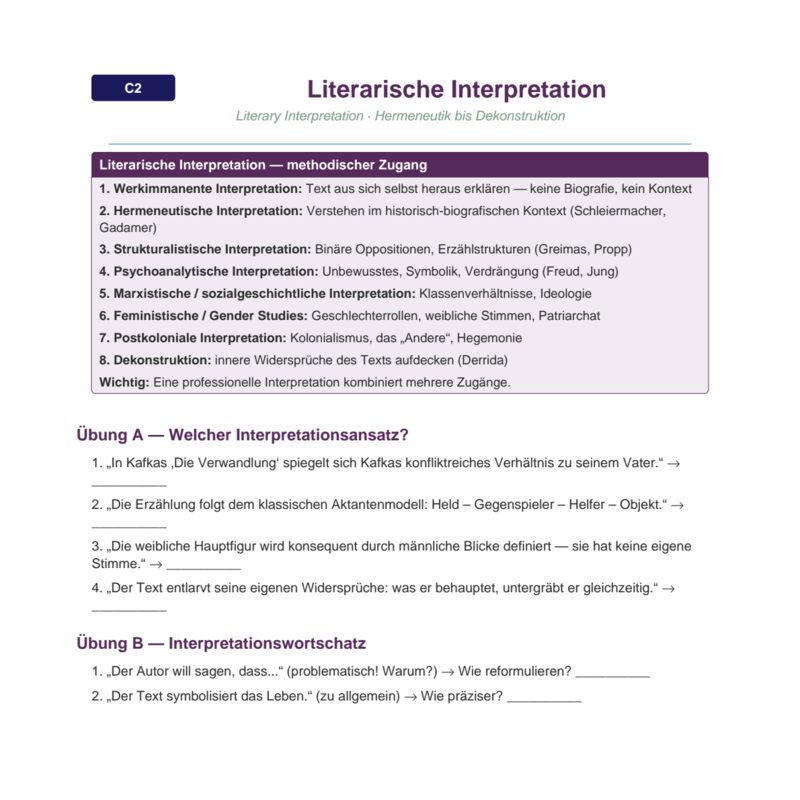
Literarische Interpretation
Methoden der Textinterpretation: Erzähltechnik, Symbolik und Intertextualität in der deutschen Literatur.
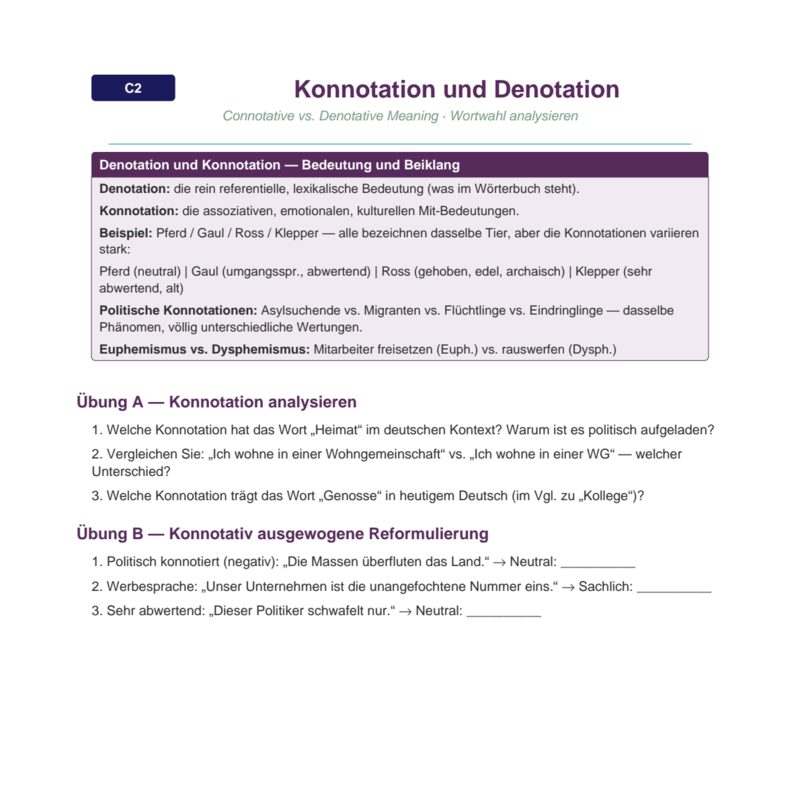
Konnotation und Denotation
Übungen zu Wortbedeutungen: denotative vs. konnotative Bedeutungsebenen in der deutschen Sprache.
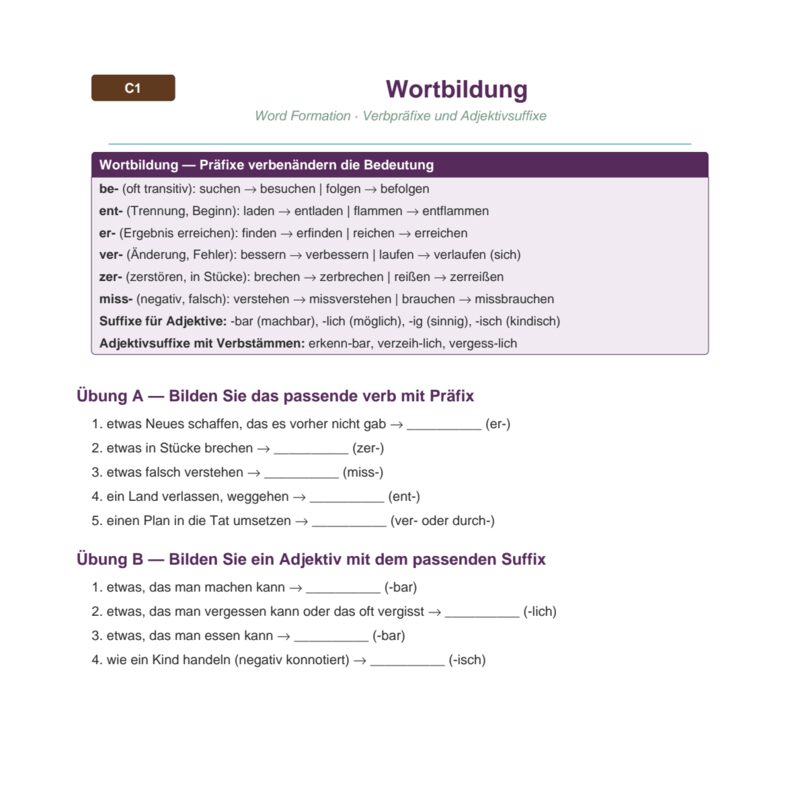
Wortbildung: Komposition und Derivation
Übungen zur deutschen Wortbildung mit Komposita, Präfixen und Suffixen auf fortgeschrittenem Niveau.
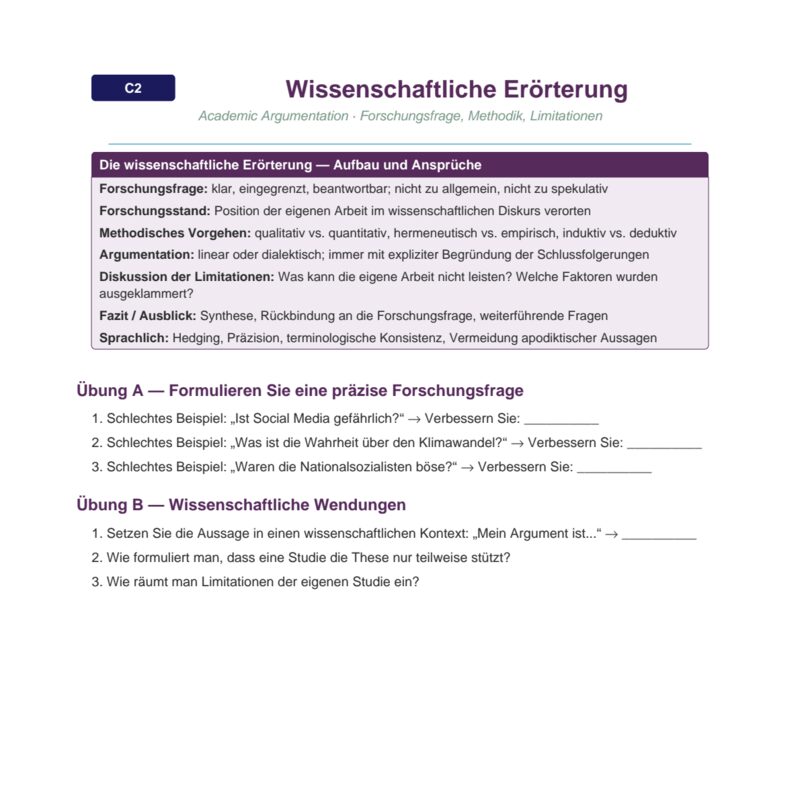
Wissenschaftliche Erörterung
Aufbau und Formulierung einer wissenschaftlichen Erörterung mit Quellenarbeit und Argumentation.
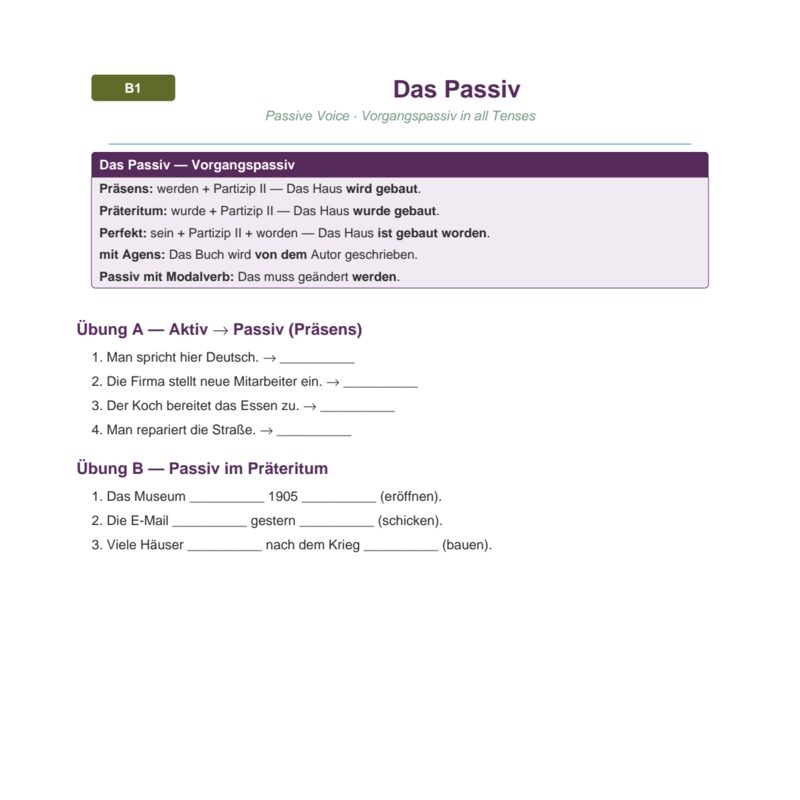
Passiv – Passive Voice
Learn and practise the German passive voice (Vorgangspassiv) with werden + Partizip II.
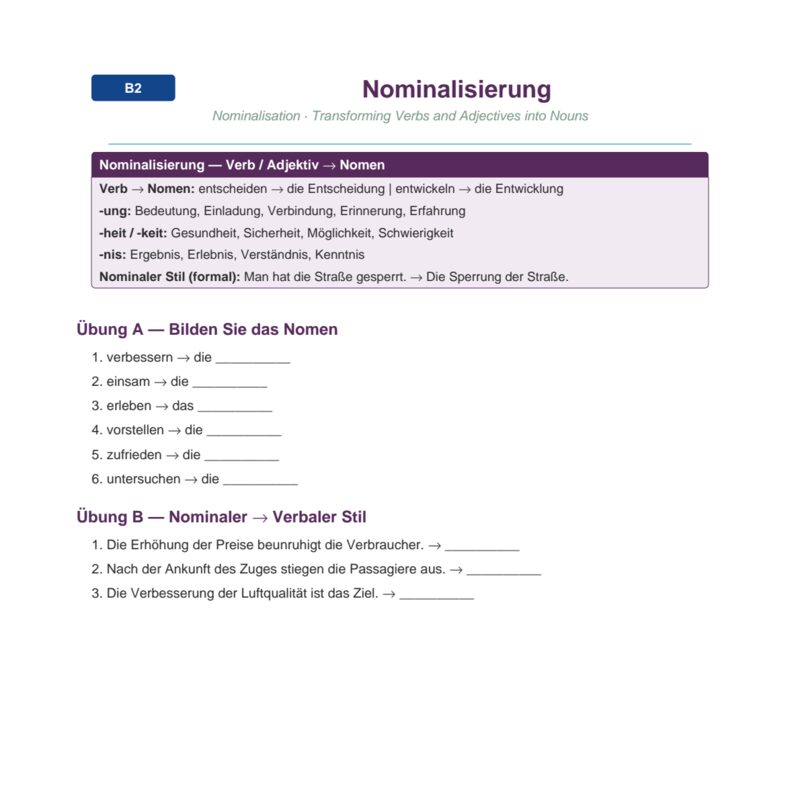
Nominalisierung – Nominalisation
Practice converting verbal expressions into nominal style commonly used in formal German.
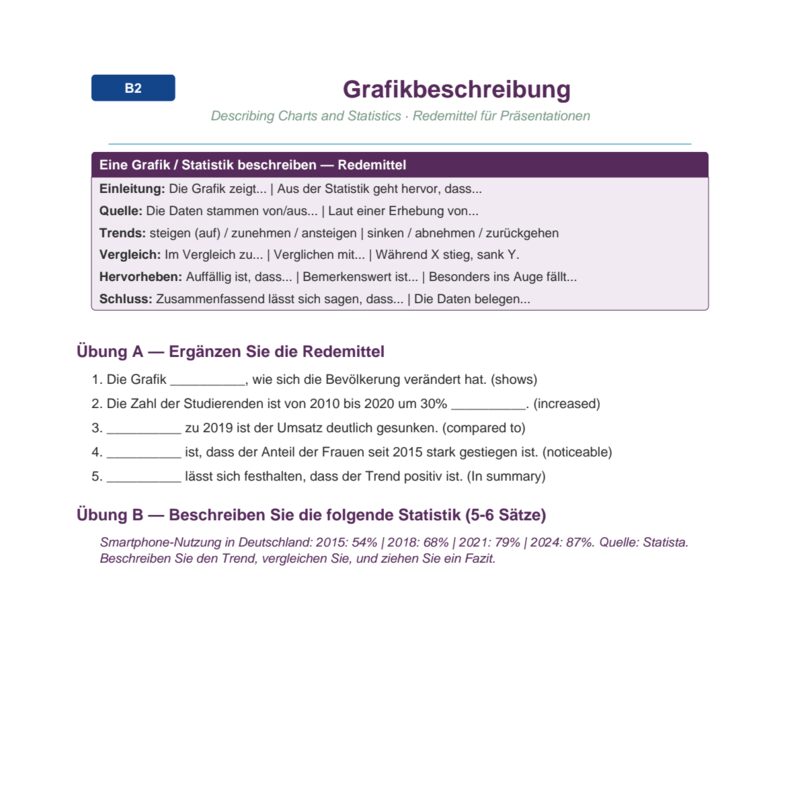
Grafikbeschreibung – Describing Charts and Graphs
Phrases and exercises for describing statistical data, trends, and charts in German.
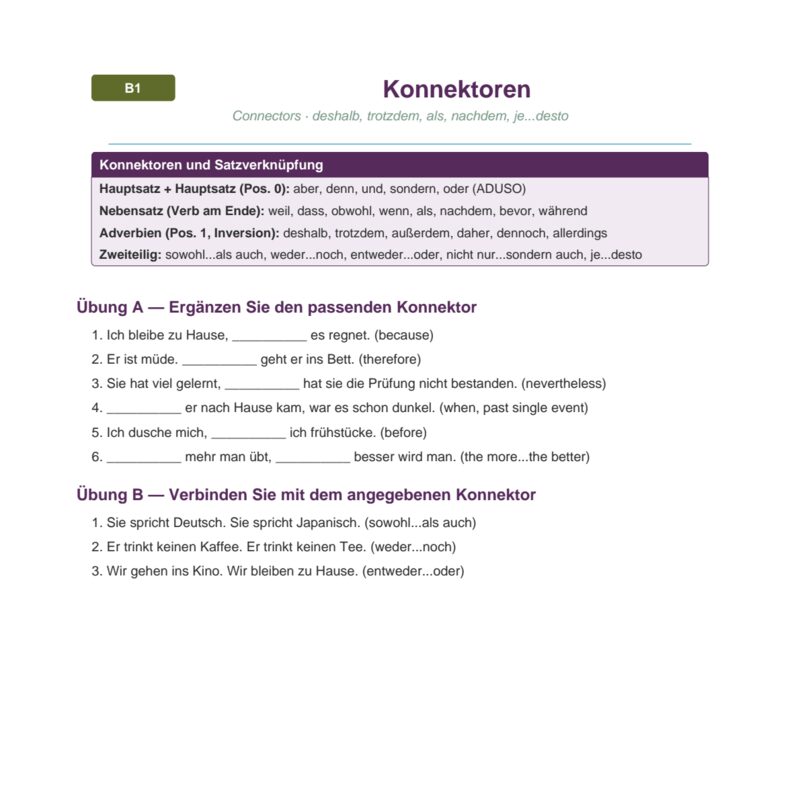
Konnektoren – Connectors
Exercises on two-part and subordinating connectors (obwohl, damit, sodass, etc.).
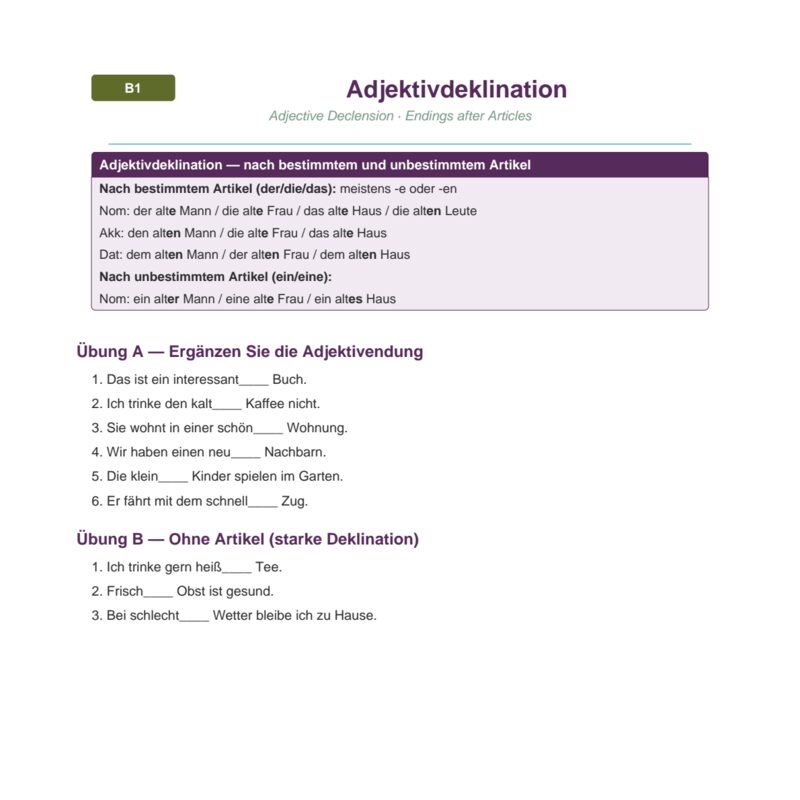
Adjektivdeklination – Adjective Declension
Comprehensive practice on adjective endings with definite, indefinite, and zero articles.
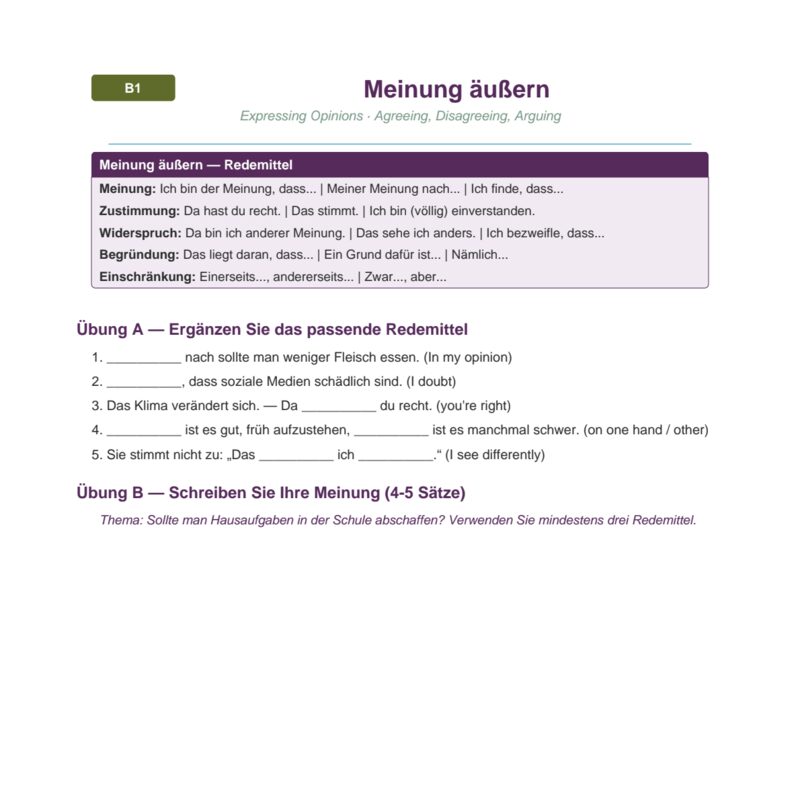
Meinung äußern – Expressing Opinions
Practice phrases and structures for expressing, supporting, and contrasting opinions in German.
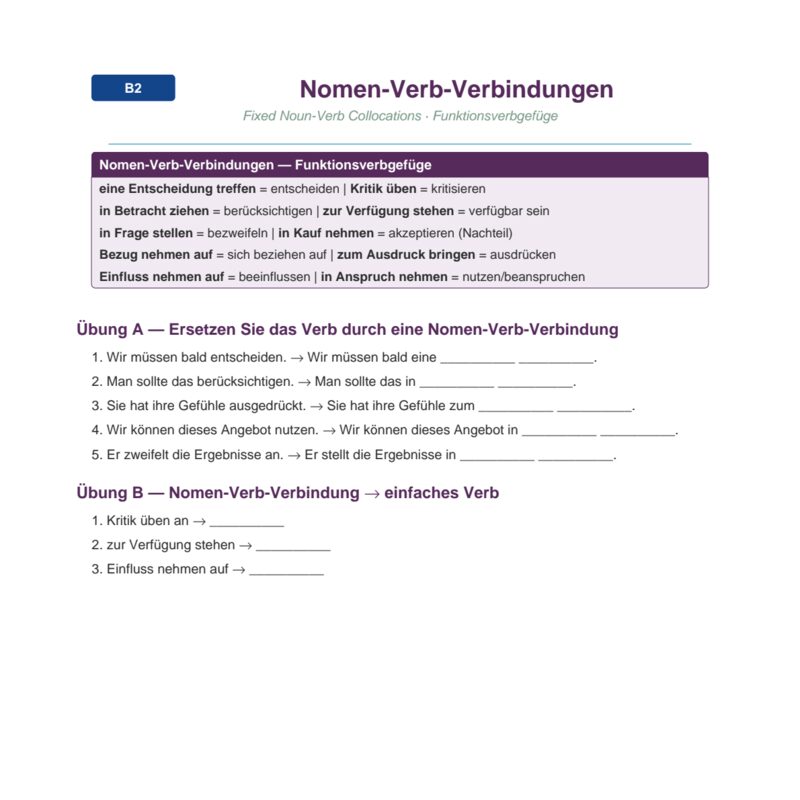
Nomen-Verb-Verbindungen – Noun-Verb Collocations
Practice common fixed noun-verb combinations used in formal and written German.
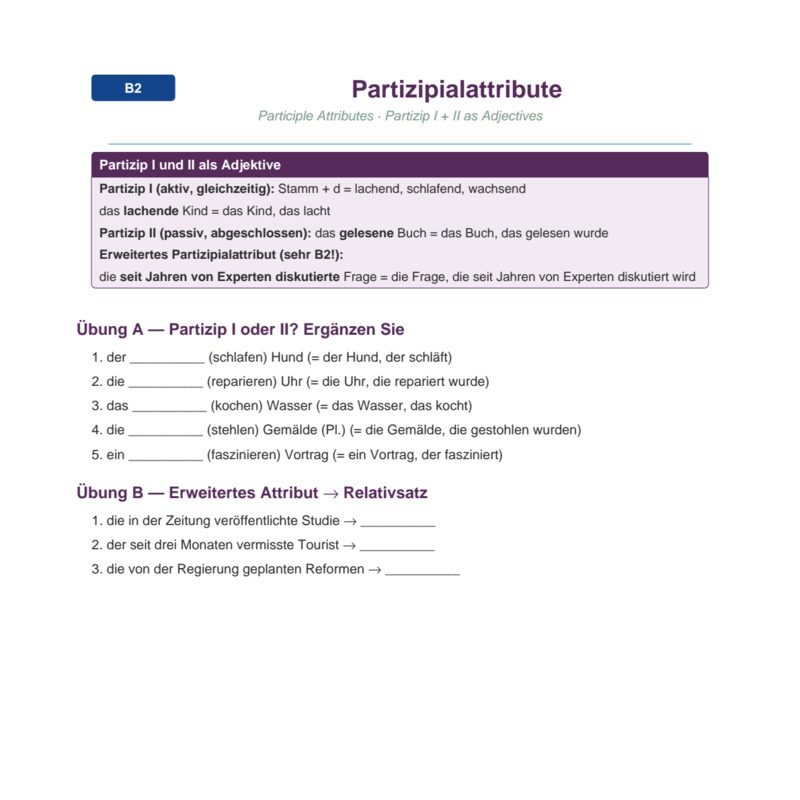
Partizipialattribute – Participial Attributes
Exercises on extended participial attributes (erweiterte Partizipialattribute) in German.
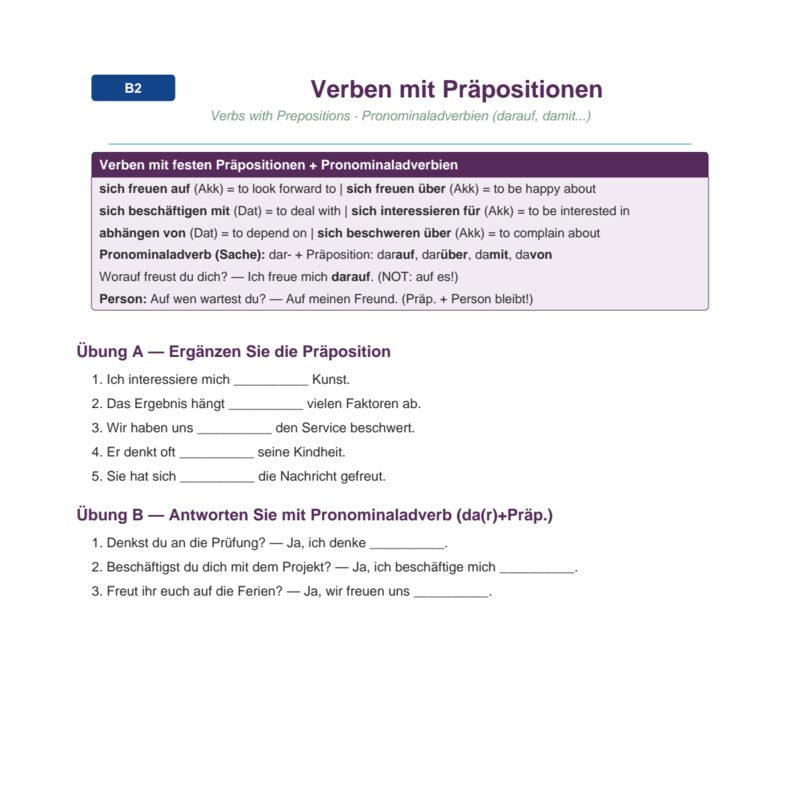
Verben mit Präpositionen – Verbs with Prepositions
Practice verbs with fixed prepositions and their corresponding pronominal adverbs (darauf, woran, etc.).
Get more German resources
Sign up free to download, favorite and share materials — or upload your own.
Sign up free